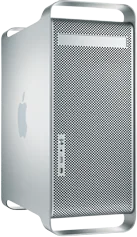
Apple Mac Studio (M4 Max or M3 Ultra) vs Apple Power Mac G5 (June 2004)
Better figure, where one is clearly better
| AppleMac Studio (M4 Max or M3 Ultra) | ApplePower Mac G5 (June 2004) | |
|---|---|---|
| Overview | ||
| Released | March 2025 | June 2004 |
| Performance | ||
| Processor | Apple M4 Max or Apple M3 Ultra | 2 × PowerPC G5 1800 MHz (Power Mac June 2004), 2 × PowerPC G5 2000 MHz (Power Mac June 2004) or 2 × PowerPC G5 2500 MHz (Power Mac June 2004) |
| CPU cores | 14, 16, 28 or 32 | 2 |
| Graphics | 32-core GPU, 40-core GPU, 60-core GPU or 80-core GPU | NVIDIA GeForce FX 5200 Ultra (64 MB) or ATI Radeon 9600 XT (128 MB) |
| Memory | 36 GB, 96 GB, 128 GB, 256 GB or 512 GB (better) | 256 MB, 512 MB, 4 GB or 8 GB |
| Storage | 512 GB to 16 TB (better) | 80 GB to 160 GB |
| CPU | M4 Max: 14-core CPU with 10 performance cores and 4 efficiency cores, or 16-core CPU; M3 Ultra: 28-core CPU with 20 performance cores and 8 efficiency cores, or 32-core CPU | Two physical PowerPC G5 processors at 1.8, 2 or 2.5 GHz, each with 512 KB L2 cache. Per-processor front-side bus is 900 MHz, 1 GHz or 1.25 GHz respectively. Only the dual 2.5 GHz uses the maker’s liquid-cooling system. |
| GPU | M4 Max: 32-core or 40-core GPU; M3 Ultra: 60-core or 80-core GPU; hardware-accelerated ray tracing | Dual 1.8 and 2 GHz: NVIDIA GeForce FX 5200 Ultra with 64 MB DDR. Dual 2.5 GHz: ATI Radeon 9600 XT with 128 MB DDR. Optional ATI Radeon 9800 XT with 256 MB occupies the adjacent PCI slot as well as AGP. |
| AI engine | 16-core Neural Engine (M4 Max); 32-core Neural Engine (M3 Ultra) | – |
| Memory type | M4 Max: 36GB; 48GB, 64GB or 128GB with the 16-core CPU / 40-core GPU. M3 Ultra: 96GB or 256GB in the current specification table. Apple announced 512GB at launch and documents a 32-core CPU / 80-core GPU, 512GB, 16TB system in its power test; that historical option is retained separately. | DDR400 PC3200 in matched pairs. Dual 1.8 GHz starts with 256 MB and has four DIMM slots with a 4 GB maximum. Dual 2 and 2.5 GHz start with 512 MB and have eight slots with an 8 GB maximum. Base and maximum memory rows retain each model’s stock storage and graphics. |
| Memory bandwidth | M4 Max: 410GB/s with the 32-core GPU, 546GB/s with the 40-core GPU; M3 Ultra: 819GB/s. M4 Max takes 36GB (32-core GPU) or 48GB, 64GB or 128GB (40-core GPU); M3 Ultra takes 96GB or 256GB, and was offered with up to 512GB at launch | – |
| Storage type | SSD | Stock 80 GB on dual 1.8 GHz and 160 GB on dual 2/2.5 GHz; 7200 rpm Serial ATA. Two bays with 150 MB/s interfaces; optional 80, 160 or 250 GB drives, up to two 250 GB drives. One optical bay with 8x DVD-R SuperDrive; Combo drive is optional. |
| Expansion slots | – | AGP 8x Pro graphics slot. Dual 1.8 GHz has three 64-bit 33 MHz PCI slots. Dual 2 and 2.5 GHz have PCI-X: two 100 MHz and one 133 MHz slots. |
| Media engine | Hardware-accelerated H.264, HEVC, ProRes and ProRes RAW; AV1 decode; M4 Max: video decode engine, two video encode engines and two ProRes encode and decode engines; M3 Ultra: two video decode engines, four video encode engines and four ProRes encode and decode engines | – |
| Display | ||
| Screen | None built in | None built in |
| Connections | ||
| Ports | 4 × Thunderbolt 5, 2 × USB-C, 2 × USB-A, HDMI, Ethernet, SD card slot, headphone jack | 3 × USB-A, Ethernet, headphone jack |
| Ethernet | 10 Gb/s (better) | 1 Gb/s |
| External displays | Up to 5 (better) | Up to 2 |
| Wi-Fi | Wi-Fi 6E | – |
| Bluetooth | 5.3 | – |
| Front ports | M4 Max: 2 × USB-C (up to 10Gb/s); M3 Ultra: 2 × Thunderbolt 5 (up to 120Gb/s); SDXC card slot (UHS-II) | USB 2.0, FireWire 400 and headphone minijack. |
| Back ports | 4 × Thunderbolt 5 (USB-C) with Thunderbolt 5 and USB 4 (up to 120Gb/s), USB 3 (up to 10Gb/s) and DisplayPort 2.1; 2 × USB-A (USB 3, up to 5Gb/s); HDMI 2.1 with multichannel audio output; 10Gb Ethernet (RJ-45); 3.5 mm headphone jack with advanced support for high-impedance headphones | Two USB 2.0, FireWire 800, FireWire 400, Gigabit Ethernet, V.92 modem, optical Toslink input/output and analogue audio line-in/out. Three chassis USB ports in total, plus keyboard USB 1.1 ports. Optional 54 Mbps AirPort Extreme and Bluetooth 1.1. |
| External displays | M4 Max: up to five (four at up to 6K 60Hz over Thunderbolt plus one at 4K 144Hz over HDMI), or three (two at up to 6K 60Hz plus one at up to 8K 60Hz or 4K 240Hz over HDMI); M3 Ultra: up to eight at up to 6K 60Hz or 4K 144Hz, or four at up to 8K 60Hz or 4K 240Hz; VRR, HDR and multichannel audio supported | ADC and DVI with included DVI-to-VGA adapter; two displays in extended or mirrored modes. A second ADC display requires a separate adapter. |
| Speakers | Built-in speaker | Built-in speaker; analogue and optical connections for external audio. |
| Keyboard and mouse | – | Apple Keyboard, Apple Mouse, USB extension cable, DVI-to-VGA adapter, modem cable and AirPort antenna. |
| Microphones | None built in | – |
| Design and power | ||
| Type | Compact | Tower |
| Weight | 2.74 kg (better) | 20.2 kg |
| Width × depth × height | 197 × 197 × 95 mm | 206 × 475 × 511 mm |
| Operating system | macOS | macOS |
| Size and weight detail | – | Maker height 51.1 cm, width 20.6 cm, depth 47.5 cm; reference weight 20.2 kg varies with configuration. |
| Materials | – | Aluminium enclosure with separate cooling zones. |
| Power supply | Built-in; 100–240V AC; 480W maximum continuous power | – |
| Colours | Silver | – |
| In the box | Mac Studio, power lead | Mac OS X Panther and iLife. The 1.8 and 2 GHz models were available on 9 June 2004. Apple initially stated July availability for the 2.5 GHz model, later than the generation’s first sale. |

More comparisons
- Apple Mac Studio (M4 Max or M3 Ultra) vs Apple Mac Studio (M5 Max or M5 Ultra)
- Apple Mac Studio (M4 Max or M3 Ultra) vs Framework Desktop (AMD Ryzen AI Max 300 Series)
- Apple Mac Studio (M1 Max / M1 Ultra) vs Apple Mac Studio (M4 Max or M3 Ultra)
- Apple iMac (Retina 5K, 27-inch, Late 2015) vs Apple Mac Studio (M4 Max or M3 Ultra)
- Apple iMac (Retina 5K, 27-inch, 2017) vs Apple Mac Studio (M4 Max or M3 Ultra)
- Apple iMac (Retina 5K, 27-inch, 2019) vs Apple Mac Studio (M4 Max or M3 Ultra)
- Apple iMac (Retina 5K, 27-inch, 2020) vs Apple Mac Studio (M4 Max or M3 Ultra)
- Apple iMac Pro (2017) vs Apple Mac Studio (M4 Max or M3 Ultra)
- Apple Mac Pro (Late 2013) vs Apple Mac Studio (M4 Max or M3 Ultra)
- Apple Mac Pro (Early 2009) vs Apple Mac Studio (M4 Max or M3 Ultra)
- Apple Mac Pro (Mid 2012) vs Apple Mac Studio (M4 Max or M3 Ultra)
- Apple Mac Pro (2019) vs Apple Mac Studio (M4 Max or M3 Ultra)
- Apple Mac Studio (M4 Max or M3 Ultra) vs Apple Power Mac G4 Cube
- Apple Mac Studio (M4 Max or M3 Ultra) vs Apple Power Mac G4 (Mirrored Drive Doors 2003)
- Apple Mac Studio (M4 Max or M3 Ultra) vs Apple Power Mac G5 (Early 2005)
- Apple Mac Studio (M4 Max or M3 Ultra) vs Apple Power Mac G5 (Late 2005)