Apple Power Mac G5 (June 2004) vs Apple Power Macintosh 4400/160
Better figure, where one is clearly better
| ApplePower Mac G5 (June 2004) | ApplePower Macintosh 4400/160 | |
|---|---|---|
| Overview | ||
| Released | June 2004 | November 1996 |
| Performance | ||
| Processor | 2 × PowerPC G5 1800 MHz (Power Mac June 2004), 2 × PowerPC G5 2000 MHz (Power Mac June 2004) or 2 × PowerPC G5 2500 MHz (Power Mac June 2004) | PowerPC 603e 160 MHz (Power Macintosh 4400/160) |
| CPU cores | 2 | 1 |
| Graphics | NVIDIA GeForce FX 5200 Ultra (64 MB) or ATI Radeon 9600 XT (128 MB) | – |
| Memory | 256 MB, 512 MB, 4 GB or 8 GB (better) | 16 MB |
| Storage | 80 GB to 160 GB (better) | 1.2 GB |
| CPU | Two physical PowerPC G5 processors at 1.8, 2 or 2.5 GHz, each with 512 KB L2 cache. Per-processor front-side bus is 900 MHz, 1 GHz or 1.25 GHz respectively. Only the dual 2.5 GHz uses the maker’s liquid-cooling system. | 160 MHz PowerPC 603e with integrated floating-point unit, 40 MHz system bus and 32 KB level-one cache; optional 256 KB level-two cache on a 160-pin DIMM card |
| GPU | Dual 1.8 and 2 GHz: NVIDIA GeForce FX 5200 Ultra with 64 MB DDR. Dual 2.5 GHz: ATI Radeon 9600 XT with 128 MB DDR. Optional ATI Radeon 9800 XT with 256 MB occupies the adjacent PCI slot as well as AGP. | Built-in video with 1 MB EDO video-memory DIMM, expandable to 2 MB EDO or up to 4 MB SGRAM. Exact support table gives 16-bit colour through 832 × 624 and 8-bit at 1024 × 768 or 1152 × 870 with standard 1 MB; 1280 × 1024 needs expanded video memory and permits 8-bit at 2 MB or 16-bit at 4 MB |
| Memory type | DDR400 PC3200 in matched pairs. Dual 1.8 GHz starts with 256 MB and has four DIMM slots with a 4 GB maximum. Dual 2 and 2.5 GHz start with 512 MB and have eight slots with an 8 GB maximum. Base and maximum memory rows retain each model’s stock storage and graphics. | 16 MB standard; maximum 96 MB using three 168-pin 64-bit 3.3 V unbuffered EDO DIMMs, 60 ns or faster. Each socket supports up to 32 MB; slot one only supports single-bank DIMMs. No memory soldered to board; 4 MB ROM |
| Storage type | Stock 80 GB on dual 1.8 GHz and 160 GB on dual 2/2.5 GHz; 7200 rpm Serial ATA. Two bays with 150 MB/s interfaces; optional 80, 160 or 250 GB drives, up to two 250 GB drives. One optical bay with 8x DVD-R SuperDrive; Combo drive is optional. | 1.2 GB internal IDE hard disk, manual-inject 1.44 MB Apple SuperDrive floppy and 8× ATAPI CD-ROM |
| Expansion slots | AGP 8x Pro graphics slot. Dual 1.8 GHz has three 64-bit 33 MHz PCI slots. Dual 2 and 2.5 GHz have PCI-X: two 100 MHz and one 133 MHz slots. | Three PCI 2.0 expansion slots, 45 W combined allowance. Exact English support says one 7-inch and two 12-inch slots; shared Service Source instead specifies one full-size 12.28-inch slot and all three support 6.88-inch cards. Card-length conflict retained. No separate Comm Slot II on this original 160 model; later 200 model differs |
| Display | ||
| Screen | None built in | None built in |
| Connections | ||
| Ports | 3 × USB-A, Ethernet, headphone jack | Headphone jack |
| Ethernet | 1 Gb/s | – |
| External displays | Up to 2 | – |
| Front ports | USB 2.0, FireWire 400 and headphone minijack. | – |
| Back ports | Two USB 2.0, FireWire 800, FireWire 400, Gigabit Ethernet, V.92 modem, optical Toslink input/output and analogue audio line-in/out. Three chassis USB ports in total, plus keyboard USB 1.1 ports. Optional 54 Mbps AirPort Extreme and Bluetooth 1.1. | DB-15 monitor output, one ADB connector, external DB-25 SCSI, two GeoPort-compatible RS-232/RS-422 serial connectors, stereo sound input and 3.5 mm headphone/line-level sound output. No standard Ethernet; add a PCI network card. Built-in LocalTalk through serial port |
| External displays | ADC and DVI with included DVI-to-VGA adapter; two displays in extended or mirrored modes. A second ADC display requires a separate adapter. | One external monitor; supported resolution and colour depth depend on installed video-memory DIMM. No built-in display |
| Speakers | Built-in speaker; analogue and optical connections for external audio. | Built-in speaker and 16-bit stereo sound input/output |
| Microphones | – | Supports an external Apple PlainTalk microphone; no built-in microphone figure is published |
| Keyboard and mouse | Apple Keyboard, Apple Mouse, USB extension cable, DVI-to-VGA adapter, modem cable and AirPort antenna. | Original System 7.5.3 and System Enabler 827. Contemporary exact maker ordering description supplies keyboard, mouse, system software and reference documentation; external display and optional network/cache hardware are separate |
| Design and power | ||
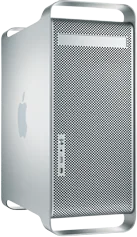
| Type | Tower | Compact |
| Weight | 20.2 kg | 9.5 kg (better) |
| Width × depth × height | 206 × 475 × 511 mm | 385 × 442 × 139 mm |
| Operating system | macOS | macOS |
| Size and weight detail | Maker height 51.1 cm, width 20.6 cm, depth 47.5 cm; reference weight 20.2 kg varies with configuration. | Shared Service Source gives 139 × 385 × 442 mm and 9.5 kg, but its corresponding 24 lb figure is inconsistent. Published metric weight retained without conversion; installed equipment changes weight |
| Power supply | – | Manually switched mains. Exact support specifies 110/220 V, 47–63 Hz and 150 W maximum; shared Service Source specifies 90–270 V switchable 110/220 V and 200 W maximum excluding monitor. These unresolved maximum-rating differences are retained without treating them as measured operating consumption |
| Materials | Aluminium enclosure with separate cooling zones. | – |
| In the box | Mac OS X Panther and iLife. The 1.8 and 2 GHz models were available on 9 June 2004. Apple initially stated July availability for the 2.5 GHz model, later than the generation’s first sale. | Exact Apple support lists 7 November 1996 as introduction. Apple Tech Info Library dated 18 November 1996 explicitly says the exact 4400/160 is currently available in Europe, supporting November 1996 sale precision without inventing a day. Contemporary German coverage planned availability there for December; regional delivery differed. This is the Europe-only 160 MHz version, not the later 200 MHz or renamed Far East 7220. |

More comparisons
- Apple Mac Studio (M4 Max or M3 Ultra) vs Apple Power Mac G5 (June 2004)
- Apple Mac Pro (2006) vs Apple Power Mac G5 (June 2004)
- Apple Power Mac G5 (June 2004) vs Apple Power Mac G5 (Late 2005)
- Apple Power Mac G5 (Late 2005) vs Apple Power Macintosh 4400/160
- Apple Power Mac G5 (Early 2005) vs Apple Power Mac G5 (June 2004)
- Apple Power Mac G5 (Early 2005) vs Apple Power Macintosh 4400/160
- Apple Power Mac G5 (June 2004) vs Apple Power Mac G5 (Late 2004)
- Apple Power Mac G5 (Late 2004) vs Apple Power Macintosh 4400/160
- Apple iMac G5 (20-inch, 2004) vs Apple Power Mac G5 (June 2004)
- Apple Power Mac G5 (2003) vs Apple Power Mac G5 (June 2004)
- Apple Power Mac G4 (Mirrored Drive Doors 2003) vs Apple Power Mac G5 (June 2004)
- Apple Power Mac G4 (FW800) vs Apple Power Mac G5 (June 2004)
- Apple Power Mac G4 (Mirrored Drive Doors 2002) vs Apple Power Mac G5 (June 2004)
- Apple Power Mac G4 (QuickSilver 2002) vs Apple Power Mac G5 (June 2004)
- Apple Power Mac G4 (QuickSilver 2001) vs Apple Power Mac G5 (June 2004)
- Apple Power Mac G4 (Digital Audio) vs Apple Power Mac G5 (June 2004)