Apple Power Mac G5 (June 2004) vs Apple Power Macintosh 5400/120
Better figure, where one is clearly better
| ApplePower Mac G5 (June 2004) | ApplePower Macintosh 5400/120 | |
|---|---|---|
| Overview | ||
| Released | June 2004 | 1996 |
| Performance | ||
| Processor | 2 × PowerPC G5 1800 MHz (Power Mac June 2004), 2 × PowerPC G5 2000 MHz (Power Mac June 2004) or 2 × PowerPC G5 2500 MHz (Power Mac June 2004) | PowerPC 603e 120 MHz (Power Macintosh 5400) |
| CPU cores | 2 | 1 |
| Graphics | NVIDIA GeForce FX 5200 Ultra (64 MB) or ATI Radeon 9600 XT (128 MB) | – |
| Memory | 256 MB, 512 MB, 4 GB or 8 GB (better) | 16 MB |
| Storage | 80 GB to 160 GB (better) | 1.6 GB |
| CPU | Two physical PowerPC G5 processors at 1.8, 2 or 2.5 GHz, each with 512 KB L2 cache. Per-processor front-side bus is 900 MHz, 1 GHz or 1.25 GHz respectively. Only the dual 2.5 GHz uses the maker’s liquid-cooling system. | 120 MHz PowerPC 603e with integrated floating-point unit, 32 KB L1 cache and 64-bit 40 MHz bus; optional 256 KB L2 High Performance Module M4505LL/A. Optional PC Compatibility Card with a 100 MHz 586 processor is separate hardware. |
| GPU | Dual 1.8 and 2 GHz: NVIDIA GeForce FX 5200 Ultra with 64 MB DDR. Dual 2.5 GHz: ATI Radeon 9600 XT with 128 MB DDR. Optional ATI Radeon 9800 XT with 256 MB occupies the adjacent PCI slot as well as AGP. | 1 MB built-in DRAM framebuffer separate from system RAM, not expandable. Apple's shared Service Source supports 640 × 480 at 60 or 67 Hz and 800 × 600 at 60 or 72 Hz with 16-bit colour, and 832 × 624 at 75 Hz with 8-bit colour; video input is unavailable at 832 × 624. Exact support lists only 8-bit colour at 800 × 600; this conflicts with the shared service table and contemporary MacUser test, so both claims remain qualified. |
| Memory type | DDR400 PC3200 in matched pairs. Dual 1.8 GHz starts with 256 MB and has four DIMM slots with a 4 GB maximum. Dual 2 and 2.5 GHz start with 512 MB and have eight slots with an 8 GB maximum. Base and maximum memory rows retain each model’s stock storage and graphics. | 16 MB standard, consisting of 8 MB soldered on the logic board and one 8 MB DIMM; two 168-pin sockets accept independently installed 70 ns or faster DIMMs, expandable to 136 MB. Optional L2 cache is separate from this memory. |
| Storage type | Stock 80 GB on dual 1.8 GHz and 160 GB on dual 2/2.5 GHz; 7200 rpm Serial ATA. Two bays with 150 MB/s interfaces; optional 80, 160 or 250 GB drives, up to two 250 GB drives. One optical bay with 8x DVD-R SuperDrive; Combo drive is optional. | 1.6 GB IDE hard drive and 1.44 MB Apple SuperDrive floppy. The original May 1996 Apple Facts configuration includes a quadruple-speed CD-ROM; original Apple TIL 19886 identifies B2765LL/A with AppleCD 600i Plus and a later higher-education-only M5184LL/B bundle with an 8× CD-ROM. The shared Service Source confirms the education 8× configuration otherwise has the same hardware. These optical-drive bundles share the same RAM/storage configuration. |
| Expansion slots | AGP 8x Pro graphics slot. Dual 1.8 GHz has three 64-bit 33 MHz PCI slots. Dual 2 and 2.5 GHz have PCI-X: two 100 MHz and one 133 MHz slots. | One 32-bit PCI 2.0 slot for a card up to 7 inches long, PCI-based Communications Slot II, optional video-input card and TV/FM tuner bay. Apple Video System supports NTSC, PAL and SECAM; original Apple TIL says video capture is included in some configurations and optional in others. Earlier Ethernet cards for non-PCI communications slots do not establish compatibility. |
| Display | ||
| Screen | None built in | 12.8″ |
| Resolution | – | 832 × 624 |
| Panel | – | CRT |
| Refresh rate | – | 75 Hz |
| Display type | – | Multiple-scan flat-square shadow-mask CRT, 15-inch nominal tube with a 12.8-inch diagonal viewable image and 0.28 mm dot pitch. Tilt-and-swivel base tilts from −5° to +15° and swivels 360°. |
| Connections | ||
| Ports | 3 × USB-A, Ethernet, headphone jack | Headphone jack |
| Ethernet | 1 Gb/s | – |
| External displays | Up to 2 | – |
| Front ports | USB 2.0, FireWire 400 and headphone minijack. | Headphone output, sound-volume and display controls; infrared receiver for the optional TV/FM remote. |
| Back ports | Two USB 2.0, FireWire 800, FireWire 400, Gigabit Ethernet, V.92 modem, optical Toslink input/output and analogue audio line-in/out. Three chassis USB ports in total, plus keyboard USB 1.1 ports. Optional 54 Mbps AirPort Extreme and Bluetooth 1.1. | ADB, external DB-25 SCSI, two LocalTalk/GeoPort-compatible serial ports, PlainTalk-compatible sound input and stereo speaker output. Exact Apple support and original TIL describe 10Base-T through a Communications Slot II card; May 1996 Apple Facts calls Ethernet optional. No universally supplied Ethernet headline is assumed. TIL lists optional thin-coax and AAUI Ethernet cards. Apple Facts specifies six external SCSI devices; the shared service says seven without the same external qualification. |
| External displays | ADC and DVI with included DVI-to-VGA adapter; two displays in extended or mirrored modes. A second ADC display requires a separate adapter. | Optional Apple External Video Connector enables video mirroring to a compatible display; the shared service lists 640 × 480, 800 × 600 and 832 × 624 external modes. Optional Apple Presentation System converts output to NTSC or PAL. A connector and compatible display are required. |
| Speakers | Built-in speaker; analogue and optical connections for external audio. | Built-in stereo speakers, 16-bit stereo sound input/output and SRS 3D surround processing, with rear stereo speaker output. |
| Microphones | – | Built-in microphone; PlainTalk-compatible external sound input. |
| Keyboard and mouse | Apple Keyboard, Apple Mouse, USB extension cable, DVI-to-VGA adapter, modem cable and AirPort antenna. | AppleDesign Keyboard, ADB mouse and preinstalled software in the exact original ordering information. Ethernet, video input, video output, TV/FM tuner and PC Compatibility Card vary by bundle or are optional. Maker gallery shows the beige shared 5400 housing with keyboard and mouse; it is not the graphite Performa 5420. |
| Design and power | ||
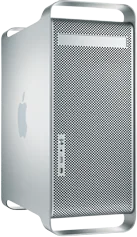
| Type | Tower | All-in-one |
| Weight | 20.2 kg (better) | 21.2 kg |
| Width × depth × height | 206 × 475 × 511 mm | 383 × 406 × 445 mm |
| Operating system | macOS | macOS |
| Size and weight detail | Maker height 51.1 cm, width 20.6 cm, depth 47.5 cm; reference weight 20.2 kg varies with configuration. | Exact May 1996 Apple Facts gives 44.5 × 38.3 × 40.6 cm (height × width × depth) and 21.2 kg / 47 lb, varying with installed devices. Exact support agrees on inch dimensions and pounds. The shared service physical table swaps width/depth and prints inconsistent pound/kilogram weights; the exact model catalogue measurements are used. |
| Power supply | – | Exact support specifies 220 W maximum, 110–240 V AC, 50–60 Hz. Shared Service Source gives 100–240 V at 47–63 Hz, a separate 125 W entry and 220 W maximum for all line/load conditions. These are electrical ratings rather than measured operating consumption. |
| Materials | Aluminium enclosure with separate cooling zones. | – |
| In the box | Mac OS X Panther and iLife. The 1.8 and 2 GHz models were available on 9 June 2004. Apple initially stated July availability for the 2.5 GHz model, later than the generation’s first sale. | Original System 7.5.3 with System Enabler 410 and 4 MB ROM. Apple records introduction on 15 April 1996; its May 1996 current education catalogue and October 1996 ordering description establish sale in 1996. The actual first-sale month remains unresolved, so release is year precision. North American Power Macintosh 5400/120 was education-channel hardware; international Performa names and faster CPU variants are separate models. |

More comparisons
- Apple Mac Studio (M4 Max or M3 Ultra) vs Apple Power Mac G5 (June 2004)
- Apple Mac Pro (2006) vs Apple Power Mac G5 (June 2004)
- Apple Power Mac G5 (June 2004) vs Apple Power Mac G5 (Late 2005)
- Apple Power Mac G5 (Late 2005) vs Apple Power Macintosh 5400/120
- Apple Power Mac G5 (Early 2005) vs Apple Power Mac G5 (June 2004)
- Apple Power Mac G5 (Early 2005) vs Apple Power Macintosh 5400/120
- Apple Power Mac G5 (June 2004) vs Apple Power Mac G5 (Late 2004)
- Apple Power Mac G5 (Late 2004) vs Apple Power Macintosh 5400/120
- Apple iMac G5 (20-inch, 2004) vs Apple Power Mac G5 (June 2004)
- Apple Power Mac G5 (2003) vs Apple Power Mac G5 (June 2004)
- Apple Power Mac G4 (Mirrored Drive Doors 2003) vs Apple Power Mac G5 (June 2004)
- Apple Power Mac G4 (FW800) vs Apple Power Mac G5 (June 2004)
- Apple Power Mac G4 (Mirrored Drive Doors 2002) vs Apple Power Mac G5 (June 2004)
- Apple Power Mac G4 (QuickSilver 2002) vs Apple Power Mac G5 (June 2004)
- Apple Power Mac G4 (QuickSilver 2001) vs Apple Power Mac G5 (June 2004)
- Apple Power Mac G4 (Digital Audio) vs Apple Power Mac G5 (June 2004)