Apple Power Mac G5 (Late 2005) vs Apple Power Macintosh 5500/275
Better figure, where one is clearly better
| ApplePower Mac G5 (Late 2005) | ApplePower Macintosh 5500/275 | |
|---|---|---|
| Overview | ||
| Released | October 2005 | 1997 |
| Performance | ||
| Processor | PowerPC G5 dual-core 2000 MHz (Power Mac Late 2005), PowerPC G5 dual-core 2300 MHz (Power Mac Late 2005) or 2 × PowerPC G5 dual-core 2500 MHz (Power Mac Late 2005) | PowerPC 603e (275 MHz, Power Macintosh 5500) |
| CPU cores | 2 or 4 | 1 |
| Graphics | NVIDIA GeForce 6600 LE (128 MB) or NVIDIA GeForce 6600 (256 MB) | – |
| Memory | 512 MB or 16 GB (better) | 16 MB or 32 MB |
| Storage | 160 GB to 250 GB (better) | 2 GB to 4 GB |
| CPU | Dual models have one physical dual-core PowerPC G5 at 2 or 2.3 GHz. Quad has two physical dual-core processors at 2.5 GHz, four cores in total. Each core has 1 MB L2 cache. Front-side bus per physical processor is 1, 1.15 or 1.25 GHz respectively. Macworld’s exact Quad review describes its liquid cooling. | 275 MHz PowerPC 603e with integrated floating-point unit, 32 KB internal cache and 64-bit PowerPC bus. UK and Dutch exact graphite specifications give 512 KB L2 cache. Shared service describes another 275 MHz configuration with the same features as the basic 5500/225 apart from clock speed; optional 256 KB family cache does not replace the documented graphite 512 KB value. |
| GPU | Stock dual-core 2 GHz: NVIDIA GeForce 6600 LE with 128 MB GDDR SDRAM. Dual-core 2.3 GHz and Quad: NVIDIA GeForce 6600 with 256 MB GDDR SDRAM. Optional NVIDIA GeForce 7800 GT 256 MB and Quadro FX 4500 512 MB; the Quadro occupies the graphics slot and adjacent x4 slot. | 2 MB SGRAM and built-in hardware acceleration for 2D QuickDraw and 3D QuickDraw 3D/RAVE. Exact archived Dutch family specifications identify ATI 3D Rage II and support 24-bit colour through 800 × 600 on the built-in CRT. Headline resolution is this explicitly documented built-in colour mode, not a fixed pixel matrix or established maximum for every colour depth. Shared service lists 640 × 480, 800 × 600 and 832 × 624 at 32 bits per pixel, 1024 × 768 and 1152 × 870 at 16 bits, and 1280 × 1024 at 8 bits; it does not establish all of these as exact regional built-in display limits. |
| Memory type | Stock 512 MB PC2-4200 DDR2 at 533 MHz, installed in matched pairs. Up to 16 GB supported; ECC configurations available from 1 GB. Rows retain the stock drive and graphics at base and maximum supported memory. | Graphite UK and Dutch family configurations have 32 MB EDO RAM, expandable to 128 MB in two 168-pin DIMM sockets. No system RAM is soldered on the logic board. Archived exact Dutch page specifies noncomposite 5 V, 60 ns or faster EDO DIMMs with 1K or 2K refresh. Shared service also permits 5 V fast-page DIMMs and warns that mixing types can use fast-page timings. Basic service configuration has 16 MB. 4 MB ROM. |
| Storage type | Stock 160 GB on dual-core 2 GHz and 250 GB on dual-core 2.3 GHz and Quad. 7200 rpm Serial ATA drives; two internal bays. Optional one or two 500 GB drives. One optical bay with 16x SuperDrive supporting dual-layer DVD+R recording. | Exact graphite family configuration has a 4 GB IDE hard drive, internal 24× CD-ROM and Apple SuperDrive floppy. Shared service also documents a basic 275 MHz configuration inheriting 16 MB RAM, a 2 GB or larger drive and 12× CD-ROM from the basic 225 MHz model; the 2 GB configuration is the documented minimum, not a claimed universal shipped capacity. Optical drives and software differ between these configurations. Shared service describes the floppy as 1.4 MB; the archived Dutch page uses the same maker wording. |
| Expansion slots | PCI Express: occupied x16 graphics slot, two open x4 slots and one open x8 slot. Older PCI and PCI-X expansion cards cannot be reused in these slots. | One 32-bit PCI 2.0 slot for a 7-inch card with Macintosh drivers; communications slot occupied by the supplied graphite modem or optional Ethernet; video-input slot and TV/FM tuner bay. Graphite family specification includes TV/FM tuner and video-input card. Avid Cinema video-editing hardware is optional and requires Apple Video System. NuBus cards are not compatible with the PCI slot. |
| Display | ||
| Screen | None built in | 12.8″ |
| Resolution | – | 800 × 600 |
| Panel | – | CRT |
| Display type | – | Built-in 15-inch nominal colour CRT with 12.8-inch visible diagonal. Shared service specifies 0.28 mm dot pitch and shadow-mask tube. Archived exact family page states up to 85 Hz without tying this figure to a resolution; headline refresh remains omitted. Display brightness controls are on the front, and the housing uses a swivel base. |
| Connections | ||
| Ports | 4 × USB-A, 2 × Ethernet, headphone jack | 2 × headphone jack |
| Ethernet | 1 Gb/s | – |
| External displays | Up to 2 | – |
| Front ports | USB 2.0, FireWire 400 and headphone minijack. | Headphone output, sound-volume and display-brightness controls, and infrared receiver for the TV/FM remote. Front jack plus rear stereo output give the headline two output jacks; sound input is counted separately in details. |
| Back ports | Three USB 2.0, FireWire 800, FireWire 400, two Gigabit Ethernet ports, optical Toslink input/output and analogue audio line-in/out. Four chassis USB 2.0 ports in total, plus two keyboard USB 1.1 ports. AirPort Extreme and Bluetooth 2.0 + EDR are optional, with integrated antennas; built-in support does not mean modules are included. | ADB; external DB-25 SCSI with support for six external devices in the original Dutch family page; two RS-232/RS-422 serial ports with LocalTalk and GeoPort support in shared service; PlainTalk-compatible stereo sound input and rear stereo output. Graphite family modem supports data up to 33.6 Kbit/s, fax up to 14.4 Kbit/s, voice, answering-machine and hands-free functions; data rate depends on connection and provider. Archived page lists MNP4, V.42, MNP5 and V.42bis. Ethernet is a communications-slot option, not universally fitted. No USB or FireWire. |
| External displays | Stock GeForce 6600 LE/6600 and optional 7800 GT have one single-link and one dual-link DVI port, supporting one 30-inch Apple Cinema HD Display alongside a second display. Optional Quadro FX 4500 has two dual-link DVI outputs for two 30-inch displays and a stereo 3D connector. DVI-to-VGA adapter included. | Computer-monitor video mirroring requires the optional external-video connector kit. Shared service supports mirroring at 640 × 480, 800 × 600 or 832 × 624; this does not establish an independent extended desktop. Avid Cinema provides optional PAL/NTSC video editing and output and requires the video-input system. Included TV/FM reception is not proof of included TV output. |
| Speakers | Built-in speaker and optical/analogue external audio connections. | Two built-in stereo speakers and 16-bit stereo sound input/output, with SRS surround-sound enhancement. Shared service supports recording at 11, 22 or 44 kHz. Front headphone and rear speaker outputs are separate. |
| Microphones | – | Built-in microphone plus external sound-input port supporting PlainTalk microphones. Shared service explicitly excludes the earlier Omni microphone and attenuated RCA adapter. |
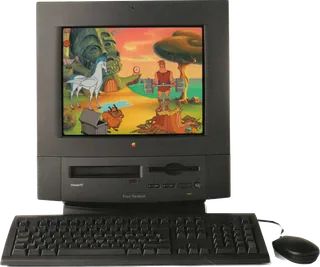
| Keyboard and mouse | Apple Keyboard, Mighty Mouse, USB keyboard extension and DVI-to-VGA adapter. | Exact archived Dutch ordering page identifies graphite Family Macintosh M6183 with keyboard, mouse, cables and model-specific software. Original UK Christmas 1997 brochure shows the graphite computer with matching keyboard and mouse, with TV/FM tuner and video-in listed in its 275 MHz specification. The screen artwork is original maker photography; it is not a clean unlit-screen alternative. |
| Design and power | ||
| Type | Tower | All-in-one |
| Operating system | macOS | macOS |
| Size and weight detail | – | Exact archived Dutch family page gives 40.6 × 19.8 × 42.8 cm and 20.2 kg, values resembling the companion tower rather than the pictured all-in-one. Shared service gives 445 mm height but swaps the family width/depth compared with other original all-in-one brochures, and prints internally inconsistent 17/19 lb versus 21.15 kg weights. These unresolved exact-model measurement conflicts are not promoted into headline weight or dimensions, and sibling-model measurements are not substituted. |
| Power supply | – | Archived exact Dutch family specifications give 220 W maximum continuous input, with regional 200–240 or 100–125 V AC at 47–63 Hz and energy-saving sleep. Shared service gives 100–240 V AC at 47–63 Hz, a separate 125 W entry and 220 W maximum for all line/load conditions. These qualified ratings are not measured operating consumption. |
| Noise | – | Shared service describes a variable-speed enclosure fan and separate processor cooling fan, without a measured acoustic figure. |
| Materials | Aluminium enclosure. | – |
| In the box | Mac OS X Tiger and iLife ’05. Apple confirmed the dual-core 2 and 2.3 GHz models available on 19 October 2005, with Quad expected in early November. Macs Only reports its Quad shipped on 10 November and arrived on 11 November; these later Quad dates do not change the generation’s first sale. The exact specification sheet does not publish weight or dimensions. | Shared service graphite configuration includes Mac OS 8.0. Original UK Christmas brochure describes purchase between 1 November and 31 December 1997 for a software offer; exact Dutch product ordering page is dated September 1997 and lists 275 MHz M6183. These establish sale in 1997; actual first-sale month or day remains unresolved. UK software includes Apple Magic Collection, Actua Soccer, Kai's Power Goo and multimedia reference titles; promotional software is not another hardware generation. Product resource is the original Dutch Apple family page covering exact 225/275 configurations; the support resource is the current official Earlier Power Mac family document index in English (Macau region), which has no exact 275 MHz entry. No exact surviving English maker support specification record or user guide was recovered. |

More comparisons
- Apple Mac Studio (M4 Max or M3 Ultra) vs Apple Power Mac G5 (Late 2005)
- Apple Mac Pro (M2 Ultra) vs Apple Power Mac G5 (Late 2005)
- Apple Mac Pro (Early 2009) vs Apple Power Mac G5 (Late 2005)
- Apple Mac Pro (Early 2008) vs Apple Power Mac G5 (Late 2005)
- Apple Mac Pro (2006) vs Apple Power Mac G5 (Late 2005)
- Apple Power Mac G5 (2003) vs Apple Power Mac G5 (Late 2005)
- Apple Power Mac G5 (June 2004) vs Apple Power Mac G5 (Late 2005)
- Apple Power Mac G5 (Late 2004) vs Apple Power Mac G5 (Late 2005)
- Apple Power Mac G5 (Early 2005) vs Apple Power Mac G5 (Late 2005)
- Apple iMac G5 (20-inch, iSight) vs Apple Power Mac G5 (Late 2005)
- Apple Power Mac G4 (Mirrored Drive Doors 2003) vs Apple Power Mac G5 (Late 2005)
- Apple Power Mac G4 (FW800) vs Apple Power Mac G5 (Late 2005)
- Apple Power Mac G4 (Mirrored Drive Doors 2002) vs Apple Power Mac G5 (Late 2005)
- Apple Power Mac G4 (QuickSilver 2002) vs Apple Power Mac G5 (Late 2005)
- Apple Power Mac G4 (QuickSilver 2001) vs Apple Power Mac G5 (Late 2005)
- Apple Power Mac G4 (Digital Audio) vs Apple Power Mac G5 (Late 2005)