Apple Macintosh PowerBook 550c vs Apple PowerBook G4 (12-inch, 1.5GHz)
Better figure, where one is clearly better
| AppleMacintosh PowerBook 550c | ApplePowerBook G4 (12-inch, 1.5GHz) | |
|---|---|---|
| Overview | ||
| Released | 1995 | 2005 |
| Display | ||
| Screen size | 10.4″ | 12.1″ |
| Resolution | 640 × 480 | 1024 × 768 (better) |
| Touchscreen | No | No |
| Display type | Backlit active-matrix colour LCD; 256 colours at 640 × 480 or 32768 colours at 640 × 400 according to Apple Japan | 12.1-inch TFT XGA active-matrix display; panel technology and refresh unpublished. |
| Performance | ||
| Processor | Motorola 68040 66 MHz (PowerBook 550c) | PowerPC G4 1.5 GHz (PowerBook 12-inch 2005) |
| CPU cores | 1 | 1 |
| Graphics | – | NVIDIA GeForce FX Go5200 (64 MB DDR) |
| Memory | 12 MB | 512 MB or 1.25 GB (better) |
| Storage | 750 MB | 60 GB to 100 GB (better) |
| CPU | Motorola 68040 with MMU and floating-point unit; Apple specifies 66 MHz internal processor clock and 33 MHz bus interface. The English support table incorrectly says no FPU, conflicting with the exact Japanese sheet and original Apple technical article | 1.5 GHz PowerPC G4, 512 KB on-chip L2 and 167 MHz system bus. Exact silicon supplier omitted. |
| GPU | Service Source specifies 512 KB video memory; built-in video output supports 256 colours | NVIDIA GeForce FX Go5200 with 64 MB DDR video memory and AGP 4×. |
| Memory type | 4 MB on the logic board plus an 8 MB expansion card in the standard 12 MB configuration; expandable to 36 MB using one 70 ns or faster low-power self-refreshing card | 512 MB PC2700 DDR333 standard; one SO-DIMM slot, maximum 1.25 GB. |
| Storage type | Internal 750 MB SCSI hard drive and 1.4 MB Apple SuperDrive; full KanjiTalk CD-ROM installation needs an external CD-ROM drive | 5400 rpm Ultra ATA/100 hard drive with Sudden Motion Sensor. Combo base60GB; SuperDrive base80GB; 100GB build-to-order on either. 8× DVD±RW/CD-RW SuperDrive; optical-drive differences retained in details. |
| Battery and size | ||
| Battery life (maker's claim) | Up to 3 hours | Up to 5 hours |
| Battery capacity | – | 50 Wh |
| Weight | 3.1 kg | 2.1 kg (better) |
| Thickness | 57 mm | – |
| Width × depth | 292 × 245 mm | – |
| Battery life detail | Two removable nickel-metal hydride intelligent batteries; Apple Japan claims three hours per battery, while the original technical article and service manual say up to 3.5 hours. Recharge takes two hours asleep or off, four hours running. Headline runtime is per battery rather than an inferred combined claim. Published 3.1 kg includes two batteries; Service Source instead lists 3.3 kg | 50 Wh lithium-ion, up to five hours. Published reference weight 2.1 kg with battery and optical drive; varies by configuration/manufacturing. Published dimensions: height 3.0 cm, width 27.7 cm, depth 21.9 cm. |
| Charger | 40 W power adapter according to Apple Service Source | 45 W power adapter |
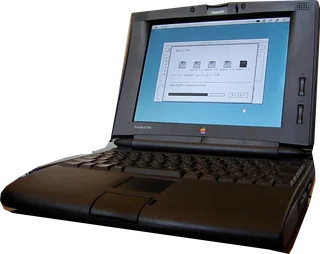
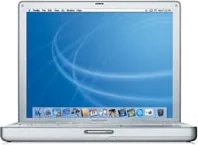
| Materials | Dark-grey enclosure according to the original Apple technical article | Aluminium enclosure |
| Connections | ||
| Ports | – | 2 × USB-A, Ethernet, headphone jack |
| Wi-Fi | – | AirPort Extreme 802.11g/b |
| Bluetooth | – | 2.0 + EDR |
| Operating system | macOS | macOS |
| Port detail | ADB, RS-422 serial/LocalTalk, AAUI Ethernet, HDI-30 SCSI, stereo audio input/output and external video. A 90-pin processor-direct slot accepts the optional PCMCIA module for two Type II or one Type III card; Service Source places it in the second battery bay | Two USB 2.0 ports, FireWire 400, 10/100 Ethernet, 56K V.92 modem, mini-DVI, audio input and headphone output. Mini-DVI-to-DVI and mini-DVI-to-VGA adapters included; television adapter separate. |
| External displays | Mirroring or extended desktop using an optional video adapter; Japanese specifications list Macintosh, VGA and SVGA support. Service Source identifies a micro DV-14 connector, while the English support table labels it mini-15 | Dual display and mirroring; external resolution up to 2048 × 1536. |
| Keyboard | Japanese JIS keyboard with tilt adjustment and power-on key; original Apple technical article specifies 79 keys including twelve function keys, unlike Service Source's generic domestic/ISO counts | Full-size keyboard with embedded numeric keypad |
| Trackpad | Built-in solid-state trackpad with adjustable acceleration | Two-finger scrolling/panning, tap, double-tap and drag support |
| Speakers | Two built-in stereo speakers and 16-bit audio with 11.035, 22.050 or 44.100 kHz sampling | Stereo speakers with midrange-enhancing third speaker |
| Microphones | Built-in electret microphone; Japanese specifications call it directional while the original technical article and service manual say omnidirectional | Internal omnidirectional microphone |
| In the box | 12 MB/750 MB PowerBook, two intelligent batteries, power adapter, KanjiTalk 7.5 CD-ROM and system disks, PowerBook Mobility Bundle, documentation and warranty. Apple records introduction on 30 May 1995, while contemporary TidBITS coverage expected late-June availability; the July maker technical article confirms a released Japan-only product without a first-sale day or month | Apple announced 31 January 2005 with availability planned later that week. Actual first on-sale month unestablished after a bounded search; year precision retained. Launch Mac OS X 10.3 Panther and iLife ’05; later units shipped Tiger. |
More comparisons
- Apple MacBook Air 13″ (M5) vs Apple PowerBook G4 (12-inch, 1.5GHz)
- Apple MacBook Air 13″ (M5) vs Apple Macintosh PowerBook 550c
- Apple MacBook Pro (15-inch, Early 2006) vs Apple PowerBook G4 (12-inch, 1.5GHz)
- Apple PowerBook G4 (12-inch, 1.5GHz) vs Apple PowerBook G4 (15-inch, Double-Layer SD)
- Apple PowerBook G4 (12-inch, 1.5GHz) vs Apple PowerBook G4 (17-inch, Double-Layer SD)
- Apple Macintosh PowerBook 550c vs Apple PowerBook G4 (15-inch, Double-Layer SD)
- Apple Macintosh PowerBook 550c vs Apple PowerBook G4 (17-inch, Double-Layer SD)
- Apple PowerBook G4 (12-inch, 1.5GHz) vs Apple PowerBook G4 (15-inch, 1.67/1.5GHz)
- Apple PowerBook G4 (12-inch, 1.5GHz) vs Apple PowerBook G4 (17-inch, 1.67GHz)
- Apple Macintosh PowerBook 550c vs Apple PowerBook G4 (15-inch, 1.67/1.5GHz)
- Apple Macintosh PowerBook 550c vs Apple PowerBook G4 (17-inch, 1.67GHz)
- Apple PowerBook G4 (12-inch, 1.33GHz) vs Apple PowerBook G4 (12-inch, 1.5GHz)
- Apple PowerBook G4 (12-inch, 1.5GHz) vs Apple PowerBook G4 (Original 2001)
- Apple iBook (1999) vs Apple PowerBook G4 (12-inch, 1.5GHz)
- Apple iBook (Early 2000) vs Apple PowerBook G4 (12-inch, 1.5GHz)
- Apple iBook (FireWire) vs Apple PowerBook G4 (12-inch, 1.5GHz)