ASUS Zenbook DUO (UX8407) vs Lenovo ThinkPad T470
Better figure, where one is clearly better
| ASUSZenbook DUO (UX8407) | LenovoThinkPad T470 | |
|---|---|---|
| Overview | ||
| Released | February 2026 | February 2017 |
| Display | ||
| Screen size | 14″ | 14″ |
| Resolution | 2880 × 1800 (better) | 1920 × 1080 |
| Panel | OLED | IPS LCD |
| Refresh rate | 144 Hz | – |
| Brightness | 500 nits (better) | 250 nits |
| HDR peak brightness | 1,000 nits | – |
| Touchscreen | Yes | No |
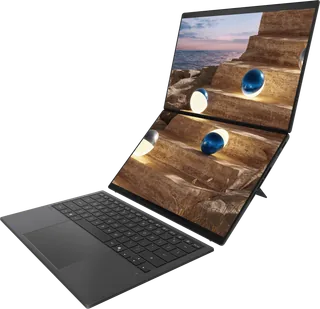
| Display type | Two 14-inch 3K ASUS Lumina Pro OLED touch screens, 16:10, stylus support | HD or Full HD non-IPS (220 nits), or Full HD IPS (250 nits); optional ten-finger on-cell touch on Full HD IPS with PPS lid |
| Colour range | 100% DCI-P3 | – |
| Screen finish | Anti-reflection coating (65% less reflection) | Anti-glare |
| Display features | 0.2 ms response; 1,000,000:1 contrast; VESA DisplayHDR True Black 1000; 1.07 billion colours; PANTONE Validated; 93% screen-to-body ratio; E-Reading mode | – |
| Performance | ||
| Processor | Intel Core Ultra 9 386H, Intel Core Ultra X9 378H or Intel Core Ultra X9 388H | Intel Core i5-7200U |
| CPU cores | 16 | 2 |
| CPU threads | 16 | 4 |
| Graphics | Intel Graphics or Intel Arc B390 GPU | Intel HD Graphics 620 |
| AI engine (NPU) | 50 TOPS | – |
| Memory | 32 GB (better) | 8 GB |
| Storage | 1 TB to 2 TB (better) | 256 GB to 512 GB |
| CPU | Core Ultra X9 388H or 378H, Core Ultra X7 358H or Core Ultra 9 386H with 4 P-cores, 8 E-cores and 4 LP E-cores (18 MB cache); Core Ultra 7 355 with 4 P-cores and 4 LP E-cores (12 MB cache) | Sixth- or seventh-generation dual-core Intel Core processors; Core i7-6500U unavailable in EMEA |
| GPU | Intel Arc B390 GPU (Core Ultra X7 and X9) or Intel Graphics, integrated | Integrated Intel HD Graphics 520 or 620; optional GeForce 940MX with 2 GB GDDR5 outside EMEA; listed configurations are integrated |
| AI engine | Copilot+ PC; Intel NPU up to 50 TOPS | – |
| Memory type | LPDDR5X on board, 16 or 32 GB, not upgradable | DDR4-2400; two SO-DIMM sockets, up to 32 GB; clocks down to the processor's memory limit |
| Storage type | One M.2 2280 PCIe 4.0 x4 slot; 512 GB, 1 TB or 2 TB NVMe SSD | 2.5-inch SATA HDD/SSD or primary M.2 2280 PCIe 3.0 ×2 NVMe SSD; optional 128 GB SATA M.2 SSD in WWAN slot excludes WWAN and WiGig; listed configurations use PCIe SSDs (Laptop Mag, Notebookcheck) |
| Battery and size | ||
| Battery life (maker's claim) | Up to 32 hours | Up to 13.9 hours |
| Battery capacity | 99 Wh | – |
| Weight | 1.65 kg | 1.65 kg |
| Thickness | 23.4 mm | 19.95 mm (better) |
| Width × depth | 310.1 × 208.6 mm | 336.6 × 232.5 mm |
| Battery life detail | 99 Wh, 4-cell Li-ion; 1080p video up to 32 hr (one screen) or 18 hr (two screens); web browsing up to 18 hr (one screen) or 12 hr (two screens); ASUS test at 150 nits and 60 Hz | Optional internal 24 Wh; removable external 24, 48 or 72 Wh; integrated graphics with internal plus 24 Wh external up to 13.9 hours (MobileMark 2014), plus 48 Wh up to 20.9 hours, plus 72 Wh up to 27.1 hours; weight shown for PPS lid with three-cell external battery |
| Charger | 100 W USB-C adapter; not included in every country | 45 W or 65 W slim-tip or USB-C adapter |
| Fast charging | 60% in 49 minutes | – |
| Materials | Ceraluminum chassis, hinge and kickstand; MIL-STD-810H tested | Magnesium-hybrid or PPS display cover; glass-fibre reinforced plastic bottom |
| Colours | Moher Gray | Black |
| Connections | ||
| Ports | 2 × Thunderbolt 4, USB-A, HDMI, headphone jack | Thunderbolt 3, 3 × USB-A, HDMI, Ethernet, SD card slot, headphone jack |
| Wi-Fi | Wi-Fi 7 | 802.11ac; optional 802.11ad WiGig |
| Bluetooth | 5.4 | Bluetooth 4.1 under Windows |
| Webcam | FHD with IR | Optional 720p; optional infrared camera |
| Operating system | Windows | Windows |
| Port detail | 2 × Thunderbolt 4 (40 Gbps, display and power delivery); USB-A 10 Gbps; HDMI 2.1 FRL; 3.5 mm combo audio jack | Three USB 3.1 Gen 1 Type-A, one USB-C 3.1 Gen 2/Thunderbolt 3 with Power Delivery and DisplayPort, HDMI 1.4b, Gigabit Ethernet, combo audio, SD/MMC/SDHC/SDXC reader and docking connector; optional smart card and micro-SIM slot |
| External displays | Two 4K 60 Hz or one 8K 60 Hz over Thunderbolt 4 | Three independent displays; USB-C up to 4096 × 2304 at 60 Hz, HDMI up to 4096 × 2160 at 24 Hz |
| Keyboard | Detachable Bluetooth keyboard, backlit, 1.7 mm key travel, Copilot key; attaches magnetically to the lower screen with pogo pins | Six-row spill-resistant keyboard; optional backlight |
| Trackpad | ErgoSense precision touchpad on the keyboard | Multi-touch Mylar clickpad; TrackPoint with dedicated buttons |
| Speakers | Six speakers with dedicated tweeters and woofers, Smart Amp | 2 W × 2 stereo speakers |
| Microphones | Array microphone | Dual-array microphone |
| Biometrics | IR camera for Windows Hello | Optional touch fingerprint reader; discrete TPM 1.2 or 2.0; optional NFC |
| In the box | ASUS Pen with wireless charger in some countries | – |

More comparisons
- ASUS Zenbook 14 (UX3480) Intel vs ASUS Zenbook DUO (UX8407)
- Lenovo ThinkPad T14s Gen 7 (Intel) vs Lenovo ThinkPad T470
- ASUS Zenbook DUO (UX8407) vs Lenovo ThinkPad T480
- ASUS Zenbook DUO (UX8407) vs Lenovo ThinkPad T440
- ASUS Zenbook A14 (UX3407, 2026) vs ASUS Zenbook DUO (UX8407)
- ASUS Zenbook DUO (UX8407) vs ASUS Zenbook S14 (UX5406, 2026)
- ASUS Zenbook A14 (UX3407, 2025) vs ASUS Zenbook DUO (UX8407)
- ASUS Zenbook DUO (UX8407) vs ASUS Zenbook S14 (UX5406, 2024)
- ASUS Zenbook DUO (UX8407) vs ASUS Zenbook S16 (UM5606WA, 2024)
- ASUS Zenbook DUO (UX8407) vs Lenovo ThinkPad T460
- ASUS Zenbook DUO (UX8407) vs Lenovo ThinkPad T450
- ASUS Zenbook DUO (UX8407) vs Lenovo ThinkPad T430
- ASUS Zenbook DUO (UX8407) vs Lenovo ThinkPad T420
- Lenovo ThinkPad T16 Gen 4 (AMD) vs Lenovo ThinkPad T470
- Lenovo ThinkPad T16 Gen 4 (Intel) vs Lenovo ThinkPad T470
- Lenovo ThinkPad T14 Gen 6 (AMD) vs Lenovo ThinkPad T470