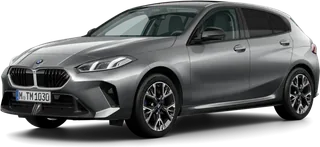
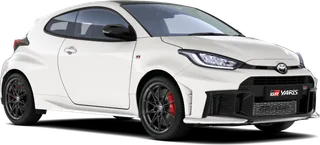
BMW 1 Series vs Toyota GR Yaris
Better figure, where one is clearly better
| BMW1 Series | ToyotaGR Yaris | |
|---|---|---|
| Overview | ||
| Released | October 2024 | March 2024 |
| Performance | ||
| Powertrain | Mild hybrid, Petrol | Petrol |
| Power | 168–296 bhp (better) | 276 bhp |
| 0–62 mph | 4.9–7.8 s (better) | 5.2 s |
| Top speed | 140–155 mph (better) | 142 mph |
| Engine or motors | 120: 125 kW (170 hp) and 123 xDrive: 160 kW (218 hp) petrol with 48 V mild hybrid; M135 xDrive: 221 kW (300 hp) 2.0-litre four-cylinder; bhp converted from BMW's kW figures | 1.6-litre turbocharged three-cylinder petrol (G16E-GTS), 1,618 cc, single-scroll ball-bearing turbo, direct and port injection; 276 bhp (280 DIN hp, 206 kW) at 6,500 rpm |
| Torque | 280 Nm (120), 360 Nm (123 xDrive), 400 Nm (M135 xDrive) | 390 Nm at 3,250–4,600 rpm (Toyota UK site and 2024 launch release; Toyota's January 2026 press specifications list 345 Nm) |
| Gearbox | 7-speed Steptronic dual-clutch automatic | 6-speed intelligent manual (iMT), or 8-speed Gazoo Racing Direct Automatic (GR-DAT) |
| Drive | Front-wheel drive (120) or xDrive all-wheel drive | GR-Four permanent all-wheel drive with an electronically controlled multi-plate coupling; Torsen limited-slip differentials front and rear |
| Range and charging | ||
| Economy (WLTP) | 37.2–53.3 mpg (better) | 29.7–32.4 mpg |
| Efficiency | WLTP combined: 48.7–53.3 mpg (120), 44.8–47.9 mpg (123 xDrive), 34.4–37.2 mpg (M135 xDrive) | WLTP combined: 32.0–32.4 mpg (manual), 29.4–29.7 mpg (automatic); 50-litre fuel tank |
| CO2 emissions | 121–130 g/km (120), 135–143 g/km (123 xDrive), 173–185 g/km (M135 xDrive), WLTP combined | 197 g/km (manual), 215 g/km (automatic), WLTP combined |
| Practicality | ||
| Body | Hatchback | Hatchback |
| Seats | 5 (better) | 4 |
| Boot | – | 174 litres |
| Length | 4,361 mm | 3,995 mm |
| Width | 1,800 mm | 1,805 mm |
| Weight | – | From 1,280 kg |
| Boot | 300 litres (1,135 folded) on the 120 and 123 xDrive; 380 litres (1,200 folded) on the M135 xDrive | 174 litres (VDA) with the rear seats in place |
| Towing | Up to 1,300 kg braked (120) | – |
| Size | 4,361 mm long, 1,800 mm wide (2,072 mm with mirrors), 1,459 mm high; 2,670 mm wheelbase; EC unladen weight including a 75 kg driver is 1,500 kg (120), 1,605 kg (123 xDrive), 1,625 kg (M135 xDrive) | 3,995 mm long, 1,805 mm wide, 1,455 mm high; 2,560 mm wheelbase; 124 mm ground clearance; 5.31 m turning radius (tyres); drag coefficient 0.352; kerb weight 1,280–1,305 kg (manual), 1,300–1,325 kg (automatic) |
| Tech and safety | ||
| Infotainment | – | Toyota Smart Connect+ with 8-inch touchscreen, cloud and embedded navigation, wireless Apple CarPlay and Android Auto; 12.3-inch digital driver's display |
| Driver assistance | – | Third-generation Toyota Safety Sense as standard, with over-the-air updates |