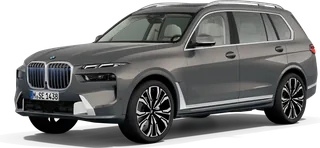
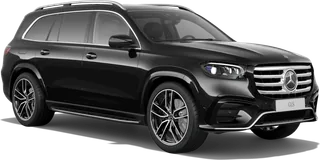
BMW X7 vs Mercedes-Benz GLS
Better figure, where one is clearly better
| BMWX7 | Mercedes-BenzGLS | |
|---|---|---|
| Overview | ||
| Released | March 2019 | 2019 |
| Performance | ||
| Powertrain | Mild hybrid | Mild hybrid |
| Power | 347–523 bhp (better) | 362 bhp |
| 0–62 mph | 4.7–5.9 s (better) | 5.7 s |
| Top speed | 152–155 mph | 155 mph |
| Engine or motors | xDrive40i: 2,998 cc six-cylinder petrol with 48 V mild hybrid, 280 kW (381 hp); xDrive40d: 2,993 cc six-cylinder diesel with 48 V mild hybrid, 259 kW (352 hp); M60i xDrive: 4,395 cc V8 with 48 V mild hybrid, 390 kW (530 hp); bhp converted from BMW's kW figures | 2,989 cc six-cylinder diesel, 270 kW (367 hp), plus 17 kW (23 hp) mild-hybrid motor; bhp converted from Mercedes' kW figure |
| Torque | 540 Nm (xDrive40i), 720 Nm (xDrive40d), 750 Nm (M60i xDrive) | 750 Nm |
| Gearbox | 8-speed automatic | 9G-TRONIC 9-speed automatic |
| Drive | xDrive all-wheel drive | All-wheel drive |
| Range and charging | ||
| Economy (WLTP) | 23.3–35.3 mpg (better) | 34.9 mpg |
| Efficiency | WLTP combined: 26.9–29.4 mpg (xDrive40i), 32.1–35.3 mpg (xDrive40d), 21.9–23.3 mpg (M60i xDrive) | 34.9 mpg WLTP combined |
| CO2 emissions | 217–238 g/km (xDrive40i), 211–231 g/km (xDrive40d), 276–293 g/km (M60i xDrive), WLTP combined | 212 g/km |
| Practicality | ||
| Body | SUV | SUV |
| Seats | 7 | 7 |
| Boot | 326 litres | 355 litres (better) |
| Length | 5,181 mm | 5,217 mm |
| Width | 2,000 mm | 1,956 mm |
| Weight | – | From 2,706 kg |
| Boot | 326 litres with all seven seats in use; 750 litres with the third row folded; 2,120 litres with both rear rows folded | 355 litres |
| Towing | Up to 3,500 kg braked with the optional trailer coupling | 3,500 kg braked, 750 kg unbraked |
| Size | 5,181 mm long, 2,000 mm wide (2,218 mm with mirrors), 1,835 mm high; 3,105 mm wheelbase; EC unladen weight including a 75 kg driver is 2,490 kg (xDrive40i), 2,565 kg (xDrive40d), 2,675 kg (M60i xDrive) | 5,217 mm long, 1,956 mm wide without mirrors (2,164 mm with), 1,823 mm high; 12.52 m turning circle; kerb weight 2,706 kg; 90-litre fuel tank |