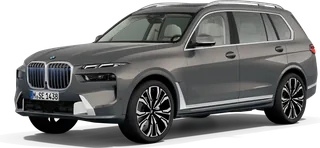
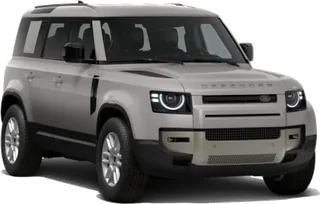
BMW X7 vs Land Rover Defender 110
Better figure, where one is clearly better
| BMWX7 | Land RoverDefender 110 | |
|---|---|---|
| Overview | ||
| Released | March 2019 | September 2019 |
| Performance | ||
| Powertrain | Mild hybrid | Mild hybrid, Plug-in hybrid |
| Power | 347–523 bhp (better) | 197–375 bhp |
| 0–62 mph | 4.7–5.9 s (better) | 6.2–10.2 s |
| Top speed | 152–155 mph (better) | 109–119 mph |
| Engine or motors | xDrive40i: 2,998 cc six-cylinder petrol with 48 V mild hybrid, 280 kW (381 hp); xDrive40d: 2,993 cc six-cylinder diesel with 48 V mild hybrid, 259 kW (352 hp); M60i xDrive: 4,395 cc V8 with 48 V mild hybrid, 390 kW (530 hp); bhp converted from BMW's kW figures | 3.0-litre Ingenium six-cylinder twin-turbo diesel mild hybrid, 200 PS (147 kW), 249 PS (183 kW) or 350 PS (257 kW); 3.0-litre Ingenium six-cylinder turbo petrol mild hybrid, 380 PS (280 kW); 2.0-litre four-cylinder turbo petrol plug-in hybrid, 300 PS (221 kW); bhp converted from Land Rover's kW figures. UK 0–60 mph: 9.5 s (D200), 7.9 s (D250), 6.1 s (D350), 5.9 s (P380), 7.4 s (P300e); 0–62 mph figures are from Land Rover Germany. The V8 OCTA is also sold as a 110 |
| Torque | 540 Nm (xDrive40i), 720 Nm (xDrive40d), 750 Nm (M60i xDrive) | 500 Nm (D200), 570 Nm (D250), 700 Nm (D350), 550 Nm (P380), 625 Nm (P300e) |
| Gearbox | 8-speed automatic | Automatic, with a two-speed transfer box |
| Drive | xDrive all-wheel drive | Permanent all-wheel drive |
| Range and charging | ||
| Zero-emission range (WLTP) | – | 31.1 miles |
| Battery | – | 15.39 kWh |
| Economy (WLTP) | 23.3–35.3 mpg | 26.2–112.5 mpg (better) |
| Range detail | – | P300e: WLTP electric range 31.1 miles combined (EAER), 36.0 miles city |
| Charging | – | P300e: 15.39 kWh usable battery; 0–80% in about 30 minutes on a rapid charger (CCS); 0–100% in about 2.5 hours on a 7 kW AC charger, or 9.23 hours from a domestic socket |
| Efficiency | WLTP combined: 26.9–29.4 mpg (xDrive40i), 32.1–35.3 mpg (xDrive40d), 21.9–23.3 mpg (M60i xDrive) | WLTP combined: 30.7–33.7 mpg (D200, D250), 30.5–33.5 mpg (D350), 24.1–26.2 mpg (P380), 92.3–112.5 mpg (P300e); P300e weighted energy consumption 243.8 Wh/km |
| CO2 emissions | 217–238 g/km (xDrive40i), 211–231 g/km (xDrive40d), 276–293 g/km (M60i xDrive), WLTP combined | 57–265 g/km (WLTP combined) |
| Practicality | ||
| Body | SUV | SUV |
| Seats | 7 | 7 |
| Boot | 326 litres | 786 litres (better) |
| Length | 5,181 mm | 5,018 mm |
| Width | 2,000 mm | – |
| Boot | 326 litres with all seven seats in use; 750 litres with the third row folded; 2,120 litres with both rear rows folded | Behind the second row: 786 litres dry (972 wet) with five seats, 743 litres with 5+2 seats, 696 litres for the P300e; behind the first row up to 1,875 litres dry (2,277 wet); 160 litres behind the third row. Five seats, six (with captain chairs) or 5+2 |
| Towing | Up to 3,500 kg braked with the optional trailer coupling | 3,500 kg braked (3,495 kg with 5+2 seats; 3,000 kg for the P300e); 750 kg unbraked |
| Size | 5,181 mm long, 2,000 mm wide (2,218 mm with mirrors), 1,835 mm high; 3,105 mm wheelbase; EC unladen weight including a 75 kg driver is 2,490 kg (xDrive40i), 2,565 kg (xDrive40d), 2,675 kg (M60i xDrive) | 5,018 mm long with the rear spare wheel (4,758 mm without it), 2,008 mm wide with mirrors folded (2,105 mm with mirrors out); 3,022 mm wheelbase; 12.84 m turning circle (kerb to kerb); ground clearance up to 293 mm and wading depth up to 900 mm with air suspension (850 mm with coil springs) |
| Tech and safety | ||
| Infotainment | – | Pivi Pro touchscreen with connected navigation, Apple CarPlay and Android Auto; Meridian sound systems on higher trims |
| Driver assistance | – | Terrain Response 2 and All Terrain Progress Control; Advanced Tow Assist available |