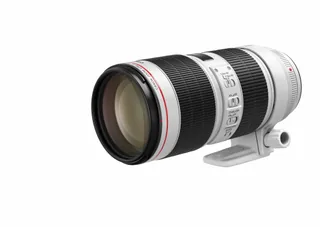
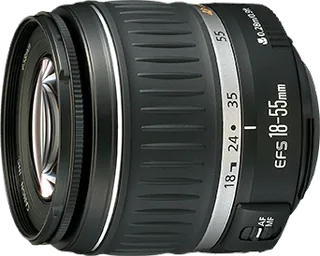
Canon EF 70–200mm f/2.8L IS III USM vs Canon EF-S 18–55mm f/3.5–5.6 USM
Better figure, where one is clearly better
| CanonEF 70–200mm f/2.8L IS III USM | CanonEF-S 18–55mm f/3.5–5.6 USM | |
|---|---|---|
| Overview | ||
| Released | September 2018 | September 2003 |
| Optics | ||
| Lens type | Zoom | Zoom |
| Focal length | 70–200 mm | 18–55 mm |
| Maximum aperture | f/2.8 | f/3.5–5.6 |
| Minimum aperture | f/32 | f/22–36 |
| Optical construction | 23 elements in 19 groups; retains the optical layout of the EF 70–200mm f/2.8L IS II USM | 11 elements in nine groups |
| Special elements | One fluorite and five UD elements | One precision aspherical element; Canon Japan identifies a PMo aspherical surface |
| Coatings | Air Sphere Coating and revised optical coatings; fluorine coating on front and rear element surfaces | – |
| Diaphragm | Eight blades with a circular aperture | Six blades with a circular aperture according to Canon Camera Museum |
| Angle of view | Diagonal 34°–12°; vertical 19°30′–7°; horizontal 29°–10° | Horizontal 64°30′–23°20′, vertical 45°30′–15°40′, diagonal 74°20′–27°50′ according to Canon Japan |
| Mount and compatibility | ||
| Mounts | Canon EF | Canon EF-S |
| Image circle | Full frame | APS-C |
| Compatibility | Canon EF mount full-frame and APS-C cameras | Canon EF-S compatible APS-C cameras; equivalent angle of view to approximately 29–88 mm on full frame |
| Teleconverter support | EF1.4X III gives 98–280 mm f/4 and 0.30× maximum magnification; EF2X III gives 140–400 mm f/5.6 and 0.44×; autofocus remains available but is slower | – |
| Focus and stabilisation | ||
| Autofocus | Yes | Yes |
| Minimum focus distance | 1.2 m | 0.28 m |
| Maximum magnification | 0.21× | 0.28× |
| Optical stabilisation | Yes | – |
| Autofocus detail | Ring-type USM; full-time manual override after One-Shot autofocus while holding the shutter button halfway | Canon Micro USM II ultrasonic motor; lens distance information is transmitted according to Canon Japan |
| Magnification detail | – | Maximum 0.28× at 55 mm; EF12 II extension tube provides 0.23–0.81× and EF25 II provides 0.51–0.92× according to Canon Japan |
| Focus distance detail | Internal focusing; maximum 0.21× magnification at 200 mm | – |
| Stabilisation detail | Up to 3.5 stops under CIPA testing at 200 mm on an EOS-1D X Mark II; Mode 1 for still subjects and Mode 2 for panning; Canon notes tripod results depend on the tripod and shooting conditions | – |
| Design | ||
| Dust and moisture resistant | Yes | – |
| Filter diameter | 77 mm | 58 mm |
| Maximum diameter | 88.8 mm | 68.5 mm |
| Length | 199 mm | 66 mm |
| Weight | 1,480 g | 190 g (better) |
| Controls | AF/MF, IS on/off and IS mode switches; focus limiter selects 1.2 m–infinity or 2.5 m–infinity | – |
| Zoom design | Internal zooming maintains physical length (Digital Camera World) | – |
| Weather resistance | Dust- and moisture-resistant construction with a rubber gasket at the mount | – |
| Dimensions detail | 88.8 mm maximum diameter × 199 mm length, measured from the mount to the lens front; add 24.2 mm for front and rear caps | 68.5 mm maximum diameter × 66 mm length; 190 g according to Canon |
| Weight detail | Approximately 1,480 g lens only according to Canon's instruction manual, UK store and Camera Museum; a Canon USA one-page specification chart instead lists approximately 1,440 g | – |
| Tripod mount | Included removable rotating B (W II) tripod mount ring; detach the lens from the camera before removing the collar | – |
| Lens hood | ET-87, with release button and reversible mounting for storage | EW-60C hood and LP814 pouch are sold separately according to Canon Japan |
| In the box | ET-87 hood and LZ1326 lens case according to the UK store; tripod mount ring included according to Canon's instruction manual | – |
| Release detail | Marketed in September 2018 according to Canon Camera Museum; Canon USA's 7 June announcement had scheduled US shipping for August 2018 | Canon Camera Museum explicitly records this USM model as sold only with the EOS Kiss Digital in September 2003. Its table records September 2004 marketing, later than that documented first kit sale |
More comparisons
- Canon EF 70–200mm f/2.8L IS III USM vs Canon RF 70-200mm F2.8L IS USM Z
- Canon EF-S 18–55mm f/3.5–5.6 USM vs Canon RF-S 18–45mm F4.5–6.3 IS STM
- Canon EF 70–200mm f/2.8L IS III USM vs Canon RF 70–200mm F2.8 L IS USM
- Canon EF 70–200mm f/2.8L IS II USM vs Canon EF 70–200mm f/2.8L IS III USM
- Canon EF 200mm f/2.8L USM vs Canon EF 70–200mm f/2.8L IS III USM
- Canon EF 200mm f/2.8L II USM vs Canon EF 70–200mm f/2.8L IS III USM
- Canon EF 70–200mm f/2.8L IS III USM vs Canon EF 70–200mm f/4L IS II USM
- Canon EF 70–200mm f/2.8L IS III USM vs Canon EF 70–200mm f/4L IS USM
- Canon EF 70–200mm f/2.8L IS III USM vs Canon EF 85mm f/1.4L IS USM
- Canon EF 70–200mm f/2.8L IS III USM vs Canon EF-S 35mm f/2.8 Macro IS STM
- Canon EF 70–200mm f/2.8L IS III USM vs Canon EF-S 18–55mm f/4–5.6 IS STM
- Canon EF 16–35mm f/2.8L III USM vs Canon EF 70–200mm f/2.8L IS III USM
- Canon EF 70–200mm f/2.8L IS III USM vs Canon EF-S 18–135mm f/3.5–5.6 IS USM
- Canon EF 24–105mm f/4L IS II USM vs Canon EF 70–200mm f/2.8L IS III USM
- Canon EF 35mm f/1.4L II USM vs Canon EF 70–200mm f/2.8L IS III USM
- Canon EF 50mm f/1.8 STM vs Canon EF 70–200mm f/2.8L IS III USM