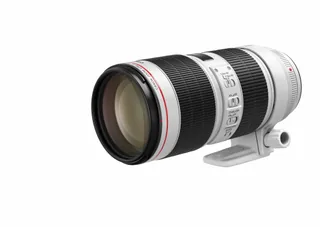
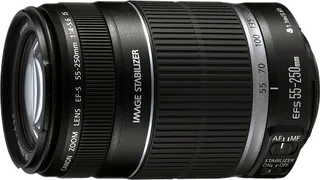
Canon EF 70–200mm f/2.8L IS III USM vs Canon EF-S 55–250mm f/4–5.6 IS
Better figure, where one is clearly better
| CanonEF 70–200mm f/2.8L IS III USM | CanonEF-S 55–250mm f/4–5.6 IS | |
|---|---|---|
| Overview | ||
| Released | September 2018 | November 2007 |
| Optics | ||
| Lens type | Zoom | Zoom |
| Focal length | 70–200 mm | 55–250 mm |
| Maximum aperture | f/2.8 | f/4–5.6 |
| Minimum aperture | f/32 | f/22–32 |
| Optical construction | 23 elements in 19 groups; retains the optical layout of the EF 70–200mm f/2.8L IS II USM | 12 elements in 10 groups |
| Special elements | One fluorite and five UD elements | UD glass element |
| Coatings | Air Sphere Coating and revised optical coatings; fluorine coating on front and rear element surfaces | Super Spectra coatings according to Canon's European announcement |
| Diaphragm | Eight blades with a circular aperture | Seven blades with a circular aperture |
| Angle of view | Diagonal 34°–12°; vertical 19°30′–7°; horizontal 29°–10° | – |
| Mount and compatibility | ||
| Mounts | Canon EF | Canon EF-S |
| Image circle | Full frame | APS-C |
| Compatibility | Canon EF mount full-frame and APS-C cameras | Canon EF-S compatible APS-C cameras; 88–400 mm equivalent field of view |
| Teleconverter support | EF1.4X III gives 98–280 mm f/4 and 0.30× maximum magnification; EF2X III gives 140–400 mm f/5.6 and 0.44×; autofocus remains available but is slower | Canon extenders cannot be used according to The Digital Picture |
| Focus and stabilisation | ||
| Autofocus | Yes | Yes |
| Minimum focus distance | 1.2 m | 1.1 m |
| Maximum magnification | 0.21× | 0.31× |
| Optical stabilisation | Yes | Yes |
| Autofocus detail | Ring-type USM; full-time manual override after One-Shot autofocus while holding the shutter button halfway | Micro Motor autofocus without full-time manual override according to The Digital Picture; focus ring rotates during autofocus |
| Focus distance detail | Internal focusing; maximum 0.21× magnification at 200 mm | Minimum focus distance 1.1 m throughout the zoom range; front element rotates during focusing according to The Digital Picture |
| Stabilisation detail | Up to 3.5 stops under CIPA testing at 200 mm on an EOS-1D X Mark II; Mode 1 for still subjects and Mode 2 for panning; Canon notes tripod results depend on the tripod and shooting conditions | Four-stop launch claim based on 1/(focal length × 1.6) shutter speed; automatic panning detection according to Canon's European announcement |
| Design | ||
| Dust and moisture resistant | Yes | – |
| Filter diameter | 77 mm | 58 mm |
| Maximum diameter | 88.8 mm | 70 mm |
| Length | 199 mm | 108 mm |
| Weight | 1,480 g | 390 g (better) |
| Controls | AF/MF, IS on/off and IS mode switches; focus limiter selects 1.2 m–infinity or 2.5 m–infinity | – |
| Zoom design | Internal zooming maintains physical length (Digital Camera World) | Barrel extends during zooming and focusing according to The Digital Picture |
| Weather resistance | Dust- and moisture-resistant construction with a rubber gasket at the mount | – |
| Dimensions detail | 88.8 mm maximum diameter × 199 mm length, measured from the mount to the lens front; add 24.2 mm for front and rear caps | Canon gives 70 mm maximum diameter × 108 mm length |
| Weight detail | Approximately 1,480 g lens only according to Canon's instruction manual, UK store and Camera Museum; a Canon USA one-page specification chart instead lists approximately 1,440 g | – |
| Tripod mount | Included removable rotating B (W II) tripod mount ring; detach the lens from the camera before removing the collar | – |
| Lens hood | ET-87, with release button and reversible mounting for storage | ET-60 hood sold separately according to The Digital Picture; LP1019 pouch also optional |
| In the box | ET-87 hood and LZ1326 lens case according to the UK store; tripod mount ring included according to Canon's instruction manual | – |
| Release detail | Marketed in September 2018 according to Canon Camera Museum; Canon USA's 7 June announcement had scheduled US shipping for August 2018 | Canon Camera Museum records November 2007 introduction. The Japanese announcement originally scheduled late October 2007 availability; this was a planned date rather than the Museum's recorded introduction. The Digital Picture tested a Canadian retail sample in November 2007 and notes the later US announcement. |
More comparisons
- Canon EF 70–200mm f/2.8L IS III USM vs Canon RF 70-200mm F2.8L IS USM Z
- Canon EF-S 55–250mm f/4–5.6 IS vs Canon RF-S 55–210mm F5–7.1 IS STM
- Canon EF 70–200mm f/2.8L IS III USM vs Canon RF 70–200mm F2.8 L IS USM
- Canon EF 70–200mm f/2.8L IS II USM vs Canon EF 70–200mm f/2.8L IS III USM
- Canon EF 200mm f/2.8L USM vs Canon EF 70–200mm f/2.8L IS III USM
- Canon EF 200mm f/2.8L II USM vs Canon EF 70–200mm f/2.8L IS III USM
- Canon EF 70–200mm f/2.8L IS III USM vs Canon EF 70–200mm f/4L IS II USM
- Canon EF 70–200mm f/2.8L IS III USM vs Canon EF 70–200mm f/4L IS USM
- Canon EF 70–200mm f/2.8L IS III USM vs Canon EF 85mm f/1.4L IS USM
- Canon EF 70–200mm f/2.8L IS III USM vs Canon EF-S 35mm f/2.8 Macro IS STM
- Canon EF 70–200mm f/2.8L IS III USM vs Canon EF-S 18–55mm f/4–5.6 IS STM
- Canon EF 16–35mm f/2.8L III USM vs Canon EF 70–200mm f/2.8L IS III USM
- Canon EF 70–200mm f/2.8L IS III USM vs Canon EF-S 18–135mm f/3.5–5.6 IS USM
- Canon EF 24–105mm f/4L IS II USM vs Canon EF 70–200mm f/2.8L IS III USM
- Canon EF 35mm f/1.4L II USM vs Canon EF 70–200mm f/2.8L IS III USM
- Canon EF 50mm f/1.8 STM vs Canon EF 70–200mm f/2.8L IS III USM