Garmin Forerunner 610 vs Garmin Forerunner 920XT
Better figure, where one is clearly better
| GarminForerunner 610 | GarminForerunner 920XT | |
|---|---|---|
| Overview | ||
| Released | April 2011 | October 2014 |
| Display | ||
| Case sizes | 45.7 mm | 48 mm |
| Panel | – | Memory-in-pixel |
| Always-on display | Yes | Yes |
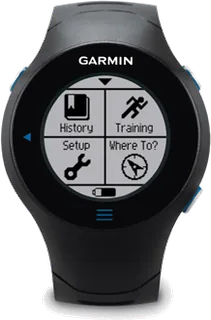
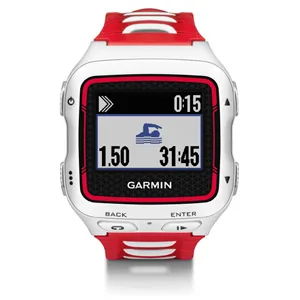
| Display detail | Backlit 25.4 mm touchscreen, 128 × 128 pixels; up to four data fields per training page. Panel technology is unpublished in the maker's specification. | 1.1 x 0.8-inch (29 x 21 mm) rectangular colour MIP display, 205 x 148 pixels, with button controls. |
| Health and fitness | ||
| ECG | No | No |
| Blood oxygen | No | No |
| Skin temperature | No | No |
| Sleep apnoea alerts | No | No |
| High blood pressure alerts | No | No |
| Body composition | No | No |
| Fall detection | No | No |
| Crash detection | No | No |
| GPS | Single-band | Single-band |
| Water resistance | – | 50 m |
| Sensors | High-sensitivity GPS receiver and ANT+ support for heart-rate straps, foot pods, GSC 10 cycling sensors, weight scales and compatible fitness equipment. No optical wrist sensor. | GPS, GLONASS, barometric altimeter and accelerometer. Heart rate requires an optional ANT+ sensor. |
| Health features | – | Steps, distance, calories and sleep tracking; no wrist optical heart-rate sensor. |
| Fitness features | Training Effect, Virtual Partner, Virtual Racer, interval and custom workouts, run/walk alerts, Auto Lap, Auto Pause and Auto Scroll; vibration alerts for pace, heart rate, time and distance. | Running, cycling, pool and open-water swimming, and multisport activities; swim stroke and SWOLF metrics, race predictor and VO2 max with an external heart-rate sensor. Running dynamics require an HRM-Run strap. |
| Safety features | Navigate to a stored location or back to the start; no base maps. | – |
| Battery and connections | ||
| Battery life (maker's claim) | Up to 8 hours | Up to 24 hours |
| In low-power mode | Up to 28 days | – |
| Mobile data option | No | No |
| Works with | No phone pairing | iPhone and Android |
| Battery life detail | Rechargeable 200 mAh lithium-ion battery; up to eight hours with GPS, four weeks in power-save mode or one week with forty-five minutes of GPS training each day. | Up to 24 hours using GPS alone, 20 hours with GPS and GLONASS or 40 hours in UltraTrac. Garmin's manual also says up to one month in watch mode with activity tracking and over four months in watch-only mode; the main battery figure uses the exact 24-hour GPS claim because a month has no fixed hour count. |
| Charging | Magnetic contact cradle with USB power. | Rechargeable lithium-ion battery with charging/data cradle. |
| Connectivity | ANT+ wireless computer uploads through the included USB ANT stick; Garmin Connect and Garmin Training Center. No direct phone pairing. | Bluetooth, ANT+ and Wi-Fi; smart notifications, Garmin Connect automatic uploads, LiveTrack through a paired phone and VIRB camera control. Connect IQ support arrived in a later software update. |
| Storage | Up to 1,000 laps and 100 saved locations. | Stores 100 hours of activity history and up to 100 waypoints. |
| Design | ||
| Weight (lightest version) | 72 g | 61 g (better) |
| Software | Garmin | Garmin |
| Case materials | IPX7 immersion protection, one metre for thirty minutes; the owner's manual says it is not intended for swimming. | Hinged band and 5 ATM water rating. |
| Size | 45.7 × 63.5 × 14.2 mm without the strap; 72 g. Width is used as the case size. | 48 x 55 x 12.7 mm; 61 g. |
| Colours | – | White case with red band. |
| Bands | Replaceable wrist strap; optional fabric strap. | – |
| In the box | Watch, AC adapter, USB charging cradle, USB ANT stick and documentation; heart-rate strap included in some bundles. | – |
More comparisons
- Garmin Forerunner 170 vs Garmin Forerunner 920XT
- Garmin Forerunner 170 Music vs Garmin Forerunner 920XT
- Garmin Forerunner 70 vs Garmin Forerunner 920XT
- Garmin Forerunner 170 vs Garmin Forerunner 610
- Garmin Forerunner 170 Music vs Garmin Forerunner 610
- Garmin Forerunner 610 vs Garmin Forerunner 70
- Garmin Forerunner 610 vs Garmin Forerunner 970
- Garmin Forerunner 570 vs Garmin Forerunner 920XT
- Garmin Forerunner 920XT vs Garmin Forerunner 970
- Garmin Forerunner 570 vs Garmin Forerunner 610
- Garmin Forerunner 165 vs Garmin Forerunner 920XT
- Garmin Forerunner 165 Music vs Garmin Forerunner 920XT
- Garmin Forerunner 165 vs Garmin Forerunner 610
- Garmin Forerunner 165 Music vs Garmin Forerunner 610
- Garmin Forerunner 265 vs Garmin Forerunner 920XT
- Garmin Forerunner 265 vs Garmin Forerunner 610