Hisense E8Q vs Samsung LED F6400
Better figure, where one is clearly better
| HisenseE8Q | SamsungLED F6400 | |
|---|---|---|
| Overview | ||
| Released | 2025 | 2013 |
| Display | ||
| Panel | Mini-LED | LED LCD |
| Panel detail | ULED MiniLED (quantum dot LCD) with a Mini-LED backlight and full-array local dimming | Edge-lit LCD on the 40-inch HDTVTest sample. Samsung's family manual supports active 3D on 40-inch and larger models; its 200 Clear Motion Rate is not native refresh. |
| Resolution | 3840 × 2160 (4K) (better) | 1920 × 1080 (Full HD) |
| Refresh rate | 144 Hz | – |
| HDR formats | Dolby Vision, HDR10, HDR10+, HLG | None |
| HDR extras | Dolby Vision IQ, HDR10+ Adaptive | – |
| Colour range | Quantum Dot Colour; wide colour gamut | – |
| Picture processing | Hi-View AI Engine, AI HDR Upscaler, 4K upscaling, MEMC, MPEG and mosquito noise reduction, AI Light Sensor, AI Sports Mode; Calman Ready | HDTVTest identifies 200 Clear Motion Rate, without the higher Series 7's Micro Dimming, on its 40-inch UK model. Samsung's older online specification table is empty. |
| Picture modes | Filmmaker Mode; 144Hz Game Mode PRO; eye-care mode | HDTVTest's 40-inch set offers Movie mode, two- and ten-point white balance, colour management and separate blur and judder controls. |
| Motion handling | AI Smooth Motion (MEMC); panel response time 6 ms (50″, 55″), 6.5 ms (65″) or 8 ms (75″) (Hisense) | Native panel refresh is unpublished in the checked maker manual. HDTVTest found forced interpolation on 3D Blu-ray films in its 40-inch test, with judder when defeated using Game Mode. |
| Viewing angle | 178° | HDTVTest observed colour and contrast washout beyond about 45 degrees off-axis on its 40-inch sample. |
| Sizes | ||
| Sizes | 50, 55, 65, 75″ | 32, 40, 46, 50, 55, 65, 75″ |
| Largest size | 75″ | 75″ |
| Gaming | ||
| HDMI ports | 4 (2 HDMI 2.1 at 4K 120 Hz+) (better) | 4 (0 HDMI 2.1 at 4K 120 Hz+) |
| Variable refresh rate | HDMI VRR, FreeSync Premium | None |
| Auto low latency mode | Yes | No |
| HDMI detail | 4 × HDMI 2.1 with ALLM; HDMI 1 and 2 4K 60Hz with VRR up to 60 Hz; HDMI 3 (eARC) and HDMI 4 4K 144Hz with VRR | Four HDMI sockets, component, composite and RGB SCART on the 40-inch UK set (HDTVTest and What Hi-Fi). The maker manual confirms HDMI-CEC; exact high-bandwidth features are not claimed. |
| Variable refresh range | Up to 144 Hz | – |
| Input lag | ≤ 7 ms with a 4K 120 Hz input (Hisense) | 45 ms in Game Mode and 43 ms with the HDMI input labelled PC on the 40-inch sample, measured using a Leo Bodnar tester (HDTVTest). |
| Game features | AMD FreeSync Premium, Game Bar, Dolby Vision Gaming, HDR10+ Gaming | Manual Game Mode; no variable refresh or automatic low-latency switching. |
| Smart TV and sound | ||
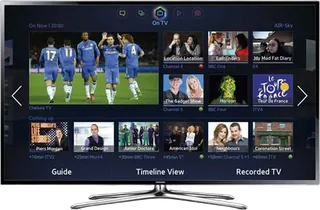
| Smart TV platform | VIDAA | Samsung Smart TV |
| Processor | Hi-View AI Engine | Dual-core smart processor on the reviewed 40-inch model (HDTVTest) |
| Speakers | 40 W, 2.1 channels | – |
| Dolby Atmos | Yes | – |
| eARC | Yes | No |
| Wi-Fi | Wi-Fi 5 (802.11ac, 2.4/5 GHz) | Wi-Fi 802.11a/b/g/n |
| Bluetooth | Yes | – |
| Speaker detail | 2 × 10 W plus a 20 W subwoofer, 2.1 ch | Samsung's UK family manual lists two 10 W speakers on 32-, 40-, 46-, 50-, 55- and 65-inch models, and two 15 W speakers on 75 inches. |
| Audio features | Dolby Atmos, DTS Virtual:X; Hi-Concerto, EzPlay, TV mode; WiSA SoundSend; user equaliser | – |
| Voice assistants | Voice control via the remote | Samsung's original Voice Recognition; What Hi-Fi found it limited and inconsistent in its 2014 test. |
| Casting | AirPlay 2; screen sharing; DMP/DMR content sharing | Screen Mirroring in Samsung's UK family manual. |
| Software updates | Software and firmware updates for at least 8 years (Hisense) | – |
| TV tuners | 2 × RF; DVB-T2/T/C/S2/S; CI+ 2.0 | Freeview HD on the reviewed 40-inch UK set (HDTVTest and What Hi-Fi). |
| USB | 1 × USB 2.0, 1 × USB 3.0 | Three USB ports on the reviewed 40-inch set (HDTVTest and What Hi-Fi). |
| Ethernet | 1 × RJ45 | Wired LAN connection in Samsung's UK family manual. |
| Optical audio out | 1 × S/PDIF; composite AV input, audio L/R input and headphone output | Optical digital output on the reviewed 40-inch set (What Hi-Fi). |
| Design and power | ||
| Size | Without stand, 50″ 1111 × 647 × 78 mm; 55″ 1226 × 711 × 78 mm; 65″ 1446 × 836 × 76 mm; 75″ 1668 × 961 × 86 mm | Width × height × depth without stands from Samsung's UK manual: 32-inch 738.2 × 437 × 49.5 mm; 40-inch 928.2 × 543.8 × 49.6 mm; 46-inch 1059.8 × 617.7 × 49.6 mm; 50-inch 1135.6 × 659.6 × 49.8 mm; 55-inch 1250.4 × 724.6 × 48.8 mm; 65-inch 1470.1 × 848.2 × 55.9 mm; 75-inch 1678.8 × 960 × 57 mm. Configuration weights exclude stands. |
| Stand | Single metal and plastic pedestal, 400 × 288 mm (50″, 55″), 401 × 326 mm (65″) or 431 × 374 mm (75″); cable management on 65″ and 75″ | Samsung's UK manual specifies 20 degrees of swivel each way on 32- to 65-inch models, and no swivel on 75 inches. |
| VESA pattern | 50″ 300 × 200 mm; 55″ 400 × 200 mm; 65″ 400 × 400 mm; 75″ 600 × 400 mm | Samsung's UK manual lists 200 × 200 mm for 32 and 40 inches, and 400 × 400 mm for 46 to 75 inches. |
| In the box | – | Smart Touch and standard remotes with batteries, IR extension cable, CI adaptor, power cord and instructions. The maker manual includes active 3D glasses only for 40-inch and larger models. |
| Power use | Maximum 160 W (50″), 180 W (55″), 240 W (65″), 330 W (75″); 0.5 W standby | – |
| Energy class | SDR: E; HDR: G | – |
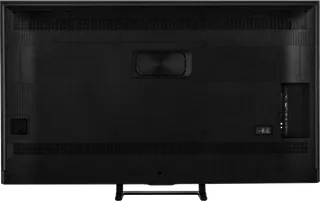
| Colours | Black/dark grey | – |
| Warranty | 2 years (UK) | – |
More comparisons
- Hisense E8Q vs Hisense E8S
- Hisense E8Q vs Hisense U7S Pro
- Samsung LED F6400 vs Samsung OLED S90H
- Samsung LED F6400 vs Samsung Neo QLED QN80H
- Hisense E8Q vs Hisense U8Q
- Hisense E8Q vs Samsung LED F8000
- Hisense E8Q vs Samsung LED H6400
- Hisense E8Q vs Hisense U7Q
- Hisense E8Q vs TCL C745K
- Hisense E8Q vs Samsung QLED Q90T (2020)
- Hisense E8Q vs Samsung QLED Q90R (2019)
- Hisense E8Q vs Sony BRAVIA XF90
- Hisense E8Q vs Samsung QLED Q8DN (2018)
- Hisense E8Q vs Samsung QLED Q9FN (2018)
- Hisense E8Q vs Samsung QLED Q7F (2017)
- Hisense E8Q vs Samsung SUHD KS8000