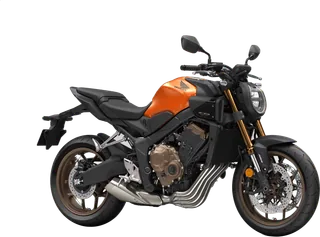
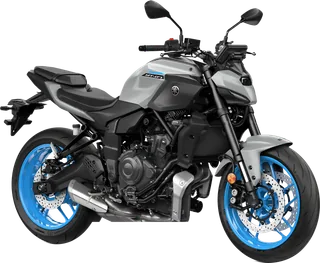
Honda CB650R (2024 generation) vs Yamaha MT-07 (2025)
Better figure, where one is clearly better
| HondaCB650R (2024 generation) | YamahaMT-07 (2025) | |
|---|---|---|
| Overview | ||
| Released | 2024 | 2025 |
| Engine and transmission | ||
| Powertrain | Petrol | Petrol |
| Engine capacity | 649 cc | 689 cc |
| Cylinders | 4 | 2 |
| Power | 70 kW | 54 kW |
| Torque | 63 Nm | 68 Nm |
| Engine details | Liquid-cooled, four-stroke, DOHC 16-valve inline four; 67 × 46 mm bore and stroke; 11.6:1 compression ratio; PGM-FI electronic injection. | Liquid-cooled four-stroke DOHC CP2 parallel twin; four valves per cylinder; 80.0 × 68.6 mm bore and stroke; 11.5:1 compression; electronic fuel injection, wet-sump lubrication and electric starting. UK capacity is 689 cc; the Japanese announcement lists 688 cm³ for its regional model. |
| Power details | 70 kW at 12,000 rpm. | Maximum 54.0 kW (73.4 PS) at 8,750 rpm. |
| Torque details | 63 Nm at 9,500 rpm. | Maximum 68.0 Nm (6.9 kgf-m) at 6,500 rpm. |
| Gearbox | Six-speed manual gearbox; optional E-Clutch operates the clutch when starting, stopping and shifting, while the rider selects gears with the foot pedal. The clutch lever remains usable and E-Clutch can be disabled. | Six-speed constant-mesh manual transmission; accessory quickshifter. Y-AMT uses actuators for clutch and gear changes, with finger-operated manual selection or automatic shifting. |
| Clutch | Wet multiplate assist/slipper clutch on the standard manual. The optional E-Clutch system adds electronic clutch actuation; upshift and downshift pedal resistance have independent Hard, Medium and Soft settings. | Wet multiplate clutch; assist and slipper clutch on the manual model. Y-AMT has no rider-operated clutch lever or foot shift pedal. |
| Final drive | Chain. | Chain. |
| Restricted versions | Maker-supported 35 kW A2 option; Honda's European specification table lists 49 Nm for the restricted version. | Yamaha's current full-power UK specification and UK fact sheets list the limited-power field as n/a; other European regional sheets list 35 kW variants. Restricted-version figures are not substituted for the UK full-power configurations. |
| Chassis and dimensions | ||
| Style | Naked | Naked |
| Seat height | 810 mm | 805 mm |
| Road-ready weight | 205 kg | 183 kg |
| Frame | Steel diamond frame with pressed swingarm-pivot plates and twin elliptical spars. | Diamond frame; 2025 redesign includes revised frame and swingarm and lighter SpinForged wheels. |
| Front suspension | 41 mm Showa Separate Function Fork Big Piston upside-down fork. | 41 mm upside-down telescopic fork; 130 mm travel. The maker does not claim front adjustment in this specification; Autotrader's preload-adjustable fork description is not adopted. |
| Rear suspension | Direct-action monoshock with ten-step spring-preload adjustment and cast aluminium swingarm. The maker's 43.5 mm figure is shock stroke, not rear-wheel travel. | Linked swingarm suspension; 130 mm travel; rear shock adjustable for preload and rebound damping. |
| Brakes | Twin 310 × 4.5 mm front discs with radial-mount four-piston calipers; 240 × 5 mm rear disc with single-piston caliper; two-channel ABS. | Two hydraulically operated 298 mm front discs with radially mounted four-piston calipers; one hydraulically operated 245 mm rear disc; ABS. |
| Wheels and tyres | Cast aluminium hollow-section five-spoke wheels; 17 × MT3.5 front and 17 × MT5.5 rear rims; 120/70 ZR17 M/C (58W) front and 180/55 ZR17 M/C (73W) rear tyres. | SpinForged wheels; Dunlop Sportmax Q5A original tyres; front 120/70ZR17 M/C (58W) and rear 180/55ZR17 M/C (73W), both tubeless. |
| Geometry | 1,450 mm wheelbase; 25.5-degree rake; 100 mm trail; 150 mm ground clearance; 2.8 m turning radius. | 24°20′ caster angle; 93 mm trail; 1,395 mm wheelbase; 150 mm minimum ground clearance. |
| Dimensions | 2,120 × 780 × 1,075 mm (length × width × height). | 2,065 × 780 × 1,110 mm overall length, width and height. |
| Weight conditions | European 24YM and 26YM press specifications publish 205 kg standard manual kerb weight and 207 kg with E-Clutch. The current UK E-Clutch table instead publishes 205.8 kg, used for that configuration. The cited tables do not specify fuel-fill percentage; no dry weight is used. | Maker wet weight includes a full oil supply and full fuel tank; 183 kg standard manual and 186 kg Y-AMT. |
| Fuel and range | ||
| Fuel tank | 15.4 litres | 14 litres |
| Fuel consumption | 4.9 litres/100 km (WMTC); Honda also publishes 20.4 km/l. Consumption varies with riding conditions, load, tyre pressure and maintenance. | Maker fuel-consumption claim 4.1 L/100 km; no calculated tank range. |
| Emissions | Current UK specification 112 g/km CO₂; European press technical tables publish 113 g/km (WMTC). | 97 g/km CO₂; EU5+ CP2 engine. |
| Equipment | ||
| ABS | Yes | Yes |
| Traction control | Yes | Yes |
| Rider aids | Switchable Honda Selectable Torque Control and two-channel ABS. E-Clutch supports automatic clutch operation while retaining manual override. | YCC-T electronic throttle and switchable traction control. Conventional cruise control is available only on Y-AMT according to both UK fact sheets; adaptive cruise control is not fitted. Autotrader's claim of optional manual-model cruise is not adopted. |
| Riding modes | – | Yamaha Ride Control offers two throttle maps and a customisable mode; settings include traction-control intervention. |
| Display | Five-inch colour TFT with Bar, Circle and Simple layouts; backlit four-way handlebar control. | Five-inch TFT display. |
| Connectivity | Honda RoadSync smartphone connection for on-screen navigation and other functions; USB-C socket under the seat. Calls, music and voice features require a compatible Bluetooth helmet headset. Honda's 24YM release prose describes USB-C, although its technical table says USB: No; the 26YM prose again describes the socket. | MyRide smartphone connectivity and Garmin StreetCross on-screen navigation, as listed in the UK fact sheet; Japanese Y-Connect branding is not substituted. |
| Lighting | LED headlight, rear light and other lighting. | LED headlight; self-cancelling indicators and revised switchgear. |
| Equipment and options | Heated grips, luggage, flyscreen, seat cover and under cowl are optional. The accessory quickshifter is for the conventional manual version, not E-Clutch. HISS immobiliser. | Acoustic intake-sound amplification; manual and Y-AMT versions share this 2025 hardware generation. Paint choices are not separate models. |
| Release and generation details | The 2024 update introduced revised headlight, radiator shrouds, seats and tail, the five-inch TFT and optional E-Clutch. Honda's November 2025 retrospective confirms the E-Clutch models first launched in 2024; exact first-sale month for this European generation is unconfirmed. Honda's 26YM release confirms unchanged engine and chassis hardware with a revised colour palette. | Fourth-generation redesign for model year 2025, retained in the current UK range. Yamaha's 4 February 2025 Japanese announcement scheduled domestic launch for 26 February; that regional planned day does not establish the earliest worldwide retail day. Year precision is retained. Current UK specifications and imagery describe the 2025 generation, rather than a separate later paint refresh. |
More comparisons
- Honda CB650R (2024 generation) vs Triumph Trident 660 (2026)
- Triumph Trident 660 (2026) vs Yamaha MT-07 (2025)
- Yamaha MT-07 (2025) vs Yamaha MT-09 (2024)
- Honda CB750 Hornet (2025 generation) vs Yamaha MT-07 (2025)
- Honda CB650R (2024 generation) vs Honda CB750 Hornet (2025 generation)
- Honda CB650R (2024 generation) vs Yamaha MT-09 (2024)
- BMW R 1300 GS vs Honda CB650R (2024 generation)
- BMW R 1250 GS vs Honda CB650R (2024 generation)