Intel Core i3-13100F vs Intel Core i5-3570K
Better figure, where one is clearly better
| IntelCore i3-13100F | IntelCore i5-3570K | |
|---|---|---|
| Overview | ||
| Released | January 2023 | April 2012 |
| Cores and clocks | ||
| Cores | 4 (4 performance, 0 efficiency) | 4 |
| Threads | 8 (better) | 4 |
| Base clock | 3.4 GHz | 3.4 GHz |
| Boost clock | 4.5 GHz (better) | 3.8 GHz |
| L3 cache | 12 MB (better) | 6 MB |
| Cores | Four P-cores and no E-cores; Hyper-Threading supported. | Four cores without Hyper-Threading; Intel Turbo Boost 2.0 supported. Intel VT-x supported; VT-d is not supported on this model. |
| Clocks | CPU multiplier locked (Intel support). Current Intel specifications list 110 W maximum turbo power; the January 2023 maker launch table and Tom's Hardware list 89 W. ComputerBase also reports 110 W. | Maximum turbo is a single-core frequency; sustained clocks and overclocking depend on motherboard support and cooling. Intel publishes TDP without a separate maximum turbo-power figure. |
| Cache | 12 MB Intel Smart Cache (L3); 5 MB total L2. | – |
| Graphics and AI | ||
| Built-in graphics | No | Yes |
| Graphics | No integrated graphics; a separate graphics card is required (Intel support). | Intel HD Graphics 4000; 650 MHz base, up to 1.15 GHz; three displays; Quick Sync Video. Intel's launch information identifies DirectX 11 support; available outputs depend on the motherboard. |
| AI engine | Intel Gaussian & Neural Accelerator 3.0; Intel Deep Learning Boost on CPU supported. | – |
| Platform | ||
| Socket | LGA1700 | LGA1155 |
| Base power | 58 W | 77 W |
| Maximum power | 110 W | – |
| Unlocked | No | Yes |
| Cooler in the box | Yes | – |
| Memory support | Current Intel specifications support up to 192 GB; two channels; DDR5-4800 or DDR4-3200; 76.8 GB/s maximum bandwidth. The January 2023 launch table lists 128 GB. | Up to 32 GB; two channels; DDR3-1333/1600; 25.6 GB/s maximum bandwidth; ECC not supported. |
| PCIe | PCIe 5.0 and 4.0; 20 CPU lanes, configured as 1×16+4 or 2×8+4; DMI 4.0 ×8. | PCIe 3.0; configurations up to 1×16, 2×8 or 1×8+2×4, as listed by Intel. Motherboard support determines available slot configurations. |
| Process | Intel 7; marketed as Raptor Lake. ComputerBase identifies the H0 Alder Lake die used by the Core i3-12100F. 45 × 37.5 mm package; 100°C maximum junction temperature. | 22 nm; Ivy Bridge; 3D tri-gate transistors; 37.5 × 37.5 mm package; 67.4°C Tcase limit, not a junction-temperature limit. |
| Cooler | Boxed retail processor includes Intel Laminar RM1 (Intel support). | LGA1155-compatible cooling required. Intel announced the quad-core family on 23 April 2012; Ars Technica's contemporaneous launch report quotes Newegg confirming retail sale on 29 April. The archived maker sale notice could not be read, so the day is supported by named secondary retail coverage. |
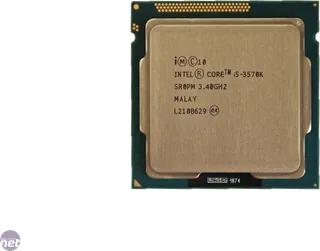
More comparisons
- Intel Core i3-13100F vs Intel Core i9-14900KS
- Intel Core i5-3570K vs Intel Core i9-14900KS
- Intel Core i3-13100F vs Intel Core i5-14400F
- Intel Core i3-13100F vs Intel Core i5-14500
- Intel Core i5-14400F vs Intel Core i5-3570K
- Intel Core i5-14500 vs Intel Core i5-3570K
- Intel Core i3-13100F vs Intel Core i5-14600K
- Intel Core i3-13100F vs Intel Core i7-14700K
- Intel Core i3-13100F vs Intel Core i9-14900K
- Intel Core i5-14600K vs Intel Core i5-3570K
- Intel Core i5-3570K vs Intel Core i7-14700K
- Intel Core i5-3570K vs Intel Core i9-14900K
- Intel Core i3-13100F vs Intel Core i9-13900KS
- Intel Core i5-3570K vs Intel Core i9-13900KS
- AMD Ryzen 5 7600 vs Intel Core i3-13100F
- Intel Core i3-12100F vs Intel Core i3-13100F