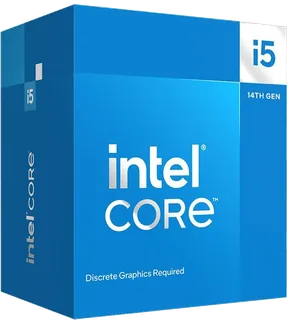
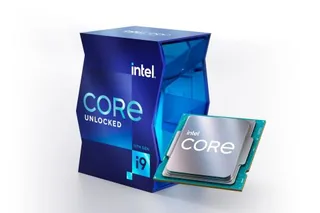
Intel Core i5-14400F vs Intel Core i9-11900K
Better figure, where one is clearly better
| IntelCore i5-14400F | IntelCore i9-11900K | |
|---|---|---|
| Overview | ||
| Released | January 2024 | March 2021 |
| Cores and clocks | ||
| Cores | 10 (6 performance, 4 efficiency) (better) | 8 |
| Threads | 16 | 16 |
| Base clock | 2.5 GHz | 3.5 GHz |
| Boost clock | 4.7 GHz | 5.3 GHz (better) |
| L3 cache | 20 MB (better) | 16 MB |
| Cores | 6 Performance-cores and 4 Efficient-cores, with Hyper-Threading; codename Raptor Lake | Hyper-Threading, Turbo Boost Max 3.0, Thermal Velocity Boost, AVX-512 and Deep Learning Boost supported. General retail sale began 30 March 2021, according to Intel's sales-embargo statement reported by Windows Central; the 16 March maker press release was the announcement. |
| Clocks | P-core base 2.5 GHz, max turbo 4.7 GHz; E-core base 1.8 GHz, max turbo 3.5 GHz | Up to 5.3 GHz with Thermal Velocity Boost at its 70°C temperature threshold; up to 5.2 GHz with Turbo Boost Max 3.0, or 5.1 GHz with Turbo Boost 2.0. Configurable TDP-down to 95 W with a 3 GHz base clock. Adaptive Boost Technology raises all-core clocks when power and thermal conditions allow (PC Gamer). Tom's Hardware reports 250 W PL2; the current Intel specification page publishes TDP only. |
| Cache | 20 MB Intel Smart Cache (L3); 9.5 MB L2 | – |
| Graphics and AI | ||
| Built-in graphics | No | Yes |
| Graphics | None; a graphics card is required | Intel UHD Graphics 750; 32 execution units; 350 MHz base, up to 1.3 GHz; up to 64 GB shared graphics memory; three displays. HDMI up to 4096×2160 at 60 Hz; DisplayPort up to 5120×3200 at 60 Hz; Quick Sync Video supported. |
| AI engine | – | Intel Gaussian & Neural Accelerator 2.0; Deep Learning Boost on the CPU. |
| Platform | ||
| Socket | LGA1700 | LGA1200 |
| Base power | 65 W | 125 W |
| Maximum power | 148 W | – |
| Unlocked | No | Yes |
| Cooler in the box | – | No |
| Memory support | Up to DDR5 4800 MT/s or up to DDR4 3200 MT/s; 2 channels, up to 192 GB | Up to 128 GB; two channels; DDR4-3200; 50 GB/s maximum bandwidth; ECC not supported. Tom's Hardware identifies DDR4-3200 Gear 1 as officially supported on the Core i9 models. |
| PCIe | PCIe 5.0 and 4.0; 20 lanes (Up to 1x16+4, 2x8+4); DMI 4.0 x8 | PCIe 4.0; 20 CPU lanes, configured as 1×16+1×4, 2×8+1×4 or 1×8+3×4. |
| Process | Intel 7 | 14 nm; Rocket Lake; 37.5 × 37.5 mm package; 100°C maximum junction temperature. Cypress Cove CPU architecture (Intel launch announcement). |
| Cooler | max operating temperature 100 °C; thermal specification PCG 2020C | No cooler included with the boxed processor (Tom's Hardware exact-model review). |
More comparisons
- AMD Ryzen 7 9700X vs Intel Core i5-14400F
- Intel Core i5-14400F vs Intel Core i9-14900KS
- Intel Core i9-11900K vs Intel Core i9-14900KS
- AMD Ryzen 5 8500G vs Intel Core i5-14400F
- AMD Ryzen 7 8700G vs Intel Core i5-14400F
- Intel Core i5-11400F vs Intel Core i5-14400F
- Intel Core i5-12400F vs Intel Core i5-14400F
- Intel Core i5-13400F vs Intel Core i5-14400F
- Intel Core i5-14400F vs Intel Core i5-14500
- Intel Core i5-14400F vs Intel Core i5-14600K
- Intel Core i5-14400F vs Intel Core i7-14700K
- Intel Core i5-14400F vs Intel Core i9-14900K
- Intel Core i5-14400F vs Intel Core i9-13900KS
- Intel Core i3-13100F vs Intel Core i5-14400F
- AMD Ryzen 9 7900 vs Intel Core i5-14400F
- Intel Core i5-13600K vs Intel Core i5-14400F