AMD Ryzen 5 8500G vs Intel Core i5-14400F
Better figure, where one is clearly better
| AMDRyzen 5 8500G | IntelCore i5-14400F | |
|---|---|---|
| Overview | ||
| Released | January 2024 | January 2024 |
| Cores and clocks | ||
| Cores | 6 | 10 (6 performance, 4 efficiency) (better) |
| Threads | 12 | 16 (better) |
| Base clock | 3.5 GHz | 2.5 GHz |
| Boost clock | 5 GHz (better) | 4.7 GHz |
| L3 cache | 16 MB | 20 MB (better) |
| Cores | Two Zen 4 and four Zen 4c cores; both support simultaneous multithreading. AMD names the family Phoenix; TechPowerUp identifies the smaller monolithic Phoenix 2 die. | 6 Performance-cores and 4 Efficient-cores, with Hyper-Threading; codename Raptor Lake |
| Clocks | AMD lists 3.5 GHz overall base; Zen 4 base 4.1 GHz, boost up to 5 GHz; Zen 4c base 3.3 GHz, boost up to 3.7 GHz. CPU multiplier locked in TechPowerUp testing; Precision Boost Overdrive, Curve Optimizer and EXPO supported. Configurable TDP 45–65 W. | P-core base 2.5 GHz, max turbo 4.7 GHz; E-core base 1.8 GHz, max turbo 3.5 GHz |
| Cache | 6 MB L2; 16 MB shared L3. | 20 MB Intel Smart Cache (L3); 9.5 MB L2 |
| Graphics and AI | ||
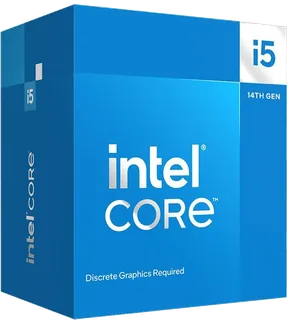
| Built-in graphics | Yes | No |
| Graphics | Radeon 740M; RDNA 3; four graphics cores at 2800 MHz; up to four displays; DisplayPort 2.1 and HDMI 2.1; hardware AV1 encode and decode. | None; a graphics card is required |
| AI engine | No dedicated Ryzen AI NPU (TechPowerUp and Phoronix). | – |
| Platform | ||
| Socket | AM5 | LGA1700 |
| Base power | 65 W | 65 W |
| Maximum power | – | 148 W |
| Unlocked | No | No |
| Memory support | DDR5 UDIMM; two channels; AMD lists maximum DDR5 capacity of 96 GB; ECC requires platform support. Two single- or dual-rank DIMMs: DDR5-5200; four single- or dual-rank DIMMs: DDR5-3600. | Up to DDR5 4800 MT/s or up to DDR4 3200 MT/s; 2 channels, up to 192 GB |
| PCIe | PCIe 4.0; 14 native lanes, 10 usable; graphics slot limited to ×4 (TechPowerUp). Two native USB4 40 Gbps, two USB 3.2 Gen 2 10 Gbps and one USB 2.0 port. | PCIe 5.0 and 4.0; 20 lanes (Up to 1x16+4, 2x8+4); DMI 4.0 x8 |
| Chipsets | AMD lists A620, X670E, X670, B650E, B650, X870E, X870, B840 and B850; motherboard firmware support required. | – |
| Process | TSMC 4nm FinFET; 137 mm² CPU compute die; one package die. | Intel 7 |
| Cooler | 95°C maximum operating temperature. Retail review package includes an air cooler (TechPowerUp); check the exact retail or tray bundle. | max operating temperature 100 °C; thermal specification PCG 2020C |

More comparisons
- AMD Ryzen 5 8500G vs AMD Ryzen 9 9950X3D2 Dual Edition
- AMD Ryzen 5 8500G vs AMD Ryzen 7 9850X3D
- AMD Ryzen 5 8500G vs AMD Ryzen 9 9950X3D
- AMD Ryzen 5 8500G vs AMD Ryzen 5 9600
- AMD Ryzen 5 8500G vs AMD Ryzen 7 9800X3D
- AMD Ryzen 5 8500G vs AMD Ryzen 9 9900X
- AMD Ryzen 5 8500G vs AMD Ryzen 9 9950X
- AMD Ryzen 5 8500G vs AMD Ryzen 5 9600X
- AMD Ryzen 7 9700X vs Intel Core i5-14400F
- Intel Core i5-14400F vs Intel Core i9-14900KS
- AMD Ryzen 5 8500G vs AMD Ryzen 7 8700G
- AMD Ryzen 5 8500G vs AMD Ryzen 5 8600G
- AMD Ryzen 5 5600 vs AMD Ryzen 5 8500G
- AMD Ryzen 5 7600 vs AMD Ryzen 5 8500G
- AMD Ryzen 5 8500G vs Intel Core i5-12400F
- AMD Ryzen 5 5600G vs AMD Ryzen 5 8500G