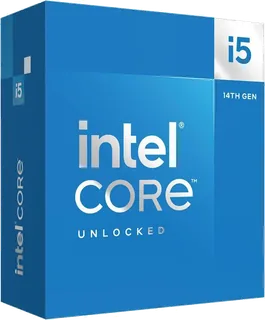
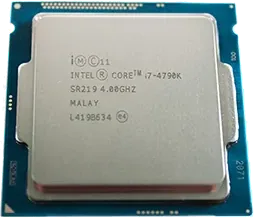
Intel Core i5-14600K vs Intel Core i7-4790K
Better figure, where one is clearly better
| IntelCore i5-14600K | IntelCore i7-4790K | |
|---|---|---|
| Overview | ||
| Released | October 2023 | June 2014 |
| Cores and clocks | ||
| Cores | 14 (6 performance, 8 efficiency) (better) | 4 |
| Threads | 20 (better) | 8 |
| Base clock | 3.5 GHz | 4 GHz |
| Boost clock | 5.3 GHz (better) | 4.4 GHz |
| L3 cache | 24 MB (better) | 8 MB |
| Cores | 6 Performance-cores and 8 Efficient-cores, with Hyper-Threading; codename Raptor Lake | Four cores with Hyper-Threading; Intel Turbo Boost 2.0 supported. The current maker page lists Transactional Synchronization Extensions as unsupported, superseding early review specifications. |
| Clocks | P-core base 3.5 GHz, max turbo 5.3 GHz; E-core base 2.6 GHz, max turbo 4 GHz | Maximum turbo is a single-core frequency; overclocking requires an appropriate motherboard and cooling. Intel publishes TDP without a separate maximum turbo-power figure. |
| Cache | 24 MB Intel Smart Cache (L3); 20 MB L2 | – |
| Graphics and AI | ||
| Built-in graphics | Yes | Yes |
| Graphics | Intel UHD Graphics 770, 32 execution units, up to 1.55 GHz; outputs eDP 1.4b, DP 1.4a, HDMI 2.1; up to 4 displays | Intel HD Graphics 4600; 20 execution units; 350 MHz base, up to 1.25 GHz; three displays; Quick Sync Video. HDMI up to 3840×2160 at 24 Hz; DisplayPort and eDP up to 3840×2160 at 60 Hz; VGA up to 1920×1200 at 60 Hz. |
| Platform | ||
| Socket | LGA1700 | LGA1150 |
| Base power | 125 W | 88 W |
| Maximum power | 181 W | – |
| Unlocked | Yes | Yes |
| Memory support | Up to DDR5 5600 MT/s or up to DDR4 3200 MT/s; 2 channels, up to 192 GB; ECC supported | Up to 32 GB; two channels; DDR3-1333/1600 or DDR3L-1333/1600 at 1.5 V, as listed by Intel; 25.6 GB/s maximum bandwidth; ECC not supported. |
| PCIe | PCIe 5.0 and 4.0; 20 lanes (Up to 1x16+4, 2x8+4); DMI 4.0 x8 | PCIe 3.0; 16 CPU lanes, configured as 1×16, 2×8 or 1×8+2×4. |
| Chipsets | Intel 600 and 700 series | – |
| Process | Intel 7 | 22 nm; Devil's Canyon, a Haswell refresh; 37.5 × 37.5 mm package; 74.04°C Tcase limit, not a junction-temperature limit. New polymer thermal interface and additional capacitors, described in Intel's Computex launch coverage and the exact-model reviews. |
| Cooler | max operating temperature 100 °C; thermal specification PCG 2020A | Intel lists both ordinary boxed and explicitly fanless boxed SKUs; cooler contents should be checked for the particular package. Compatible Intel 8- and 9-series chipsets require the appropriate motherboard BIOS. Intel's June 2014 fact sheet confirms volume availability that month; the announcement itself is not used as the on-sale day. |
More comparisons
- Intel Core i5-14600K vs Intel Core Ultra 5 245K
- AMD Ryzen 9 9900X vs Intel Core i5-14600K
- Intel Core i5-14600K vs Intel Core i9-14900KS
- Intel Core i7-4790K vs Intel Core i9-14900KS
- Intel Core i5-14500 vs Intel Core i5-14600K
- Intel Core i5-14400F vs Intel Core i5-14600K
- Intel Core i5-14400F vs Intel Core i7-4790K
- Intel Core i5-14500 vs Intel Core i7-4790K
- AMD Ryzen Threadripper PRO 7945WX vs Intel Core i5-14600K
- Intel Core i5-12600K vs Intel Core i5-14600K
- Intel Core i5-13600K vs Intel Core i5-14600K
- Intel Core i5-14600K vs Intel Core i5-4670K
- Intel Core i5-14600K vs Intel Core i5-4690K
- Intel Core i5-14600K vs Intel Core i5-6600K
- Intel Core i5-14600K vs Intel Core i5-7600K
- Intel Core i5-14600K vs Intel Core i7-5820K