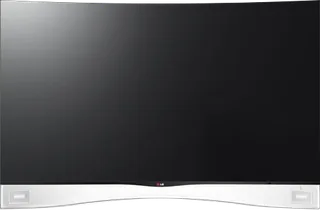
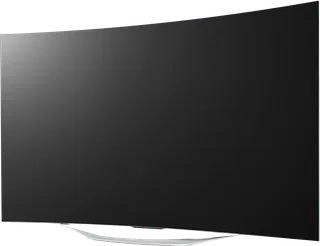
LG OLED EA9800 vs LG OLED EC9300
Better figure, where one is clearly better
| LGOLED EA9800 | LGOLED EC9300 | |
|---|---|---|
| Overview | ||
| Released | April 2013 | August 2014 |
| Display | ||
| Panel | OLED | OLED |
| Panel detail | Curved WRGB OLED with passive Cinema 3D | Curved WRGB OLED with passive Cinema 3D |
| Resolution | 1920 × 1080 (Full HD) | 1920 × 1080 (Full HD) |
| HDR formats | None | None |
| Picture processing | Resolution Upscaler Plus, Real Cinema 24p and ISF Expert picture modes | – |
| Motion handling | Native panel refresh rate is not established by the exact maker tables; no marketing motion rate is substituted. | Native panel refresh is not established by the exact maker tables; unlimited MCI and Absolute Motion Clarity are marketing descriptions, not native Hz. |
| Sizes | ||
| Sizes | 55″ | 55″ |
| Largest size | 55″ | 55″ |
| Gaming | ||
| HDMI ports | 4 (0 HDMI 2.1 at 4K 120 Hz+) | 4 (0 HDMI 2.1 at 4K 120 Hz+) |
| Variable refresh rate | None | None |
| HDMI detail | Four HDMI inputs; MHL support | Four HDMI inputs, three side and one rear; ARC on the rear input and MHL support reported by AVForums |
| Input lag | 55 ms in Game mode (HDTVTest); 54 ms (AVForums). Both measured roughly 138 ms in the calibrated ISF picture mode. | 39 ms in PC mode and 49 ms in Game mode (HDTVTest); 41 ms and 52 ms respectively (AVForums), both on firmware 04.32.20 |
| Smart TV and sound | ||
| Smart TV platform | NetCast | webOS |
| Processor | Triple XD Engine | – |
| Speakers | 2.0 channels | 40 W |
| Wi-Fi | Built-in Wi-Fi | Built-in Wi-Fi |
| Speaker detail | Maker Clear Speaker system with 10 W + 10 W + 10 W + 10 W output, a two-channel arrangement and subwoofer; Norway describes a three-way eight-speaker system | 40 W output. LG Czech specifies no subwoofer, while AVForums describes a 2.1-channel system; channel count is omitted because the sources conflict. |
| Audio features | Dolby Digital and DTS decoding | Dolby Digital and DTS decoding; LG wireless sound synchronisation |
| Casting | Miracast, DLNA, WiDi, Wi-Fi Direct, NFC and LG Cloud | DLNA, MHL and LG Cloud; Miracast and WiDi reported by AVForums |
| Software updates | NetCast 4.0, explicitly named by LG Norway. LG Finland labels the same EA980W as webOS, conflicting with Norway and the original UK reviews. LG's July 2013 retrospective states that curved OLED sales began in Korea in April; this is the global sale month, rather than the later UK introduction. | Launched with the original webOS Smart+ interface; the retained LG Czech page now says webOS 2.0. LG's syndicated August 27 2014 release states the US EC9300 was on sale that month, supporting August first-sale precision without treating the earlier promised August 24 day as independently confirmed delivery. |
| TV tuners | DVB-T2, DVB-C and DVB-S2; two RF inputs and CI slot. Composite, component and SCART inputs are also specified. | DVB-T2, DVB-C and DVB-S2, with CI slot; UK Freeview HD and satellite reception confirmed by AVForums. Analogue composite, component and SCART inputs are specified by LG. |
| USB | Three USB inputs, two USB 2.0 and one USB 3.0, with USB hub support | Three side USB 2.0 inputs with hub support; no USB 3.0 |
| Ethernet | Ethernet LAN port | Ethernet LAN port |
| Optical audio out | Optical digital audio output and headphone output | Optical digital audio and side headphone outputs |
| Design and power | ||
| Size | – | Without stand (W × H × D): 1225 × 715 × 80 mm, from LG's exact EC930V Dutch specification |
| Stand | LG publishes only the complete fixed-stand dimensions and weight: 1227 × 798.5 × 192 mm (W × H × D), 17.2 kg. No panel-only weight is assigned. UK reviews identify the stand as non-removable and the TV as unsuitable for conventional wall mounting. | With stand (W × H × D): 1225 × 753 × 204 mm; 16.4 kg. The stand is detachable and does not swivel; wall mounting is supported, per AVForums. |
| Power use | 97 W on-mode; below 0.3 W standby; 146 kWh annual energy use in the maker's original energy table | 106 W on-mode in the maker energy table; 0.3 W standby; Dutch maker supply 220–240 V, 50/60Hz |
| In the box | – | Magic Remote and conventional remote; UK reviews identify two pairs of passive 3D glasses plus two clip-ons. LG's Dutch accessory table instead lists three pairs plus one clip-on, a regional package difference. |
More comparisons
- LG OLED EA9800 vs LG OLED evo C6
- LG OLED EC9300 vs LG OLED evo C6
- LG OLED B6 vs LG OLED EC9300
- LG OLED B6 vs LG OLED EA9800
- Hisense A85Q vs LG OLED EC9300
- Hisense A85Q vs LG OLED EA9800
- LG OLED B5 vs LG OLED EC9300
- LG OLED B5 vs LG OLED EA9800
- LG OLED B4 vs LG OLED EC9300
- LG OLED EC9300 vs LG OLED evo G4
- LG OLED B4 vs LG OLED EA9800
- LG OLED EA9800 vs LG OLED evo G4
- LG OLED B3 vs LG OLED EC9300
- LG OLED B3 vs LG OLED EA9800
- LG OLED EA9800 vs Panasonic MZ980
- LG OLED EC9300 vs Panasonic MZ980