LG OLED EA9800 vs Sony XEL-1
Better figure, where one is clearly better
| LGOLED EA9800 | SonyXEL-1 | |
|---|---|---|
| Overview | ||
| Released | April 2013 | December 2007 |
| Display | ||
| Panel | OLED | OLED |
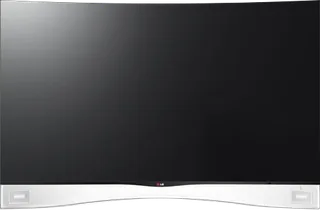
| Panel detail | Curved WRGB OLED with passive Cinema 3D | Sony Organic Panel; screen approximately 3 mm at its thinnest point, with electronics in the integral base |
| Resolution | 1920 × 1080 (Full HD) (better) | 960 × 540 |
| HDR formats | None | None |
| Picture processing | Resolution Upscaler Plus, Real Cinema 24p and ISF Expert picture modes | – |
| Motion handling | Native panel refresh rate is not established by the exact maker tables; no marketing motion rate is substituted. | – |
| Sizes | ||
| Sizes | 55″ | 11″ |
| Largest size | 55″ (better) | 11″ |
| Gaming | ||
| HDMI ports | 4 (0 HDMI 2.1 at 4K 120 Hz+) | 2 (HDMI 2.1 count unpublished) |
| Variable refresh rate | None | None |
| HDMI detail | Four HDMI inputs; MHL support | UK model accepts 1080p and 24p over HDMI; all inputs are scaled to the 960 × 540 panel. Original Japanese version has one HDMI input, unlike the UK version's two. |
| Input lag | 55 ms in Game mode (HDTVTest); 54 ms (AVForums). Both measured roughly 138 ms in the calibrated ISF picture mode. | – |
| Smart TV and sound | ||
| Smart TV platform | NetCast | None (no smart platform) |
| Processor | Triple XD Engine | – |
| Speakers | 2.0 channels | 2.4 W |
| Wi-Fi | Built-in Wi-Fi | – |
| Speaker detail | Maker Clear Speaker system with 10 W + 10 W + 10 W + 10 W output, a two-channel arrangement and subwoofer; Norway describes a three-way eight-speaker system | UK specification lists 1.2 W + 1.2 W; original Japanese model is rated 1 W + 1 W under JEITA conditions |
| Audio features | Dolby Digital and DTS decoding | – |
| Casting | Miracast, DLNA, WiDi, Wi-Fi Direct, NFC and LG Cloud | – |
| Software updates | NetCast 4.0, explicitly named by LG Norway. LG Finland labels the same EA980W as webOS, conflicting with Norway and the original UK reviews. LG's July 2013 retrospective states that curved OLED sales began in Korea in April; this is the global sale month, rather than the later UK introduction. | – |
| TV tuners | DVB-T2, DVB-C and DVB-S2; two RF inputs and CI slot. Composite, component and SCART inputs are also specified. | UK model has analogue terrestrial, digital terrestrial and cable tuners; Japanese launch version instead has Japanese terrestrial, BS and 110-degree CS digital tuners |
| USB | Three USB inputs, two USB 2.0 and one USB 3.0, with USB hub support | USB 2.0 input with photo viewer (UK specification) |
| Ethernet | Ethernet LAN port | – |
| Optical audio out | Optical digital audio output and headphone output | Optical digital audio output (UK specification) |
| Design and power | ||
| Size | – | UK model including its integral stand is 287 × 255 × 147 mm (width × height × depth); original Japanese model is 287 × 253 × 140 mm |
| Stand | LG publishes only the complete fixed-stand dimensions and weight: 1227 × 798.5 × 192 mm (W × H × D), 17.2 kg. No panel-only weight is assigned. UK reviews identify the stand as non-removable and the TV as unsuitable for conventional wall mounting. | Built-in tilting table stand |
| Colours | – | Piano black |
| In the box | – | UK model includes RM-ED015 remote commander, AC cable and operating instructions |
| Power use | 97 W on-mode; below 0.3 W standby; 146 kWh annual energy use in the maker's original energy table | – |
More comparisons
- LG OLED EA9800 vs LG OLED evo C6
- LG OLED B6 vs LG OLED EA9800
- Sony BRAVIA 8 II vs Sony XEL-1
- Hisense A85Q vs LG OLED EA9800
- LG OLED B5 vs LG OLED EA9800
- LG OLED B4 vs LG OLED EA9800
- LG OLED EA9800 vs LG OLED evo G4
- LG OLED B3 vs LG OLED EA9800
- LG OLED EA9800 vs Panasonic MZ980
- LG OLED B2 vs LG OLED EA9800
- LG OLED C1 vs LG OLED EA9800
- LG OLED EA9800 vs LG OLED evo G1
- LG OLED EA9800 vs LG OLED EG9100
- LG OLED EG9100 vs Sony XEL-1
- LG OLED EA9800 vs LG OLED EC9300
- LG OLED EC9300 vs Sony XEL-1