LG UltraGear OLED 45GX950A vs Samsung Odyssey Neo G9 G95NC
Better figure, where one is clearly better
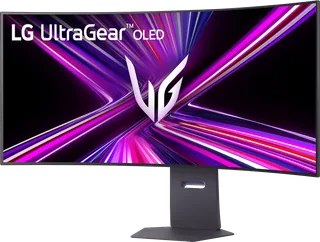
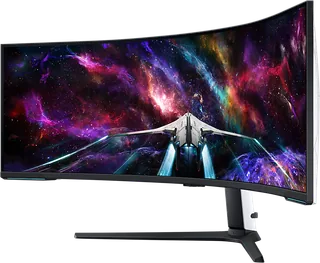
| LGUltraGear OLED 45GX950A | SamsungOdyssey Neo G9 G95NC | |
|---|---|---|
| Overview | ||
| Released | April 2025 | 2023 |
| Display | ||
| Screen size | 44.5″ | 57″ |
| Resolution | 5120 × 2160 (5K2K) | 7680 × 2160 (DUHD) (better) |
| Sharpness | 125 pixels per inch | 140 pixels per inch (better) |
| Panel | OLED (LG Display WOLED with RGWB subpixels; dual mode 2560 × 1080 at 330 Hz (TFTCentral, from LG)) | VA (VA with Quantum Mini LED backlight) |
| Refresh rate | 165 Hz | 240 Hz (better) |
| Response time (grey to grey) | 0.03 ms (better) | 1 ms |
| Brightness (typical) | 275 nits | 420 nits (better) |
| HDR peak brightness | – | 1,000 nits |
| HDR certification | DisplayHDR True Black 400 | DisplayHDR 1000 |
| HDR formats | HDR10 | HDR10+ Gaming |
| Contrast ratio | 1,500,000:1 | 2,500:1 |
| Colour range | 98.5% DCI-P3 (typical) | 95% DCI-P3 |
| DCI-P3 coverage | 98.5% (better) | 95% |
| Dimming zones | – | 2,392 |
| Shape | Curved (800R) | Curved (1000R) |
| Adaptive sync | FreeSync Premium Pro, G-Sync Compatible | FreeSync Premium Pro |
| Subpixel layout | RGWB (TFTCentral) | – |
| Colour depth | 10-bit, 1.07 billion colours | Up to 1 billion colours |
| Colour modes | Reader Mode, Colour Weakness mode; HDR Effect | Entertain, Graphic, Eco, Game Standard, FPS, RTS, RPG, Sports, Original and Custom |
| HDR detail | HDR10; VESA DisplayHDR True Black 400 | Quantum Mini LED local dimming with 2392 zones; 1000-nit peak brightness stated in Samsung's launch release; HDR10+ Gaming |
| Viewing angles | 178° / 178° | 178° horizontal and vertical |
| Eye care | – | Eye Saver Mode, Flicker Free and UL-certified Glare Free |
| Pixel pitch | 0.2035 × 0.2035 mm | – |
| Calibration | Factory calibrated; hardware calibration ready (LG Calibration Studio) | Factory tuning with calibration report |
| Connections | ||
| Video inputs | 2 × HDMI 2.1, DisplayPort 2.1, USB-C | 3 × HDMI 2.1, DisplayPort 2.1 |
| USB-C charging | Up to 90 W (better) | None |
| USB ports | 2 × USB-A | 2 × USB-A |
| KVM switch | – | Yes |
| Speakers | Yes | No |
| HDMI detail | 2 × HDMI 2.1 (1.8 m cable included) | 3 x HDMI 2.1; HDMI 1 is limited to 7680 x 2160 at 120Hz in Samsung's manual; full DUHD 240Hz requires HDMI 2.1 FRL 6 support on the graphics card |
| DisplayPort detail | DisplayPort 2.1 with DSC (cable included) | 1 x DisplayPort 2.1; full DUHD 240Hz requires UHBR 13.5 support on the graphics card |
| USB-C detail | USB-C with video up to 5120 × 2160 at 165 Hz, data and 90 W power delivery; also the USB upstream port | – |
| USB hub detail | 2 × USB 3.0 downstream | Two USB-A downstream ports and two USB-B upstream ports; Samsung lists USB 3.0 and its manual states compatibility with USB 2.0 upstream cables |
| Picture by picture | PIP; 2-way PBP | Picture in picture and picture by picture |
| Audio out | 4-pole headphone out (sound and mic), DTS Headphone:X | Headphone output |
| Speaker detail | 2 × 10 W, Rich Bass | – |
| Design | ||
| Stand adjusts | Height, tilt, swivel | Height, tilt, swivel |
| VESA mount | Yes | Yes |
| Weight with stand | 14 kg | 19 kg |
| Height adjustment | – | 120 mm, ± 5 mm tolerance |
| Tilt | – | -3° to +10° |
| Swivel | – | -15° to +15° |
| VESA pattern | 100 × 100 mm | 100 x 100 mm |
| Size with stand | 991.6 × 342 × 545.6–665.6 mm (W × D × H) | 1327.5 x 499.6 x 601 mm (W x D x H) |
| Size without stand | 991.6 × 225.5 × 460.7 mm (W × D × H) | 1327.5 x 338.4 x 429.5 mm (W x D x H) |
| Weight without stand | 9.4 kg | 15.4 kg |
| Colours | – | Black front and stand, white rear; Core Lighting+ and CoreSync |
| Controls | 4-way joystick; user-defined key; auto input switch; dual controller; Unity Hexagon Lighting | – |
| Power and support | ||
| Power use | Less than 0.5 W sleep, less than 0.3 W off | 59 W typical; 300 W maximum; 0.5 W standby; 0.3 W off |
| Energy class | – | G |
| Power supply | External adapter, 20 V / 18 A output, 100–240 V input | Internal; AC 100–240V, 50/60Hz |
| In the box | HDMI 2.1 cable, DisplayPort 2.1 cable, USB-C cable, power adapter and cord, mouse holder | HDMI cable, DisplayPort cable, USB 3.0 cable and 1.5 m power cable |
More comparisons
- LG UltraGear evo GX9 (39GX950B) vs LG UltraGear OLED 45GX950A
- Dell Alienware 39 5K OLED (AW3926QW) vs LG UltraGear OLED 45GX950A
- Samsung Odyssey Neo G9 G95NC vs Samsung Odyssey OLED G8 32″ (G80SH)
- LG UltraGear OLED GX7 (27GX790B) vs LG UltraGear OLED 45GX950A
- Dell UltraSharp 52 Thunderbolt Hub (U5226KW) vs Samsung Odyssey Neo G9 G95NC
- Samsung Odyssey G7 G75F (37″) vs Samsung Odyssey Neo G9 G95NC
- LG UltraGear OLED 34GX900A vs LG UltraGear OLED 45GX950A
- Samsung Odyssey Neo G9 G95NC vs Samsung Odyssey OLED G6 (G60SF)
- LG UltraGear OLED 27GX700A vs LG UltraGear OLED 45GX950A
- LG UltraGear OLED 45GX950A vs Samsung Odyssey G9 (G91F)
- Samsung Odyssey G9 (G91F) vs Samsung Odyssey Neo G9 G95NC
- Samsung Odyssey Neo G9 G95NC vs Samsung Odyssey OLED G8 G81SF 27-inch
- LG UltraGear OLED 45GX950A vs Samsung Odyssey OLED G9 G95SC
- LG UltraGear 27G850A-B vs LG UltraGear OLED 45GX950A
- LG UltraGear OLED GX7 (27GX790A) vs LG UltraGear OLED 45GX950A
- LG UltraGear OLED 32GS95UE vs LG UltraGear OLED 45GX950A