Logitech Anywhere Mouse MX vs Logitech MX Master 4
Better figure, where one is clearly better
| LogitechAnywhere Mouse MX | LogitechMX Master 4 | |
|---|---|---|
| Overview | ||
| Released | August 2009 | October 2025 |
| Tracking | ||
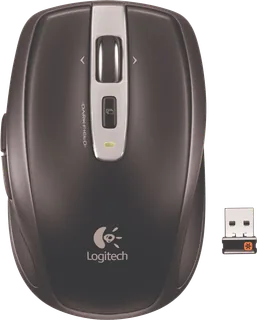
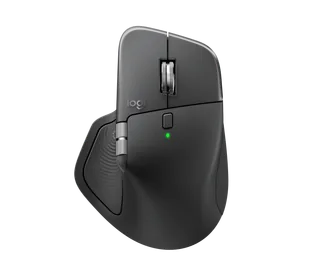
| Shape | Compact | Ergonomic |
| Hand | Right hand | Right hand |
| Sensitivity | – | Up to 8,000 DPI |
| Sensor | Darkfield laser | Darkfield high precision |
| Buttons | 7 | 8 (better) |
| Free-spinning wheel | Yes | Yes |
| Thumb wheel | No | Yes |
| Quiet clicks | – | Yes |
| Sensor | Darkfield laser tracking on many surfaces, including clear glass at least 4 mm thick. Logitech's launch sources do not give a DPI figure. | 200–8,000 DPI, adjustable in 50 DPI steps (1,000 DPI by default); tracks on almost any surface, including glass; 125 Hz report rate over Logi Bolt and Bluetooth |
| Scroll wheel | Press the wheel to switch between stepped and free-spinning vertical scrolling; tilt it for horizontal scrolling. | MagSpeed electromagnetic wheel with SmartShift, which switches between ratchet and free-spin as you scroll faster; up to 1,000 lines a second; adjustable ratchet force |
| Thumb wheel | No separate thumb wheel; the two left-side buttons navigate back and forward. | Aluminium thumb wheel for horizontal scrolling; app-specific functions such as zoom or brush size in Logi Options+ |
| Gestures | – | Gesture button next to the back and forward buttons (hold it and move the mouse; up to five actions); Actions Ring shortcut overlay opened from the Haptic Sense Panel |
| Haptic feedback | – | Haptic Sense Panel under the thumb; feedback for the Actions Ring, Smart Actions, gestures, moving between screens and app plugins including Adobe Photoshop, Adobe Lightroom Desktop and Zoom; four intensity levels; also works with Windows 11's built-in haptics (Windows 11 update from March 2026 or later) |
| Connections and battery | ||
| Connects by | USB receiver | Bluetooth and USB receiver |
| Devices it switches between | – | 3 |
| Power | AA battery | Rechargeable |
| Battery life (maker's claim) | Up to 7 months | Up to 70 days |
| Charging port | – | USB-C |
| Receiver | Logitech Unifying nano receiver over 2.4 GHz, with a compartment inside the battery cover for storage; one receiver can pair with up to six compatible devices. | Logi Bolt USB-C receiver in the box (USB-A Bolt receivers also work); the Mac version works with Logi Bolt but comes without a receiver |
| Charging | Two replaceable AA alkaline batteries, rated by Logitech support for up to seven months; the mouse can also run on one AA battery. | USB-C; a 1-minute charge gives 3 hours of use; 650 mAh battery; charging cable not included |
| Works with | At launch, Windows XP, Vista or 7 and Mac OS X 10.4 or later with a USB port. | Bluetooth Low Energy 5.1 with Windows 11 or later, macOS 13 or later, iPadOS 15 or later, Android 12 or later, Linux and ChromeOS; Logi Bolt with Windows 10, 11 or later, macOS 13 or later, Linux and ChromeOS; the Mac version lists macOS 13 or later and iPadOS 15 or later |
| Software | Logitech SetPoint on Windows and Logitech Control Center on Mac supported button configuration at launch. | Logi Options+ on Windows and macOS (Actions Ring, Smart Actions, haptics, Logitech Flow); basic support in Logi Tune; basic functions work without software on other systems |
| Design | ||
| Weight | 125 g (better) | 150 g |
| Size | 90.5 × 63 × 34.5 mm (length × width × height); 125 g with two AA batteries according to Logitech's 2009 fact sheet. | 128.15 × 88.35 × 50.8 mm (length × width × height) |
| Materials | – | Plastics with 54% (Graphite, Space Black) or 48% (Pale Grey, White Silver) certified post-consumer recycled content; thumb wheel of low-carbon aluminium; battery with 100% recycled cobalt |
| Colours | – | Graphite, Pale Grey; Mac version in Space Black, White Silver |
| In the box | Mouse, Unifying receiver, travel pouch, two AA batteries and documentation. | Mouse, Logi Bolt USB-C receiver, documentation; the Mac version has the mouse and documentation only |
| Warranty | Three-year limited warranty in Logitech's launch fact sheet. | 2-year limited hardware warranty |
More comparisons
- Logitech MX Master 3S vs Logitech MX Master 4
- Logitech MX Master vs Logitech MX Master 4
- Logitech MX Master 2S vs Logitech MX Master 4
- Logitech MX Master 3 vs Logitech MX Master 4
- Logitech MX Master 4 vs Logitech MX Revolution
- Logitech MX Master 4 vs Logitech Performance Mouse MX
- Logitech MX Master 4 vs Logitech MX1000 Laser Cordless Mouse
- Logitech MX Master 4 vs Logitech MX700 Cordless Optical Mouse
- Logitech MX Master 4 vs Logitech VX Nano Cordless Laser Mouse for Notebooks
- Logitech MX Anywhere 3S vs Logitech MX Master 4
- Logitech MX Anywhere 2S vs Logitech MX Master 4
- Apple Wireless Mighty Mouse vs Logitech MX Master 4
- Apple Magic Mouse 2 (Lightning) vs Logitech MX Master 4
- Logitech MX Master 4 vs ZOWIE EC2-DW
- Logitech MX Master 4 vs Razer Basilisk V3 Pro 35K
- Logitech MX Master 4 vs Razer DeathAdder V4 Pro