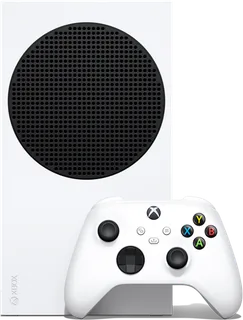
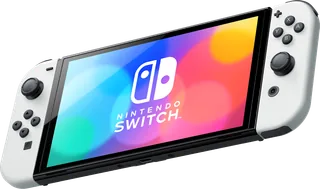
Microsoft Xbox Series S vs Nintendo Switch – OLED Model
Better figure, where one is clearly better
| MicrosoftXbox Series S | NintendoSwitch – OLED Model | |
|---|---|---|
| Overview | ||
| Released | November 2020 | October 2021 |
| Performance | ||
| Type | Home console | Hybrid |
| CPU | AMD Zen 2, 8 cores | NVIDIA customised Tegra processor |
| GPU | AMD RDNA 2 | NVIDIA customised Tegra processor (integrated GPU) |
| GPU compute | 4 TFLOPS | – |
| Memory | 10 GB (better) | 4 GB |
| Storage | 512 GB, 1 TB (better) | 64 GB |
| Disc drive | No | No |
| CPU | 8 cores, custom Zen 2 with SMT | NVIDIA customised Tegra processor (the 16 nm "Mariko" Tegra X1 revision, according to Digital Foundry) |
| GPU | 20 compute units at 1.565 GHz, custom RDNA 2 | – |
| Memory detail | 10 GB GDDR6 on a 128-bit bus; 8 GB at 224 GB/s and 2 GB at 56 GB/s | 4 GB (Digital Foundry; not published by Nintendo) |
| Storage detail | Custom NVMe SSD; I/O throughput 2.4 GB/s raw, 4.8 GB/s compressed (hardware decompression) | 64 GB; part is reserved for the system |
| Storage expansion | 1 TB Storage Expansion Cards for Xbox Series X|S match internal SSD performance (sold separately); USB 3.1 external hard drives | microSD, microSDHC and microSDXC cards |
| Display and video | ||
| Maximum output | 1440p up to 120 fps | 1080p up to 60 fps |
| Built-in screen | – | 7″ OLED, 1280 × 720 |
| Built-in screen | – | Capacitive touch screen; 7-inch OLED; 1280 × 720; brightness sensor. Nintendo doesn't publish the refresh rate |
| Video output | HDMI 2.1; gaming at 1440p with upscaling to 4K, up to 120 fps; 4K video streaming | HDMI through the dock in TV mode; up to 1920 × 1080 at 60 fps; 1280 × 720 in handheld and tabletop modes |
| HDR | HDR | – |
| Variable refresh rate | HDMI Variable Refresh Rate and AMD FreeSync; Auto Low Latency Mode | – |
| Audio | Dolby Digital 5.1, DTS 5.1, Dolby TrueHD with Atmos, up to 7.1 L-PCM | Stereo speakers; linear PCM 5.1ch over HDMI in TV mode; 3.5 mm headset jack |
| Design and power | ||
| Battery life (maker's claim) | – | Up to 9 hours |
| Weight | 1,930 g | 420 g (better) |
| Battery life detail | – | About 4.5 to 9 hours depending on the game (about 5.5 hours in The Legend of Zelda - Breath of the Wild); 4310 mAh; charges in about 3 hours. Console alone weighs about 320 g |
| Power use | – | TV mode 6 W while gaming; handheld 4 W while gaming |
| Colours | Robot White (512 GB and 1 TB), Carbon Black (1 TB) | White; Neon Blue/Neon Red |
| In the box | Console, Xbox Wireless Controller, Ultra High Speed HDMI cable, power cord | – |
| Connections | ||
| Ports | 1 × HDMI 2.1, 3 × USB 3.1 Gen 1, Gigabit Ethernet, Storage Expansion Card slot | USB-C on the console (charging and dock); dock has 2 × USB 2.0, HDMI and LAN |
| Wi-Fi and Bluetooth | Wi-Fi 802.11ac dual band; dedicated dual-band Xbox Wireless radio for accessories | Wi-Fi 5 (IEEE 802.11 a/b/g/n/ac), Bluetooth 4.1; wired LAN through the dock in TV mode |
| Controller | Xbox Wireless Controller; works with Xbox One controllers and accessories | Detachable Joy-Con (L) and (R) |
| Backward compatibility | Thousands of digital games across four generations of Xbox; disc-based games aren't supported | Nintendo Switch game cards only |
More comparisons
- Nintendo Switch 2 vs Nintendo Switch – OLED Model
- Nintendo Switch – OLED Model vs Sony PlayStation Portal
- Microsoft Xbox Series S vs Sony PlayStation 5 Slim
- Nintendo New 2DS XL vs Nintendo Switch – OLED Model
- Nintendo Switch vs Nintendo Switch – OLED Model
- Nintendo Switch Lite vs Nintendo Switch – OLED Model
- Microsoft Xbox Series S vs Sony PlayStation 5
- Microsoft Xbox Series S vs Microsoft Xbox Series X
- Microsoft Xbox One X vs Microsoft Xbox Series S
- Microsoft Xbox One S vs Microsoft Xbox Series S
- Microsoft Xbox One vs Microsoft Xbox Series S
- Microsoft Xbox 360 vs Microsoft Xbox Series S
- Microsoft Xbox vs Microsoft Xbox Series S