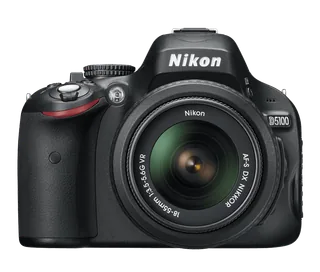
Nikon D5100 vs Nikon Z50II
Better figure, where one is clearly better
| NikonD5100 | NikonZ50II | |
|---|---|---|
| Overview | ||
| Released | April 2011 | November 2024 |
| Image and sensor | ||
| Camera type | DSLR | Mirrorless |
| Sensor format | APS-C | APS-C |
| Sensor type | CMOS | CMOS |
| Sensor dimensions | 23.6 × 15.6 mm | 23.5 × 15.7 mm |
| Effective resolution | 16.2 MP | 20.9 MP |
| Largest image | 4928 × 3264 | 5568 × 3712 |
| RAW recording | Yes | Yes |
| Standard ISO range | 100–6400 | 100–51200 |
| Sensor detail | Nikon DX CMOS with 16.2 million effective and 16.9 million total pixels; approximately 1.5× lens focal-length equivalent; sensor cleaning, Airflow Control System and Image Dust Off reference data | 21.51 million total pixels; Japanese exact specification gives 20.88 million effective, rounded to 20.9 on Nikon UK. Image-dust-off reference data requires NX Studio. |
| Image formats | Compressed 14-bit NEF RAW, JPEG and simultaneous RAW plus JPEG; maximum 4928 × 3264 pixels; customisable Picture Controls and in-camera RAW processing | 14-bit NEF RAW with lossless or high-efficiency compression; JPEG and HEIF; RAW plus JPEG or HEIF |
| ISO detail | ISO 100–6400 in one-third stops, expandable up to ISO 25600 equivalent; Auto ISO; Night Vision is a separate monochrome special effect | Standard still-image ISO 100–51200, expandable to equivalent ISO 204800; HLG starts at ISO 400. Movie ISO 100–25600, with N-Log-specific limits. |
| Image processor | EXPEED 2 | EXPEED 7 |
| Lens and shooting | ||
| Lens mount | Nikon F mount | Nikon Z mount |
| Stabilisation | Optical lens stabilisation | Optical lens stabilisation |
| Maximum continuous burst | 4 fps | 30 fps |
| Lens detail | Autofocus with AF-S and AF-I lenses; no body autofocus motor for screw-drive lenses. Non-CPU lenses require manual exposure without metering; IX and F3AF lenses unsupported | NIKKOR Z FX and DX lenses; FX lenses have a DX field-of-view crop. F-mount NIKKOR lenses require an adapter and retain model-dependent restrictions. |
| Autofocus | Multi-CAM 1000; 11 phase-detection points including one cross-type; -1 to +19 EV at ISO 100, 20°C; AF-S/AF-C/AF-A, single-point, dynamic, auto-area and 11-point 3D tracking. Contrast-detection live view supports face, wide, normal and subject-tracking areas | Hybrid phase/contrast detection; 209 single-point or 231 auto-area positions, nine subject types, 3D tracking and AF-A. Nikon's −9 EV sensitivity uses AF-S, ISO 100, an f/1.2 lens and 20°C. |
| Shutter | 1/4000 to 30 seconds in one-third or half stops, Bulb and Time with optional ML-L3 remote; flash sync 1/200 second | Mechanical, electronic front-curtain and electronic; 1/4000 to 30 seconds plus Bulb/Time, extendable to 900 seconds in manual mode. Flash sync up to 1/250 second with reduced guide number above 1/200; Auto FP supported. |
| Burst detail | Approximately 4 fps with manual focus, S/M exposure, 1/250 second or faster and remaining settings at defaults; quiet release and interval-timer shooting | Extended continuous shooting approximately 11 fps, or 15 fps silent; ordinary high approximately 5.6 fps, rising to 9.7 fps silent without RAW. C15/C30 high-speed capture with pre-release capture reaches 30 fps for JPEGs, not RAW. |
| Stabilisation detail | Optical VR depends on the lens; no sensor-shift stabilisation | No sensor-shift stabilisation; optical stabilisation depends on a VR lens. Electronic video VR adds a crop. |
| Flash | Built-in pop-up flash; guide number approximately 12 m at ISO 100, 20°C, or 13 at manual full output; accessory shoe | Manual pop-up flash, guide number approximately 7 at ISO 100 in metres; i-TTL and ISO 518 accessory shoe |
| Exposure controls | P/S/A/M, Auto, scene and special-effects modes; 420-pixel RGB matrix, centre-weighted and spot metering; ±5 EV compensation; three-frame exposure/white-balance bracketing, two-frame Active D-Lighting bracketing and two-exposure HDR | Auto, P/S/A/M and scene modes; ±5 EV still-image or ±3 EV movie compensation |
| Video | ||
| Highest video resolution | 1920 × 1080 at 30 fps | 3840 × 2160 at 60 fps |
| Video detail | H.264 MOV at Full HD 30p/25p/24p, 720p 30p/25p/24p or 640 × 424 at 30p/25p; actual NTSC rates 29.97/23.976; maximum approximately 20 minutes or three minutes with Miniature Effect. Photography Blog's 1920 × 1280, Motion JPEG AVI and five-minute passages differ from Nikon's technical sheet | UHD 3840 × 2160 up to 60p, with additional crop at 50/60p; full-width DX UHD up to 30p is oversampled from 5.6K. Full HD up to 120p; H.265 8/10-bit and H.264, N-Log and HLG, waveform, timecode, tally lamp, Product Review mode and Full HD Hi-Res Zoom. Maker recording limit 125 minutes, subject to conditions; no internal RAW video listed. |
| Audio | Built-in mono microphone with adjustable sensitivity; external stereo microphone through 3.5 mm input; linear PCM audio | Built-in stereo microphones; PCM 48 kHz/24-bit for MOV or AAC 48 kHz/16-bit for MP4; external microphone and headphone monitoring |
| Screen and viewfinder | ||
| Viewfinder | Optical | Electronic |
| Screen size | 3″ | 3.2″ |
| Screen dots | 921,000 | 1,040,000 |
| Touchscreen | – | Yes |
| Tilting screen | Yes | Yes |
| Display detail | Side-hinged 3-inch vari-angle TFT, approximately 921000 dots globally, rounded to 920000 in Japan; 170° viewing angle and 100% coverage; dots count subpixels | Vari-angle TFT, approximately 100% coverage and 170° viewing angle; dots count subpixels |
| Viewfinder detail | Pentamirror; approximately 95% coverage, 0.78× magnification with 50mm f/1.4 at infinity and 17.9 mm eyepoint | 0.39-inch XGA OLED, approximately 2.36 million dots, 100% coverage, 1.02× magnification and 19.5 mm eyepoint; maker maximum brightness claim 1000 cd/m² |
| Connections and design | ||
| Wi-Fi | – | Yes |
| Bluetooth | – | Yes |
| Battery life (maker's claim) | 660 photographs | 250 photographs |
| Body weight | 510 g | 495 g (better) |
| Release detail | Nikon Japan records first sale on 21 April 2011; global announcement on 5 April 2011 | Announced in November 2024; Nikon US states availability in late November 2024. Month precision is retained because an exact first UK retail day is unconfirmed. |
| Recording media | One SD/SDHC/SDXC card slot; MMC unsupported | Single SD/SDHC/SDXC slot supporting UHS-II, in the battery compartment |
| Ports | Hi-Speed USB, HDMI Type C, NTSC/PAL analogue video output, 3.5 mm external microphone input and accessory terminal for optional MC-DC2 remote or GP-1 GPS; optional ML-L3 infrared remote | USB-C SuperSpeed USB; Micro HDMI Type D; 3.5 mm microphone input and headphone output, the latter also supports MC-DC3 remote release |
| Wireless connections | No integrated wireless networking; optional GP-1 GPS unit | Wi-Fi IEEE 802.11a/b/g/n/ac and Bluetooth 5.0; SnapBridge and Nikon Imaging Cloud |
| Battery life detail | EN-EL14 rechargeable lithium-ion battery; approximately 660 CIPA photographs per charge | EN-EL25a; CIPA approximately 250 monitor shots with power saving enabled or 230 without; EVF 240 with power saving or 220 without. Tested with NIKKOR Z DX 16–50mm f/3.5–6.3 VR; movie battery-life claim 55 minutes. EN-EL25 compatibility gives shorter battery life; Photography Blog's 300-shot EN-EL25 narrative is not the current maker claim. |
| Charging | External MH-24 charger; optional EH-5b adapter with EP-5A power connector | USB charging and power with compatible equipment; optional EH-8P adapter |
| Dimensions | Approximately 128 × 97 × 79 mm | Approximately 127 × 96.8 × 66.5 mm |
| Weight detail | Approximately 510 g body only or 560 g including battery and SD card, excluding body cap | Approximately 495 g body only or 550 g including battery/card, excluding body cap |
| In the box | EN-EL14 battery, MH-24 charger, AN-DC3 strap, EG-CP14 audio-video cable, UC-E6 USB cable, DK-5 eyepiece cap, BS-1 shoe cover, DK-20 eyecup, BF-1B body cap and ViewNX 2 CD-ROM | EN-EL25a battery, AN-DC29 strap, USB-C cable and BF-N1 body cap |

More comparisons
- Nikon Z50II vs Nikon Z5IIC
- Fujifilm X-T30 III vs Nikon Z50II
- Nikon Z50II vs Nikon ZR
- Fujifilm X-E5 vs Nikon Z50II
- Canon EOS R50 V vs Nikon Z50II
- Nikon Z50II vs Nikon Z5II
- Nikon D70 vs Nikon Z50II
- Nikon D80 vs Nikon Z50II
- Nikon D90 vs Nikon Z50II
- Nikon D300S vs Nikon Z50II
- Nikon D70S vs Nikon Z50II
- Nikon D500 vs Nikon Z50II
- Nikon D3100 vs Nikon Z50II
- Nikon D3200 vs Nikon Z50II
- Nikon D3300 vs Nikon Z50II
- Nikon D3400 vs Nikon Z50II