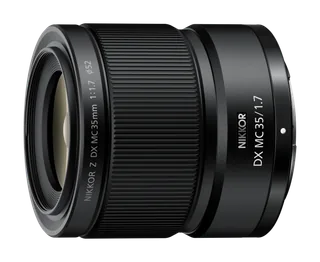
Nikon NIKKOR Z 40mm f/2 vs Nikon NIKKOR Z DX MC 35mm f/1.7
Better figure, where one is clearly better
| NikonNIKKOR Z 40mm f/2 | NikonNIKKOR Z DX MC 35mm f/1.7 | |
|---|---|---|
| Overview | ||
| Released | September 2021 | October 2025 |
| Optics | ||
| Lens type | Prime | Prime |
| Focal length | 40 mm | 35 mm |
| Maximum aperture | f/2 | f/1.7 |
| Minimum aperture | f/16 | f/16 |
| Macro lens | – | Yes |
| Optical construction | Six elements in four groups | Eight elements in seven groups; internal focusing |
| Special elements | Two aspherical elements | One aspherical ED element |
| Aperture detail | f/2 maximum; f/16 minimum; electromagnetic diaphragm | At infinity f/1.7–16; at 0.16 m focus distance f/3.2–22 |
| Diaphragm | Nine rounded blades | Nine rounded blades |
| Angle of view | FX 57°; DX 38°50′ | DX 44°; Nikon Canada gives 52.5 mm equivalent angle of view in FX format |
| Mount and compatibility | ||
| Mounts | Nikon Z mount | Nikon Z mount |
| Image circle | Full frame | APS-C |
| Compatibility | Nikon Z mount; full-frame FX and DX cameras | Native Nikon Z mount; designed for DX/APS-C format |
| Focus and stabilisation | ||
| Autofocus | Yes | Yes |
| Minimum focus distance | 0.29 m | 0.16 m |
| Maximum magnification | 0.17× | 0.67× |
| Optical stabilisation | No | No |
| Autofocus detail | Quiet stepping-motor autofocus, according to Nikon UK | Stepping motor; automatic or manual focusing |
| Focus distance detail | Internal focusing; minimum 0.29 m measured from focal plane; barrel length remains constant while focusing | Minimum 0.16 m measured from the focal plane; UK maker states 7.2 cm working distance from the front of the lens |
| Magnification detail | Maximum reproduction ratio 0.17× | Actual maximum reproduction ratio 0.67×; Nikon describes this as life-size equivalent in 35 mm/FX format, rather than an actual 1× ratio |
| Stabilisation detail | No lens optical VR; compatible cameras can provide in-body stabilisation. Original Z50 and Zfc bodies lack IBIS | No optical VR, as confirmed by both reviews; camera-body stabilisation depends on the body |
| Video features | Nikon describes reduced focus breathing, quiet focusing and silent aperture control through the control ring | Suppressed focus breathing and quiet focusing; silent control ring |
| Design | ||
| Dust and moisture resistant | Yes | Yes |
| Filter diameter | 52 mm | 52 mm |
| Maximum diameter | 70 mm | 70 mm |
| Length | 45.5 mm | 72 mm |
| Weight | 170 g (better) | 220 g |
| Controls | One programmable focus/control ring for focus, aperture, exposure compensation or ISO; focus mode selected through the camera | Customisable control ring for focus, aperture, exposure compensation or ISO; no physical AF/manual switch, as noted by Amateur Photographer |
| Zoom design | – | Internal focusing keeps total length unchanged |
| Filter detail | 52 mm screw-in filters, 0.75 mm pitch | 52 mm screw-in filters, 0.75 mm pitch |
| Weather resistance | Nikon states dust- and drip-resistant sealing, but explicitly does not guarantee resistance in all conditions | Designed for dust and drip resistance; resistance is not guaranteed under every condition |
| Dimensions detail | Standard version approximately 70 × 45.5 mm; SE approximately 71.5 × 45.5 mm, measured from lens mount flange | Approximately 70 mm maximum diameter × 72 mm from mount flange |
| Weight detail | Approximately 170 g for either finish | Approximately 220 g, lens only |
| Lens hood | Not included; Nikon UK now lists optional HN-43 hood | Optional HN-43, sold separately |
| In the box | LC-52B front cap and LF-N1 rear cap; no supplied hood or case | LC-52B front cap and LF-N1 rear cap |
| Release detail | September 2021 UK launch coverage gives September 30 availability, while Nikon USA specifies later that autumn. Month precision is retained. The later SE changes the exterior finish and diameter, with the same optical specification | Nikon Canada states late October 2025 availability; earliest exact retail day and first UK day unconfirmed, so month precision retained |

More comparisons
- Nikon NIKKOR Z 70–200mm f/2.8 VR S II vs Nikon NIKKOR Z DX MC 35mm f/1.7
- Nikon NIKKOR Z 40mm f/2 vs Nikon NIKKOR Z 70–200mm f/2.8 VR S II
- Nikon NIKKOR Z 24–105mm f/4–7.1 vs Nikon NIKKOR Z DX MC 35mm f/1.7
- Nikon NIKKOR Z 24–105mm f/4–7.1 vs Nikon NIKKOR Z 40mm f/2
- Nikon AF-S DX Micro NIKKOR 40mm f/2.8G vs Nikon NIKKOR Z DX MC 35mm f/1.7
- Nikon NIKKOR Z DX 24mm f/1.7 vs Nikon NIKKOR Z DX MC 35mm f/1.7
- Nikon NIKKOR Z 35mm f/1.4 vs Nikon NIKKOR Z DX MC 35mm f/1.7
- Nikon NIKKOR Z DX MC 35mm f/1.7 vs Nikon NIKKOR Z MC 105mm f/2.8 VR S
- Nikon NIKKOR Z 35mm f/1.2 S vs Nikon NIKKOR Z DX MC 35mm f/1.7
- Nikon NIKKOR Z 50mm f/1.4 vs Nikon NIKKOR Z DX MC 35mm f/1.7
- Nikon NIKKOR Z DX 16–50mm f/2.8 VR vs Nikon NIKKOR Z DX MC 35mm f/1.7
- Nikon NIKKOR Z 24-70mm f/2.8 S II vs Nikon NIKKOR Z DX MC 35mm f/1.7
- Nikon NIKKOR Z 28-135mm f/4 PZ vs Nikon NIKKOR Z DX MC 35mm f/1.7
- Nikon NIKKOR Z 28-400mm f/4-8 VR vs Nikon NIKKOR Z DX MC 35mm f/1.7
- Nikon NIKKOR Z 135mm f/1.8 S Plena vs Nikon NIKKOR Z DX MC 35mm f/1.7
- Nikon NIKKOR Z 600mm f/6.3 VR S vs Nikon NIKKOR Z DX MC 35mm f/1.7