Nintendo DS Lite vs Nintendo DSi
Better figure, where one is clearly better
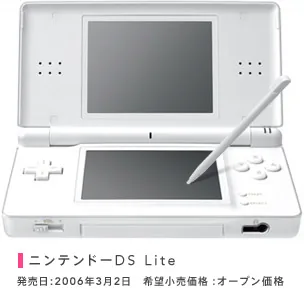
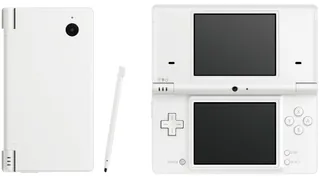
| NintendoDS Lite | NintendoDSi | |
|---|---|---|
| Overview | ||
| Released | March 2006 | November 2008 |
| Performance | ||
| Type | Handheld | Handheld |
| CPU | ARM9 CPU and ARM7 CPU | Nintendo custom ARM CPU |
| GPU | – | Nintendo TWL integrated graphics |
| Storage | – | 256 MB |
| Disc drive | No | No |
| CPU | – | Nintendo's custom ARM CPU and GPU, marked TWL in iFixit's exact DSi teardown; Nintendo's public specification does not identify clock speeds |
| GPU | – | Integrated in the TWL chip (iFixit) |
| Storage detail | Games on Nintendo DS cards or Game Boy Advance cartridges; no built-in game storage | 256 MB of Samsung MoviNAND flash memory with an integrated MMC controller (iFixit); downloaded software runs from internal storage, with SD/SDHC cards used for backups rather than direct game launching (Ars Technica) |
| Storage expansion | Game Boy Advance cartridge slot | SD and SDHC card slot |
| Display and video | ||
| Built-in screen | 3″ LCD, 256 × 192 | 3.25″ LCD, 256 × 192 |
| Built-in screen | Two 3-inch backlit TFT LCDs, 256 × 192 each, approximately 260,000 colours; four brightness levels and a resistive touch screen on the lower display (Nintendo Japan) | Two 3.25-inch transmissive TFT colour LCDs, 256 × 192 each, approximately 260,000 colours; five brightness levels and a touch screen on the lower display |
| Audio | Built-in stereo speakers and microphone; virtual surround in supported games; stereo headphone and microphone connector | Built-in speakers and microphone; DSi Sound plays unprotected AAC files with .m4a, .mp4 or .3gp extensions, 16–320 kbps and 32–48 kHz, and stores up to 18 recordings of up to 10 seconds each (Nintendo Japan) |
| Design and power | ||
| Battery life (maker's claim) | Up to 19 hours | Up to 14 hours |
| Weight | 218 g | 214 g (better) |
| Battery life detail | Built-in rechargeable lithium-ion battery; approximately 15–19 hours at lowest brightness, 10–15 at low, 7–11 at high and 5–8 at highest, varying by software; full charge approximately 3 hours (Nintendo Japan) | TWL-003 user-replaceable battery pack; 840 mAh in iFixit's tested unit. Nintendo rates approximately 9–14 hours at lowest brightness, 8–12 at low, 6–9 at medium, 4–6 at high and 3–4 at highest; software, temperature, wireless and camera use affect runtime. Full charge approximately 2 hours 30 minutes |
| Power use | – | Approximately 2.8 W maximum while charging (Nintendo Japan manual) |
| Size | 133 × 73.9 × 21.5 mm when folded (width × depth × thickness) | 137 × 74.9 × 18.9 mm when folded (width × depth × thickness); approximately 214 g includes battery and stylus |
| In the box | – | DSi, AC adapter, two styluses, quick start guide, instruction manuals and support booklet (Nintendo Japan) |
| Colours | Crystal White, Ice Blue, Enamel Navy, Noble Pink, Jet Black, Gloss Silver, Metallic Rose and Crimson/Black (Nintendo Japan's series page; regional ranges vary) | – |
| Connections | ||
| Ports | Nintendo DS card slot, Game Boy Advance cartridge slot and stereo headphone/microphone connector | Nintendo DS card slot, SD card slot, AC adapter connector and stereo headphone/microphone connector |
| Wi-Fi and Bluetooth | IEEE 802.11 and Nintendo's own wireless protocol; nominal range 10–30 m depending on surroundings; supported games allow several consoles to share one DS card | Wi-Fi IEEE 802.11b/g (DSSS/OFDM), 2.4 GHz, nominal range approximately 10–30 m depending on surroundings (Nintendo's Japanese manual); WPA2 works for supported DSi functions, while older DS games retain their older wireless-security restrictions (Ars Technica) |
| Controller | Built-in D-pad, A/B/X/Y, L/R, Start and Select buttons; touch screen and stylus; built-in microphone with voice recognition in supported games | Built-in D-pad, A/B/X/Y, L/R, Start and Select buttons, stylus and touch screen; two fixed-focus CMOS cameras, approximately 0.3 megapixels each (Nintendo Japan) |
| Backward compatibility | Nintendo DS and Game Boy Advance games; no Game Boy or Game Boy Color cartridges. Game Boy Advance communication functions, link cable, Wireless Adapter, e-Reader+ and GameCube–GBA cable are unsupported | Nintendo DS and DSi games and installed DSiWare; no Game Boy Advance games or DS accessories requiring the GBA slot. DSi Shop purchases and free downloads ended on 31 March 2017 (Nintendo UK); launch-era reviews describe the service before closure |
More comparisons
- Nintendo DS Lite vs Nintendo Switch 2
- Nintendo DS Lite vs Nintendo Switch Lite
- Nintendo DSi vs Nintendo Switch Lite
- Nintendo DS Lite vs Nintendo New 3DS XL
- Nintendo DSi vs Nintendo New 3DS XL
- Nintendo 3DS XL vs Nintendo DSi
- Nintendo 3DS XL vs Nintendo DS Lite
- Nintendo 3DS vs Nintendo DS Lite
- Nintendo 3DS vs Nintendo DSi
- Nintendo DSi vs Nintendo DSi XL
- Nintendo DS Lite vs Nintendo DSi XL
- Nintendo DS Lite vs Sony PSPgo
- Nintendo DSi vs Sony PSPgo
- Nintendo DS vs Nintendo DSi
- Nintendo DSi vs Sony PSP-3000
- Nintendo DSi vs Sony PSP-2000