Nokia E61i vs Nokia E66
Better figure, where one is clearly better
| NokiaE61i | NokiaE66 | |
|---|---|---|
| Overview | ||
| Released | 2007 | 2008 |
| Display | ||
| Screen size | 2.8″ | 2.4″ |
| Resolution | 320 × 240 | 320 × 240 |
| Sharpness | 143 pixels per inch | 167 pixels per inch (better) |
| Panel | LCD | LCD |
| Display type | 2.8-inch non-touchscreen TFT LCD, 320 × 240 pixels and 16 million colours in GSMArena production test and IT Pro specifications. | 2.4-inch 320 × 240 LCD with up to 16 million colours in the maker datasheet; TFT identified in GSMArena's production test. The physical screen is portrait-oriented; resolution is stored long side first for comparison. |
| Display features | – | Ambient light sensor and accelerometer-driven portrait/landscape rotation; non-touchscreen |
| Performance | ||
| Chip | – | ARM11 369 MHz (GSMArena) |
| Memory | – | 128 MB |
| Storage | 50 MB | 110 MB (better) |
| CPU | – | 369 MHz ARM11 processor identified by GSMArena's exact-model production review |
| Memory | Nokia guide 9255175 lists up to 50 MB user memory and a 32-bit RISC ARM9 without clock or installed RAM. GSMArena and IT Pro list 60 MB user memory. Configuration uses the maker guide figure; storage is not physical RAM, which is omitted. | 128 MB installed SDRAM from GSMArena, distinct from free application memory. Maker publishes up to 110 MB internal user memory; the configuration records that user-accessible capacity. |
| Storage type | Hot-swappable microSD under removable rear cover in owner guide; IT Pro lists support up to 2 GB. GSMArena received no memory card in its test package. | microSD expansion up to 8 GB in the maker launch sheet; optional card capacity is not built-in storage |
| Cameras | ||
| Main camera | 2 MP | 3.2 MP (better) |
| Ultra wide camera | None | None |
| Telephoto camera | None | None |
| Optical zoom | None | None |
| Main camera | 2 MP rear camera. Maker guide confirms up to 1600 × 1200 JPEG pictures, night mode, white balance, colour effects, six-picture sequence and self-timer. | 3.2 MP autofocus camera with LED flash; maker gives up to 2048 × 1536 still pixels |
| Front camera | No secondary video-call camera in GSMArena test. No front-camera resolution inferred. | Front camera for video calls confirmed by maker; no sensor megapixel figure inferred |
| Video recording | GSMArena reports up to 352 × 288 at 15 fps in MPEG-4 format; maker guide describes .3gpp clips without numerical frame rate. | Maker specifies QVGA video; GSMArena's production test records 320 × 240 at 15 fps |
| Camera features | – | Dedicated shutter key; scene, white-balance, exposure, self-timer and sequence controls in GSMArena's production test. Its tested software does not geotag photos. |
| Battery and charging | ||
| Battery | – | 1,000 mAh |
| Wireless charging | None | None |
| Battery life detail | Removable BP-4L. Maker guide 9255175 accessory chapter lists 970 mAh, conflicting with the 1500 mAh battery photographed and described in GSMArena production test. Headline capacity omitted pending resolution. GSMArena obtained six days of moderate mixed UMTS use, an attributed test rather than a standardised maker claim. | Removable BL-4U 1000 mAh Li-Ion. Maker maxima are 7.5 hours GSM or 3.5 hours WCDMA talk, and 11 days GSM or 14 days WCDMA standby. These are network operating conditions, not video-playback claims. GSMArena's stationary GPS/display-on test lasts six hours. |
| Wired charging | Dedicated bottom charger socket; maker guide lists AC-3/AC-4/AC-5 and CA-44 compatibility, plus CA-70 charging connectivity cable. No charging wattage or generic data-port charging claim inferred. | Separate charging connector; compatible Nokia charger. No charging wattage published in the maker datasheet; micro-USB data support does not establish USB charging. |
| Design | ||
| Type | Standard | Standard |
| Weight | 153 g | 121 g (better) |
| Thickness | 13.9 mm | 13 mm (better) |
| Height × width | 117 × 70 mm | 107 × 49 mm |
| Weight detail | 153 g and 117 × 70 × 11.5–13.9 mm in maker guide 9255175; headline uses maximum thickness. GSMArena and IT Pro list 150 g, retained as a source conflict. | Maker launch sheet rounds size to 107 × 49 × 13 mm and gives 121 g. GSMArena measures/lists 107.5 × 49.5 × 13.6 mm; that greater precision is review evidence, not a silently substituted maker claim. |
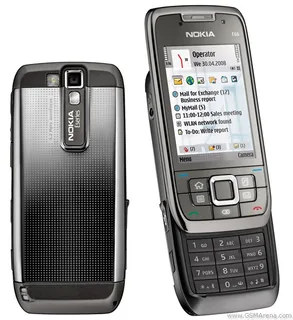
| Materials | – | Stainless-steel rear cover and slider body; numeric keypad slides out below the display. This is a mechanical slider, not a folding or flexible-display phone. |
| Colours | – | Grey Steel and White Steel in original maker launch sheet; regional availability varies |
| Buttons | QWERTY keyboard, Navi directional pad, email/phonebook/My Own shortcut keys and side volume/voice controls; GSMArena distinguishes these from the E61 joystick. | Numeric keypad, navigation control and one-touch Home, Calendar, Contacts and Email keys; dedicated shutter and side volume controls |
| Sensors | – | Accelerometer and ambient light sensor |
| Speakers | Built-in loudspeaker; Pop-Port wired audio. Original Bluetooth lacks stereo A2DP in production test. | Built-in loudspeaker and FM/Visual Radio; GSMArena reports no RDS. Compatible wired headset serves as radio antenna. |
| Software | ||
| Operating system | Symbian | Symbian |
| Software at launch | Symbian 9.1a, S60 Third Edition in maker technical table. No Feature Pack 1 in GSMArena test. | Symbian OS 9.2, S60 Third Edition Feature Pack 1, identified by GSMArena's production review |
| Software features | – | Business/personal home-screen profiles; Mail for Exchange, Nokia Intellisync and POP/IMAP email. PDF reader, ZIP manager and office-document viewing; editing required a Quickoffice upgrade in GSMArena's test, whereas TechRadar describes document creation. Exact tested software/upgrade status differs between reports. Historical online services may no longer operate. |
| Release detail | Announced 12 February 2007 with Q2 availability planned. Nokia annual report confirms shipments during 2007; GSMArena production test was published 4 May. Earliest worldwide on-sale month remains unresolved, so year precision retained. No predecessor relation inferred without explicit maker wording. | Announced 16 June 2008 alongside E71, with July shipments forecast. Nokia's 2008 annual report confirms actual E66 shipments during that year; earliest worldwide retail month remains unresolved. No speculative E65 predecessor relation added while that model is absent. |
| In the box | – | GSMArena's tested package contains a compact charger, 2.5 mm headset, leather case and 2 GB microSD card with maps; regional contents may differ |
| Connectivity | ||
| Mobile network | GSM 850/900/1800/1900 and UMTS 2100 in exact RM-227 maker guide. No HSDPA in GSMArena test. | Quad-band GSM/EGSM 850/900/1800/1900; separate WCDMA 900/2100, 850/2100 and 850/1900 variants, not one five-band handset. HSDPA up to 3.6 Mbps; WCDMA up to 384 kbps down/up. No LTE. |
| Wi-Fi | Integrated WLAN; maker table lists 802.11g/e/i. IT Pro lists 802.11b/g, WPA/WPA2 personal/enterprise. | IEEE 802.11b/g |
| Bluetooth | Bluetooth 1.2 in maker technical table. GSMArena confirms no A2DP stereo-headset support in original firmware. | Bluetooth 2.0 with EDR and A2DP stereo audio |
| USB | USB 2.0 via Pop-Port in maker guide; IT Pro specifies Full-Speed, not Hi-Speed. GSMArena tested PC Suite, mass-storage and direct-print connection modes. | Micro-USB and infrared; separate 2.5 mm AV/headset connector. GSMArena describes USB 2.0 compatibility; no Hi-Speed rate inferred from that label. |
| Positioning | – | Built-in GPS with assisted GPS and Nokia Maps; original reviews describe temporary/subscription-based voice guidance. Historical online map services are not promised available today. |

More comparisons
- Nokia E66 vs Nokia E72
- Nokia E61i vs Nokia E72
- Nokia E52 vs Nokia E66
- Nokia E52 vs Nokia E61i
- Nokia E55 vs Nokia E66
- Nokia E55 vs Nokia E61i
- Nokia E61i vs Sony Ericsson Xperia X1
- Nokia E66 vs Nokia N85
- Nokia E61i vs Nokia N96
- Nokia E66 vs Sony Ericsson C905
- Nokia E63 vs Nokia E66
- Nokia E61i vs Nokia E63
- Nokia E66 vs Nokia N78
- Nokia E66 vs Nokia N79
- Nokia E66 vs Nokia E71
- Nokia E65 vs Nokia E66