OPPO Find N6 vs OPPO Find X9
Better figure, where one is clearly better
| OPPOFind N6 | OPPOFind X9 | |
|---|---|---|
| Overview | ||
| Released | March 2026 | November 2025 |
| Display | ||
| Main screen | 8.12″ | 6.59″ |
| Resolution | 2480 × 2248 (better) | 2760 × 1256 |
| Sharpness | 412 pixels per inch | 460 pixels per inch (better) |
| Panel | LTPO OLED | OLED |
| Refresh rate | 120 Hz | 120 Hz |
| Peak brightness | 2,500 nits | 3,600 nits (better) |
| Cover screen | 6.62″, 2616 × 1140, 120 Hz | – |
| Display type | Inner Samsung E7 AMOLED with COE and cover BOE X3 AMOLED; adaptive 1–120 Hz on both; LTPO identification from Digital Camera World | 6.59-inch flexible AMOLED, LTPS |
| Pixel density | Inner 412 ppi and cover 431 ppi | 460 ppi |
| Brightness detail | Both screens 600 nits typical and 1,800 nits HBM; local peak 2,500 nits inside and 3,600 nits outside; minimum 1 nit | 800 nits typical, 1,800 nits high brightness mode, 3,600 nits peak |
| Screen protection | Inner PET and UTG; Ceramic Guard cover glass; second-generation Titanium Flexion Hinge and Auto-Smoothing Flex Glass | Corning Gorilla Glass 7i |
| Display features | Both screens have 10-bit colour and 100% DCI-P3 in standard, natural and vivid modes; touch sampling up to 240 Hz, default 125 Hz; up to 2,160 Hz PWM dimming; OPPO AI Pen supports both screens with 4,096 pressure levels | Up to 120 Hz refresh; 10-bit colour depth; 100% DCI-P3; up to 240 Hz touch sampling; 3,840 Hz PWM dimming |
| Cover screen | 6.62-inch AMOLED, 94.2% screen ratio and adaptive 1–120 Hz; inner screen ratio 96.4% | – |
| Performance | ||
| Chip | Qualcomm Snapdragon 8 Elite Gen 5 | MediaTek Dimensity 9500 |
| Memory | 16 GB (better) | 12 GB |
| Storage | 512 GB | 512 GB |
| CPU | Seven-core version of Snapdragon 8 Elite Gen 5, with two prime and five performance cores | MediaTek Dimensity 9500, eight cores |
| GPU | Qualcomm Adreno 840 at 1,200 MHz | Arm Mali G1-Ultra MC12 |
| Storage type | Global CPH2765 16 GB/512 GB; LPDDR5X RAM, UFS 4.1 storage and no memory-card support | UFS 4.1; LPDDR5X RAM; no memory-card slot |
| Cameras | ||
| Main camera | 200 MP (better) | 50 MP |
| Ultra wide camera | 50 MP | 50 MP |
| Telephoto camera | 50 MP | 50 MP |
| Optical zoom | 3× | 3× |
| Front camera | 20 MP | 32 MP (better) |
| Main camera | 200 MP, f/1.8, 90° field of view, seven-element lens, autofocus and two-axis OIS | 50 MP, ƒ/1.6, 85° field of view, autofocus and OIS |
| Ultra wide camera | 50 MP, f/2.0, 120° field of view, six-element lens and autofocus | 50 MP, ƒ/2.0, 120° field of view, autofocus |
| Telephoto camera | 50 MP periscope, f/2.7, 34° field of view, four-element lens, autofocus and two-axis OIS; 3× optical zoom | 50 MP, ƒ/2.6, 33° field of view, autofocus and OIS |
| Front camera | 20 MP f/2.4, 91° field of view and four-element lens on each display | 32 MP, ƒ/2.4, 90° field of view |
| Zoom | 3× optical zoom; video zoom up to 18× digital | 3× optical; digital zoom up to 120× |
| Video recording | Main camera 4K up to 120 fps Dolby Vision; all three rear cameras 4K60 Dolby Vision; EIS/OIS up to 4K60; Log support; slow motion up to 1080p240 or 720p480; dual-view and time-lapse modes | Rear 4K at 30, 60 or 120 fps; 4K slow motion at 120 fps; Dolby Vision supported |
| Front video | Up to 4K30, HDR and dual-view; EIS at 1080p30 or 720p30 | 4K at 30 or 60 fps |
| Camera features | Additional 2 MP monochrome camera at f/2.4 with 88° field of view; True Color sensor, Hasselblad portrait, XPAN, Hi-Res, Master, night, long exposure, AI ID photo, document scanning and Pro Video | Hasselblad Master Camera System; 2 MP monochrome camera; spectral sensor; XPAN and Master modes |
| Battery and charging | ||
| Battery | 6,000 mAh | 7,025 mAh (better) |
| Wired charging | Up to 80 W | Up to 80 W |
| Wireless charging | Up to 50 W | Up to 50 W |
| Battery life detail | Silicon-carbon battery, 6,000 mAh typical and 5,850 mAh rated | 7,025 mAh typical, 6,840 mAh rated silicon-carbon battery |
| Wired charging | 80 W SUPERVOOC; compatible with 67 W and lower SUPERVOOC, 55 W PPS, 18 W PD and 18 W QC. Maker specification identifies 55 W as PPS rather than the PD shorthand used in reviews. | Up to 80 W SUPERVOOC or UFCS; also supports up to 55 W PPS and 11.7 W USB PD |
| Wireless charging | Up to 50 W AIRVOOC | Up to 50 W AIRVOOC |
| Design | ||
| Type | Foldable | Standard |
| Weight | 225 g | 203 g (better) |
| Thickness | 8.93 mm | 7.99 mm (better) |
| Height × width | 159.87 × 74.12 mm | 156.98 × 73.93 mm |
| Water and dust resistance | IP58 | IP69 |
| Stylus | Yes | – |
| Size unfolded | 159.87×145.58×4.21 mm | – |
| Materials | Aviation-grade aluminium frame | Aluminium frame |
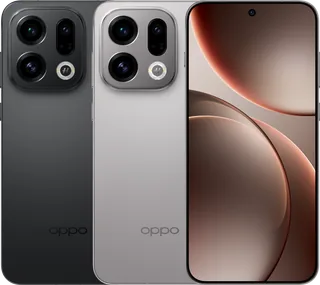
| Colours | Stellar Titanium and Blossom Orange | Space Black, Titanium Grey |
| Buttons | Customisable Snap Key, power key with side fingerprint sensor and volume controls | Customisable Snap Key |
| Water resistance detail | IP56, IP58 and IP59; IP58 test at 1.5 m for 30 minutes; IP5X permits limited dust ingress and resistance can decrease with wear | IP66, IP68 and IP69 tested under controlled laboratory conditions |
| Biometrics | Side fingerprint sensor and face recognition | Ultrasonic in-display fingerprint sensor; face recognition |
| Sensors | Proximity, ambient light, colour temperature, compass, accelerometer, gyroscope, side fingerprint, Hall and infrared remote control | Proximity, ambient light, colour temperature, compass, accelerometer, gyroscope, Hall, laser focus and spectral sensors; infrared remote control |
| Speakers | Stereo speakers, confirmed by Stuff | – |
| Software | ||
| Operating system | Android | Android |
| Software at launch | ColorOS 16.0 based on Android 16, with Android version confirmed by Stuff and Digital Camera World | ColorOS 16 based on Android 16 |
| Software updates | Four years of OS updates and six years of security patches, reported by Stuff | – |
| AI features | Free-Flow Window with up to four apps, Boundless View, AI Mind Space, recording and photo tools; O+ Connect supports file transfers, screen mirroring and remote control with Mac or Windows | – |
| In the box | Phone, charger, USB cable, SIM tool, protective case, quick guide and safety guide; contents vary by market | Phone, USB data cable, SIM ejector tool, quick guide and safety guide; UK specification does not list a charger |
| Connectivity | ||
| Mobile network | GSM 850/900/1800/1900; WCDMA B1/2/4/5/6/8/19; LTE FDD B1/2/3/4/5/7/8/12/13/17/18/19/20/25/26/28/32/66/71, TDD B38/39/40/41/42/48; 5G n1/2/3/5/7/8/12/20/25/26/28/38/40/41/66/71/75/77/78/79 | 5G and 4G LTE |
| SIM | Two nano-SIM/nano-USIM slots; eSIM supported on global CPH2765 | Nano-SIM and eSIM; second SIM supported |
| Wi-Fi | Wi-Fi 7/6/5 and 802.11a/b/g/n; 2×2 MIMO; concurrent 2.4/5 GHz, 160 MHz at 5 GHz and 320 MHz at 6 GHz; Wi-Fi Display and tethering | Wi-Fi 7; 2×2 MIMO; 320 MHz on 6 GHz |
| Bluetooth | Bluetooth 6.0 and BLE; SBC, AAC, LDAC, aptX, aptX HD, aptX Adaptive and LHDC 5.0 | Bluetooth 6.0; BLE Audio; SBC, AAC, LDAC, aptX, aptX HD and LHDC 5.0 |
| NFC | Supported; availability depends on region | Yes |
| USB | USB-C, USB 3.2 Gen 1 and OTG; digital USB-C headphones supported, analogue USB-C headphones unsupported | USB-C |
| Positioning | BeiDou B1I/B1C/B2a, GPS L1/L5, GLONASS G1, Galileo E1/E5a, QZSS L1/L5 and NavIC L5; A-GNSS, Wi-Fi and cellular positioning | Dual-band GPS, GLONASS, BeiDou, Galileo, QZSS and NavIC |

More comparisons
- Google Pixel 11 Pro Fold vs OPPO Find N6
- OPPO Find N6 vs Samsung Galaxy Z Fold8
- OPPO Find N6 vs Samsung Galaxy Z Fold8 Ultra
- OPPO Find N6 vs OPPO Find X9 Ultra
- OPPO Find X9 vs OPPO Find X9 Ultra
- Honor Magic V6 vs OPPO Find N6
- OPPO Find N5 vs OPPO Find N6
- OnePlus Open vs OPPO Find N6
- OPPO Find N6 vs Samsung Galaxy Z Fold7
- OPPO Find N6 vs OPPO Find X9 Pro
- OPPO Find N6 vs OPPO Find X8 Ultra
- OPPO Find N6 vs OPPO Find X8
- OPPO Find N6 vs OPPO Find X8 Pro
- OPPO Find N6 vs OPPO Find X7
- OPPO Find N6 vs OPPO Find X7 Ultra
- OPPO Find N3 Flip vs OPPO Find N6