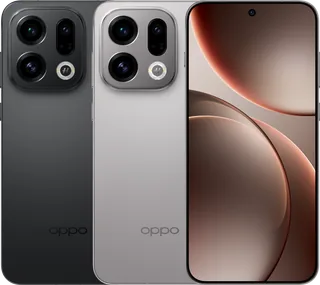
OPPO Find X8 Ultra vs OPPO Find X9
Better figure, where one is clearly better
| OPPOFind X8 Ultra | OPPOFind X9 | |
|---|---|---|
| Overview | ||
| Released | April 2025 | November 2025 |
| Display | ||
| Screen size | 6.82″ | 6.59″ |
| Resolution | 3168 × 1440 (better) | 2760 × 1256 |
| Sharpness | 510 pixels per inch (better) | 460 pixels per inch |
| Panel | LTPO OLED | OLED |
| Refresh rate | 120 Hz | 120 Hz |
| Peak brightness | 1,600 nits | 3,600 nits (better) |
| Display type | Flat 6.82-inch AMOLED, 3168 × 1440, adaptive 1–120 Hz; LTPO identified in both independent full tests. | 6.59-inch flexible AMOLED, LTPS |
| Pixel density | 510 ppi | 460 ppi |
| Brightness detail | Maker exact table: manual maximum 800 nits typical; automatically triggered global maximum 1,600 nits typical. A separate small-window peak is not published in that table. | 800 nits typical, 1,800 nits high brightness mode, 3,600 nits peak |
| Screen protection | OPPO Crystal Shield Glass, manufacturer product page. | Corning Gorilla Glass 7i |
| Display features | Approximately 1.07 billion colours, P3 gamut and touch sampling up to 240 Hz. Maker product footnote specifies 2160 Hz PWM below 70 nits; Dolby Vision and HDR10+ identified in GSMArena’s exact test. | Up to 120 Hz refresh; 10-bit colour depth; 100% DCI-P3; up to 240 Hz touch sampling; 3,840 Hz PWM dimming |
| Performance | ||
| Chip | Qualcomm Snapdragon 8 Elite | MediaTek Dimensity 9500 |
| Memory | 12 GB – 16 GB (better) | 12 GB |
| Storage | 256 GB, 512 GB, 1 TB (better) | 512 GB |
| CPU | Eight-core Snapdragon 8 Elite, maximum CPU frequency 4.32 GHz. | MediaTek Dimensity 9500, eight cores |
| GPU | Adreno 830, GSMArena full test. | Arm Mali G1-Ultra MC12 |
| Memory | Original China PKJ110: 12/256 GB or 16/512 GB. Satellite China PKU110: 16 GB/1 TB. Both exact tables list Black, White and Pink finishes. | – |
| Storage type | LPDDR5X RAM and UFS 4.1 storage. No memory-card expansion; OTG supported. | UFS 4.1; LPDDR5X RAM; no memory-card slot |
| Cameras | ||
| Main camera | 50 MP | 50 MP |
| Ultra wide camera | 50 MP | 50 MP |
| Telephoto camera | 50 MP | 50 MP |
| Optical zoom | 6× (better) | 3× |
| Front camera | 32 MP | 32 MP |
| Main camera | 50 MP, f/1.8, 23 mm equivalent, 1G7P lens, autofocus and two-axis optical stabilisation. Maker specifies 1-inch optical format; GSMArena identifies Sony LYT-900. Optical format is not a physical sensor dimension. | 50 MP, ƒ/1.6, 85° field of view, autofocus and OIS |
| Ultra wide camera | 50 MP, f/2.0, 15 mm equivalent, six-element lens, 120° field of view and autofocus. Samsung JN5 identified by GSMArena; no maker OIS claim. | 50 MP, ƒ/2.0, 120° field of view, autofocus |
| Telephoto camera | 50 MP, f/2.1, 70 mm equivalent, two groups of three elements, autofocus and two-axis OIS. Maker specifies 1/1.56-inch optical format and 10 cm minimum focus; GSMArena identifies Sony LYT-700. | 50 MP, ƒ/2.6, 33° field of view, autofocus and OIS |
| Second telephoto camera | 50 MP, f/3.1, 135 mm equivalent, 1G3P lens, autofocus and two-axis OIS. Maker specifies 1/1.95-inch optical format; GSMArena identifies Sony LYT-600. Its detailed camera discussion gives 95 cm minimum focus, unlike the copied 35 cm entry in its overview table; this distance is therefore not a headline maker figure. | – |
| Front camera | 32 MP, f/2.4, 21 mm equivalent, five-element lens and autofocus, exact maker table. | 32 MP, ƒ/2.4, 90° field of view |
| Zoom | Manufacturer optical settings up to 6× and digital still zoom up to 120×; video optical settings up to 6× and digital up to 30×. Intermediate settings include processing and sensor crops. | 3× optical; digital zoom up to 120× |
| Video recording | Rear 4K30/60/120, 1080p30/60/120 and 720p30. Slow motion: 720p240/480, 1080p120/240 and 4K120. Current product advertises 4K120 Dolby Vision and 10-bit Log. GSMArena’s launch test found 4K120 on main and telephoto cameras, not ultrawide, without standard electronic stabilisation at 120 fps; Log was still pending then. | Rear 4K at 30, 60 or 120 fps; 4K slow motion at 120 fps; Dolby Vision supported |
| Front video | 4K30/60, 1080p30/60 and 720p30; HDR and electronic video stabilisation, exact maker table. | 4K at 30 or 60 fps |
| Camera features | A separate 2 MP True Chroma colour-sensing camera has f/2.5, 23 mm equivalent and a three-element lens; it is not another selectable imaging lens. Hasselblad Master Mode, portraits, XPAN, night and dual-view. Shared manufacturer O-Log white paper explicitly includes Find X8 Ultra; linked support destination provides colour-grading documentation/LUT tools rather than general repair support. | Hasselblad Master Camera System; 2 MP monochrome camera; spectral sensor; XPAN and Master modes |
| Battery and charging | ||
| Battery | 6,100 mAh | 7,025 mAh (better) |
| Wired charging | Up to 100 W (better) | Up to 80 W |
| Wireless charging | Up to 50 W | Up to 50 W |
| Battery life detail | Two series cells: typical 3,050 mAh and 23.38 Wh combined, equivalent to 6,100 mAh; rated 2,985 mAh per cell and 22.87 Wh combined, equivalent to 5,970 mAh. | 7,025 mAh typical, 6,840 mAh rated silicon-carbon battery |
| Wired charging | 100 W SuperVOOC; compatible 80/67/65/50/33 W SuperVOOC. Exact current maker table: 55 W PPS (11 V/5 A) after updating to latest software, 44 W UFCS, 18 W PD (9 V/2 A) and 18 W QC. Launch-review charging behaviour does not establish current PPS firmware behaviour. | Up to 80 W SUPERVOOC or UFCS; also supports up to 55 W PPS and 11.7 W USB PD |
| Wireless charging | 50 W proprietary wireless charging with compatible separate equipment. Magnetic accessories require the separate magnetic case; built-in magnets are not claimed. | Up to 50 W AIRVOOC |
| Charges other devices | 10 W reverse wireless charging, exact maker table. | – |
| Design | ||
| Type | Standard | Standard |
| Weight | 226 g | 203 g (better) |
| Thickness | 8.78 mm | 7.99 mm (better) |
| Height × width | 163.09 × 76.8 mm | 156.98 × 73.93 mm |
| Water and dust resistance | IP69 | IP69 |
| Materials | Glass rear and aluminium frame, manufacturer product page. Approximate maker dimensions and weight apply to both original and satellite specification tables. | Aluminium frame |
| Colours | Black (星野黑), White (月光白), Pink (晨曦微光). Original and satellite exact tables list all three. | Space Black, Titanium Grey |
| Buttons | Left shortcut button and right camera-control key. Maker footnote limits sliding camera zoom to landscape operation. | Customisable Snap Key |
| Water resistance detail | IP68 and IP69 laboratory claims. IP68: static fresh water 1.5 m for 30 minutes, water/phone temperature difference no more than 5°C. IP69: 80±5°C water at 15±1 litres/minute, 30 seconds at each 0°/30°/60°/90° position, rotating 5±1 rpm with screen upward. Resistance may degrade; these are controlled tests. | IP66, IP68 and IP69 tested under controlled laboratory conditions |
| Biometrics | Ultrasonic under-display fingerprint and face recognition. | Ultrasonic in-display fingerprint sensor; face recognition |
| Sensors | Proximity, ambient light, colour temperature, compass, acceleration, gyroscope, ultrasonic fingerprint, laser focus, spectrum, infrared remote and Hall sensor. Hall recognition of magnetic accessories is not a folio-cover claim. | Proximity, ambient light, colour temperature, compass, accelerometer, gyroscope, Hall, laser focus and spectral sensors; infrared remote control |
| Speakers | Stereo speakers, GSMArena full test. | – |
| Software | ||
| Operating system | Android | Android |
| Software at launch | ColorOS 15.0 on Android 15; China-market firmware. Contemporary IT Home reports actual sale on 16 April 2025. Manufacturer actual first-sale paragraph not recovered; no official international retail release inferred. | ColorOS 16 based on Android 16 |
| In the box | China package: phone, USB cable, charger, SIM tool, protective case and quick guide. Accessories and services remain regional. | Phone, USB data cable, SIM ejector tool, quick guide and safety guide; UK specification does not list a charger |
| Connectivity | ||
| Mobile network | GSM 850/900/1800 MHz; WCDMA B1/4/5/8; LTE FDD B1/3/4/5/7/8/18/19/20/26/28A/66 and TDD B34/38/39/40/41/42/48; 5G n1/3/5/7/8/20/28A/38/40/41/66/77/78/79/80/81/83/84. Original and satellite exact tables list the same bands. Band presence does not establish overseas carrier features. | 5G and 4G LTE |
| SIM | Dual nano-SIM / nano-USIM; dual standby and dual-active modes have radio/band conditions in the maker table. | Nano-SIM and eSIM; second SIM supported |
| Wi-Fi | Wi-Fi 7/6/5/a/b/g/n, 2.4 and 5 GHz, simultaneous 2×2 MIMO and MU-MIMO; 5 GHz bandwidth up to 160 MHz. No 6 GHz claim. | Wi-Fi 7; 2×2 MIMO; 320 MHz on 6 GHz |
| Bluetooth | Bluetooth 5.4; SBC, AAC, aptX, aptX HD, LDAC and LHDC 5.0. BLE Audio requires compatible OPPO Enco X3 according to the maker footnote. | Bluetooth 6.0; BLE Audio; SBC, AAC, LDAC, aptX, aptX HD and LHDC 5.0 |
| NFC | Read/write NFC, SIM1 NFC-SIM, HCE and eSE. China transit/payment/access-card/car-key functions depend on local services. | Yes |
| Satellite features | Only PKU110 satellite edition, 16 GB/1 TB: Tiantong communication requires an enabled China Telecom SIM/service and operator coverage. Original PKJ110 does not provide satellite calling. Satellite first-sale date not established separately. | – |
| USB | USB-C charging, data, digital headphones and OTG; analogue USB-C headphones are not supported. Transfer generation not published in exact maker table. | USB-C |
| Positioning | BeiDou B1i/B1c/B2a, GPS L1/L5, GLONASS G1, Galileo E1/E5a and QZSS L1/L5. | Dual-band GPS, GLONASS, BeiDou, Galileo, QZSS and NavIC |

More comparisons
- OPPO Find X9 vs OPPO Find X9 Ultra
- OPPO Find X8 Ultra vs OPPO Find X9 Ultra
- OPPO Find N6 vs OPPO Find X9
- OPPO Find N6 vs OPPO Find X8 Ultra
- OPPO Find X9 vs vivo V70
- OPPO Find X8 Pro vs OPPO Find X9
- OPPO Find X8 vs OPPO Find X9
- OPPO Find X9 vs OPPO Reno14 Pro 5G
- Motorola motorola edge 60 vs OPPO Find X9
- Honor HONOR 400 Pro vs OPPO Find X9
- Motorola motorola edge 60 pro vs OPPO Find X9
- OPPO Find X9 vs OPPO Find X9 Pro
- OPPO Find N5 vs OPPO Find X9
- OPPO Find X7 vs OPPO Find X9
- OPPO Find X9 vs Xiaomi POCO F8 Pro
- OPPO Find X8 Ultra vs Xiaomi POCO F8 Ultra