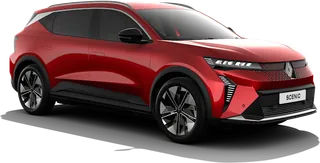
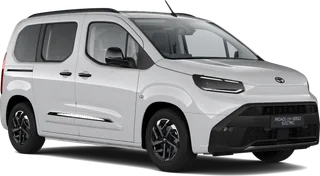
Renault Scenic E-Tech electric vs Toyota Proace City Verso
Better figure, where one is clearly better
| RenaultScenic E-Tech electric | ToyotaProace City Verso | |
|---|---|---|
| Overview | ||
| Released | May 2024 | August 2024 |
| Performance | ||
| Powertrain | Electric | Electric |
| Power | 215 bhp (better) | 134 bhp |
| 0–62 mph | 7.9 s (better) | 11.2 s |
| Top speed | 105 mph (better) | 82 mph |
| Engine or motors | Single front electric motor; bhp converted from Renault's 160 kW figure, which is listed alongside the marketed 220 hp designation | Front permanent-magnet synchronous motor, 134 bhp (136 DIN hp, 100 kW) in Power mode, 108 bhp in Normal and 81 bhp in Eco; lithium-ion battery, 50 kWh usable (the Toyota UK site gives 52 kWh gross), 216 cells |
| Torque | 300 Nm | 270 Nm (Power mode), 210 Nm (Normal), 180 Nm (Eco) |
| Gearbox | Single-speed automatic | Single-speed automatic |
| Drive | Front-wheel drive | Front-wheel drive |
| Range and charging | ||
| Zero-emission range (WLTP) | 370–381 miles (better) | 211 miles |
| Battery | 87 kWh (better) | 50 kWh |
| Fastest charging | 150 kW | – |
| Range detail | July 2026 UK price guide lists MY26 techno, techno esprit Alpine and iconic esprit Alpine as stock only; figures describe these UK versions | WLTP combined: 210–211 miles (Toyota UK site); Toyota's 2024 launch release and press specifications quote up to 213 miles |
| Charging | Up to 11 kW AC; heat pump and battery temperature optimisation for DC charging as standard; five regenerative braking levels including One Pedal | DC fast charging (CCS2) to 80% in about 30 minutes; 11 kW AC on-board charger, about 4.5 hours on a wallbox |
| Efficiency | – | WLTP combined: 29.3–29.5 kWh/100 miles |
| CO2 emissions | 0 g/km at the tailpipe | 0 g/km at the tailpipe |
| Practicality | ||
| Body | Crossover | MPV |
| Seats | 5 | 7 (better) |
| Boot | 545 litres | 597 litres (better) |
| Length | 4,470 mm | 4,401 mm |
| Width | 1,864 mm | 1,848 mm |
| Weight | From 1,853 kg | From 1,736 kg |
| Boot | 1,449 litres with the rear seats folded, from the current UK specification page | 597 litres (L1) or 806 litres (L2) to the belt line with the rear seats up; 983 or 1,538 litres to the roof |
| Towing | 1,100 kg braked, 750 kg unbraked | 750 kg braked and unbraked (L1); not permitted (L2) |
| Size | 2,785 mm wheelbase; 1,908 mm wide with mirrors folded and 2,085 mm extended; UK spec page gives 1,853 kg kerb weight excluding driver, while the August 2026 brochure quotes 1,840 kg for techno | 4,401 mm (L1) or 4,751 mm (L2) long, 1,848 mm wide, 1,812–1,818 mm high; 2,785 mm (L1) or 2,975 mm (L2) wheelbase; 10.82–11.43 m turning circle (tyres); kerb weight 1,736–1,928 kg (L1), 1,847–1,909 kg (L2); top speed 84 mph in Toyota's press specifications, 82 mph on the Toyota UK site |
| Tech and safety | ||
| Infotainment | 12-inch openR link touchscreen with Google built in; 12.3-inch driver display; wireless Apple CarPlay and over-the-air updates | 10-inch multimedia display with navigation, Apple CarPlay and Android Auto |
| Driver assistance | Contextual adaptive cruise control, blind-spot warning, emergency lane keeping, rear cross-traffic alert with automatic braking, driver attention camera and front, rear and side parking sensors | Reversing camera on Design |
| Warranty | 3 years; first 2 years unlimited mileage, then a 100,000-mile total limit; traction battery 8 years or 100,000 miles | – |