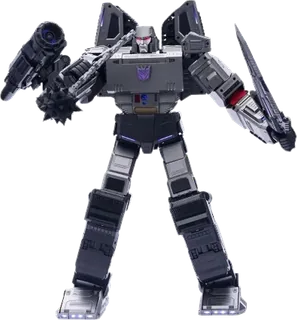
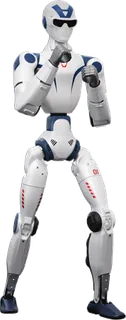
Robosen Flagship Megatron vs Unitree R1
Better figure, where one is clearly better
| RobosenFlagship Megatron | UnitreeR1 | |
|---|---|---|
| Overview | ||
| Released | – | – |
| Task and control | ||
| Form | Humanoid | Humanoid |
| Use | Companion, Education | Education, Research |
| User programming | Yes | No / Yes |
| Phone app | Yes | Yes |
| Intended use | – | Motion demonstrations and education/research; EDU is the version for supported secondary development. A humanoid shape does not establish useful autonomous household labour. |
| Movement | Bipedal robot and tracked tank; maker lists 5 cm/s and 10 cm/s respectively. | Six degrees of freedom per leg. Air has four per arm; standard and EDU have five per arm plus two waist and two head degrees of freedom. EDU can be configured with additional hand joints, taking its total from 26 to as many as 40. |
| Autonomy | – | The maker describes multimodal voice and image interaction, but warns that some example functions shown are still being developed and tested. Standard motion routines are distinct from general autonomous manipulation. |
| User programming | – | The exact current comparison marks secondary development absent on Air and standard R1, supported on EDU. EDU offers optional computing and dexterous hands; these are not standard features of the entry models. |
| Remote control | Voice and app control. | Handheld controller included in the maker's comparison; the maker also provides its R1 app. |
| Regional availability | Standard SKU WZTG1F-SE orderable from UK store on 3 October 2026; purchase area states shipment in 3–5 days. Limited-anniversary edition is separate. | The official global store lists Air, standard and EDU variants as available for ordering, with an In Stock heading. Additional EDU accessories require contact with sales. Shipping/import clearance conditions apply; individual destination delivery is not established by the headline. Checked October 2026. |
| Release details | Exact first-sale date not established; store update and preorder dates are not retail dates. | Contemporary launch coverage dates the announcement to 25 July 2025. The first retail delivery date is not established; the December 2025 store publication timestamp is not treated as first sale. |
| Hardware | ||
| Degrees of freedom | – | 20–26 |
| Height | – | 1,230 mm |
| Width | – | 357 mm |
| Depth | – | 190 mm |
| Robot weight | – | 27–29 kg |
| Camera | – | Yes |
| Microphone | Yes | Yes |
| Wi-Fi | – | Yes |
| Bluetooth | Yes | Yes |
| Processing | – | Eight-core high-performance processor across the range. EDU optionally supports additional high-power computing modules, including Orin configurations; no exact standard processor model is published. |
| Sensors | Six-axis IMU and chest/back touch zones. | Air monocular camera; standard R1 and EDU binocular camera. Joint encoders are described as dual plus single encoders. |
| Camera | – | Monocular on Air; binocular on standard and EDU. Camera presence is not proof of depth-map accuracy or independent navigation performance. |
| Audio | More than 270 recorded voice lines. | Four-microphone array and speaker across the range. |
| Display | 112 LEDs. | – |
| Actuators | 36 servos; this is not assumed to mean 36 independent degrees of freedom. | Low-inertia high-speed inner-rotor permanent-magnet synchronous motors with local air cooling. Knee movement −10° to +139°; the maker's numerical joint limits are not an agility score. |
| Payload | – | Maker arm-load claim about 2 kg, varying greatly with arm extension. Its table labels this row Maximum Torque of Arm Joint but gives kilograms and a load footnote; it is not a published N·m torque figure. |
| Connections | Bluetooth 5.0 BLE; USB-C charging. | Wi-Fi 6 and Bluetooth 5.2. |
| Size and weight | Standard-edition maker table gives robot 6.6 × 13.9 × 20.6 inches and tank 17.3 × 9.1 × 6.0 inches without axis labels; net weight 8.4 lb. Rounded imperial values retained. | Standing height × width × thickness 1,230 × 357 × 190 mm. Weight with battery approximately 27 kg for Air and 29 kg for standard/EDU. The current specification supersedes the approximately 25 kg wording in initial launch coverage; optional EDU attachments may alter the supplied configuration. |
| Accessories | – | Optional dexterous hands and additional computing modules are EDU-specific. Maker store renders are explicitly labelled prototype images; their exact appearance can differ from supplied hardware. |
| Battery | ||
| Battery life (maker's claim) | 80–90 minutes working time | About 1 hour |
| Battery capacity | 2,700 mAh | – |
| Battery | 11.1 V pack. | Quick-release lithium battery; capacity is not published in the exact current R1 table used. |
| Charging | Approximately 90 minutes. | Charger supplied; the current comparison does not publish a charge-time claim. |
| Runtime conditions | – | About one hour is the maker's claim across configurations, without a detailed workload test. Actual performance varies with scenarios and configurations. |
More comparisons
- Robosen Elite Optimus Prime vs Robosen Flagship Megatron
- Robosen Flagship Megatron vs Robosen Flagship Soundwave G1
- Unitree G1 vs Unitree R1
- Robosen Bumblebee G1 Performance vs Robosen Flagship Megatron
- Robosen Buzz Lightyear Space Ranger Alpha vs Robosen Flagship Megatron
- LivingAI EMO vs Robosen Flagship Megatron
- Robosen Flagship Bumblebee vs Robosen Flagship Megatron
- Robosen Flagship Megatron vs Unitree G1
- Robosen Flagship Megatron vs Robosen Interstellar Scout K1
- Robosen Flagship Bumblebee vs Unitree R1
- Robosen Flagship Megatron vs Robosen Toy Story Buzz Lightyear