Samsung Galaxy S24 Ultra vs vivo X100 Ultra
Better figure, where one is clearly better
| SamsungGalaxy S24 Ultra | vivoX100 Ultra | |
|---|---|---|
| Overview | ||
| Released | January 2024 | May 2024 |
| Display | ||
| Screen size | 6.8″ | 6.78″ |
| Resolution | 3120 × 1440 | 3200 × 1440 (better) |
| Sharpness | 505 pixels per inch | 518 pixels per inch (better) |
| Panel | LTPO OLED | LTPO OLED |
| Refresh rate | 120 Hz | 120 Hz |
| Peak brightness | 2,600 nits | 3,000 nits (better) |
| Display type | Dynamic AMOLED 2X, Quad HD+, 16M colours; Super Smooth 120 Hz refresh rate (1–120 Hz); 6.8 inches both as a full rectangle and accounting for rounded corners | E7 AMOLED; LTPO confirmed by Android Central, up to 120 Hz |
| Pixel density | – | 517 ppi |
| Brightness detail | Up to 2,600 nits peak; 5,000,000:1 contrast ratio; VDE-certified 100% Mobile Color Volume in DCI-P3 | 3,000 nits local peak |
| Screen protection | Corning Gorilla Armor, with up to 75% less reflection | – |
| Display features | Vision booster | 103% NTSC, DCI-P3, 1.07 billion colours, HDR and 8,000,000:1 contrast; 1,440 Hz PWM requires developer-mode setting |
| Performance | ||
| Chip | Snapdragon 8 Gen 3 for Galaxy | Qualcomm Snapdragon 8 Gen 3 |
| Memory | 12 GB | 12 GB – 16 GB (better) |
| Storage | 256 GB, 512 GB, 1 TB | 256 GB, 512 GB, 1 TB |
| CPU | Octa-core (3.39 GHz, 3.1 GHz, 2.9 GHz, 2.2 GHz) | Eight cores, 1 × 3.3 GHz + 2 × 3.0 GHz + 3 × 3.2 GHz + 2 × 2.3 GHz; 4 nm process |
| GPU | – | Qualcomm Adreno 750 |
| Storage type | – | LPDDR5X four-channel RAM and UFS 4.0; China-market 12 GB/256 GB, 16 GB/512 GB and 16 GB/1 TB; virtual RAM is separate; no storage expansion |
| Cooling | Vapour chamber 1.9 times larger than the S23 Ultra's | – |
| Cameras | ||
| Main camera | 200 MP (better) | 50 MP |
| Ultra wide camera | 12 MP | 50 MP |
| Telephoto camera | 50 MP | 200 MP |
| Optical zoom | 5× (better) | 3.7× |
| Front camera | 12 MP | 50 MP (better) |
| Main camera | 200 MP wide, F1.7, 85° field of view, OIS, autofocus | 50 MP, one-inch sensor, f/1.75, 23 mm equivalent and gimbal OIS with CIPA 4.5 stabilisation |
| Ultra wide camera | 12 MP, F2.2, 120° field of view | 50 MP, f/2.2 and 116° field of view |
| Telephoto camera | 50 MP, F3.4, 22° field of view, OIS, 5x optical zoom | 200 MP, 1/1.4-inch sensor, f/2.67, 85 mm equivalent, ZEISS APO and OIS with CIPA 4.5 stabilisation |
| Second telephoto camera | 10 MP, F2.4, 36° field of view, OIS, 3x optical zoom | – |
| Front camera | 12 MP, F2.2, 80° field of view, autofocus | 50 MP, f/2.45 and autofocus |
| Zoom | 3x and 5x optical zoom; 2x and 10x optical-quality zoom (Adaptive Pixel sensor); digital zoom up to 100x | 3.7× optical and up to 100× digital zoom; advertised 20× telephoto macro is not an optical zoom ratio |
| Video recording | Up to 8K (7680 × 4320) at 30 fps; slow motion at 240 fps (FHD) and 120 fps (UHD) | Main and telephoto 4K at 120 fps, 4K at 60 fps Dolby Vision HDR and 8K recording |
| Camera features | ProVisual Engine; Quad Tele System; Nightography; Super HDR; Generative Edit; Instant Slow-mo | Physical 6 nm vivo V3+ imaging chip, ZEISS T* coating, multifocal portraits and telephoto macro |
| Battery and charging | ||
| Battery | 5,000 mAh | 5,500 mAh (better) |
| Video playback (maker's claim) | Up to 30 hours | – |
| Wired charging | Up to 45 W | Up to 80 W (better) |
| Wireless charging | Yes (wattage not published) | Up to 30 W |
| Battery life detail | 5,000 mAh typical, 4,855 mAh rated; up to 28 hours of internet use (Wi-Fi) and 95 hours of audio playback | Second-generation silicon battery with semi-solid technology; 5,500 mAh typical at 3.8 V, 20.90 Wh; 5,400 mAh rated, 20.52 Wh |
| Wired charging | Up to 65% in around 30 minutes with a 45 W adapter (sold separately) and 5 A USB-C cable; compatible with PD | 80 W FlashCharge |
| Wireless charging | Fast Wireless Charging 2.0 (WPC) | 30 W wireless FlashCharge |
| Charges other devices | Wireless PowerShare | – |
| Design | ||
| Type | Standard | Standard |
| Weight | 232 g | 229 g (better) |
| Thickness | 8.6 mm (better) | 9.23 mm |
| Height × width | 162.3 × 79 mm | 164.07 × 75.57 mm |
| Water and dust resistance | IP68 | IP69 |
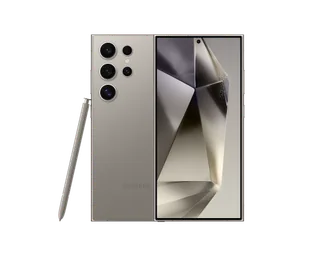
| Stylus | Yes | – |
| Materials | Titanium frame (not the volume and side keys), the first on a Galaxy phone | Glass rear; Titanium colour name does not establish a titanium frame |
| Colours | Titanium Grey, Titanium Black, Titanium Violet, Titanium Yellow; Titanium Blue, Titanium Green and Titanium Orange (online only) | Titanium, White and Grey |
| Water resistance detail | IP68, tested for submersion in up to 1.5 m of fresh water for up to 30 minutes; not advised for beach or pool use | Maker confirms both IP68 and IP69 |
| Biometrics | Fingerprint sensor | In-display ultrasonic fingerprint sensor |
| Sensors | Accelerometer, barometer, fingerprint sensor, gyro sensor, geomagnetic sensor, Hall sensor, light sensor, proximity sensor | Accelerometer, ambient light, proximity, gyroscope, compass, front/rear colour temperature, ultrasonic fingerprint, laser focus, infrared blaster, flicker and multispectral sensors; X-axis linear motor |
| Speakers | Stereo speakers | Stereo speakers; three microphones and four recording channels |
| Software | ||
| Operating system | Android | Android |
| Software at launch | One UI 6.1 (Android 14) | Android 14 with OriginOS 4, China market |
| Software updates | Seven generations of OS upgrades and seven years of security updates; security updates until 31 January 2031 (UK) | – |
| AI features | Galaxy AI, including Live Translate, Interpreter, Note Assist, Transcript Assist and Generative Edit; Circle to Search with Google | – |
| Connectivity | ||
| Mobile network | 5G Sub6 (FDD, TDD, SDL); 4G LTE (FDD, TDD); 3G WCDMA; 2G GSM | China model; GSM 850/900/1800/1900 MHz, CDMA BC0; WCDMA B1/2/4/5/6/8/19; LTE FDD B1/2/3/4/5/7/8/12/17/18/19/20/25/26/28/66, TDD B34/38/39/40/41/42; 5G n1/2/3/5/7/8/12/20/25/26/28/38/40/41/66/77/78/79 |
| SIM | Two nano-SIMs, nano-SIM and eSIM, or dual eSIM | Two nano-SIMs, dual SIM dual standby |
| Wi-Fi | Wi-Fi 7 (802.11a/b/g/n/ac/ax/be), 2.4, 5 and 6 GHz, EHT320, MIMO, 4096-QAM | Wi-Fi 6 and 7, 2.4/5 GHz, 2 × 2 MIMO, MU-MIMO and simultaneous 2.4/5 GHz connection |
| Bluetooth | Bluetooth 5.3 | Bluetooth 5.4; SBC, AAC, aptX, aptX HD, aptX Adaptive, aptX Lossless, LDAC and LHDC 5.0 |
| Ultra Wideband | Yes | – |
| NFC | Yes | Supported |
| Satellite features | – | Tiantong satellite communication on the 16 GB/1 TB version only; regional service requirements apply |
| USB | USB Type-C, USB 3.2 Gen 1 | USB 3.2 Gen 1, OTG and DisplayPort video output |
| Positioning | GPS, Glonass, Beidou, Galileo, QZSS | GPS L1/L5, BeiDou B1C/B1I/B2a, GLONASS G1, Galileo E1/E5a, QZSS L1/L5, A-GPS, cellular and Wi-Fi positioning |

More comparisons
- Samsung Galaxy S24 Ultra vs Samsung Galaxy S26 FE
- vivo X100 Ultra vs vivo X300 Ultra
- Samsung Galaxy S24 Ultra vs Samsung Galaxy S26
- Samsung Galaxy S24 Ultra vs Samsung Galaxy S26 Ultra
- Samsung Galaxy S24 Ultra vs Samsung Galaxy S26+
- vivo X100 Ultra vs vivo X300 FE
- vivo X100 Ultra vs vivo X300
- vivo X100 Ultra vs vivo X300 Pro
- Samsung Galaxy S24 Ultra vs Samsung Galaxy S25 FE
- Samsung Galaxy S24 Ultra vs Xiaomi Xiaomi 15T Pro
- vivo X100 Ultra vs vivo X200 FE
- Samsung Galaxy S24 Ultra vs Samsung Galaxy S25 Edge
- vivo X100 Ultra vs vivo X200 Ultra
- Samsung Galaxy S24 Ultra vs Samsung Galaxy S25 Ultra
- Samsung Galaxy S24 Ultra vs Samsung Galaxy S25
- vivo X100 Ultra vs vivo X200