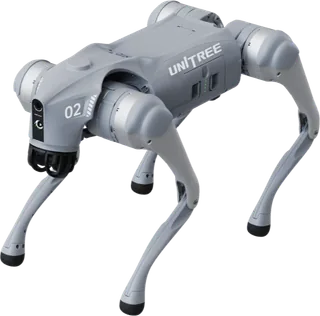
Sony aibo ERS-1000 vs Unitree Go2
Better figure, where one is clearly better
| Sonyaibo ERS-1000 | UnitreeGo2 | |
|---|---|---|
| Overview | ||
| Released | – | – |
| Task and control | ||
| Form | Quadruped | Quadruped |
| Use | Companion | Companion, Education, Research |
| User programming | – | Yes |
| Phone app | Yes | Yes |
| Intended use | – | Air and Pro provide remote-control and demonstration functions; EDU is the maker's configuration for robotics research and secondary development. |
| Movement | – | Air 0–2.5 m/s, Pro 0–3.5 m/s and X/EDU 0–3.7 m/s, with an approximately 5 m/s maximum claim for X/EDU. Published climbing angles are 30° for Air and 40° for the other configurations; performance depends on terrain and configuration. |
| Autonomy | – | LiDAR-based detection and avoidance are listed across the range. ISS 2.0 side-following is included on Pro, X and EDU, rather than Air. Demonstrations and AI descriptions do not establish general autonomous household work. |
| User programming | – | The maker lists graphical programming across the range, so basic app programming is distinct from full secondary development. Its comparison table lists none for Air/Pro, partial access for X and full access for EDU; select the development configuration required for the task. |
| Remote control | – | App control; handheld controller optional on Air/Pro and included with X/EDU in the maker's comparison. Store bundles also offer Air/Pro with a controller. |
| Cloud and offline operation | AI Cloud Plan supports cloud learning and connected services. | – |
| Subscription | US bundle includes a three-year AI Cloud Plan; continuing cloud service has separate terms. | – |
| Regional availability | US Sony store offers the White ERS-1000 with an active cart and estimated 5–6 October delivery when checked. Sony Japan ended domestic sales in June 2026; availability is regional. | The official global store accepts orders for Air, Pro and X; its selected product variants are available and its delivery note says shipment within one month. EDU requires a sales quotation. Freight, import clearance and destination rules apply; this is not a statement of immediate UK warehouse stock. Checked October 2026. |
| Release details | First-sale date omitted pending exact sale evidence; the original announcement’s planned date is not used as proof. | Unitree's dated press release confirms the announcement on 12 July 2023. The first retail delivery date is not established by the sources used; the store listing's creation date is not treated as first sale. |
| Hardware | ||
| Degrees of freedom | 22 | 12 |
| Height | 293 mm | 400 mm |
| Width | 180 mm | 310 mm |
| Depth | 305 mm | 700 mm |
| Robot weight | 2.2 kg | 15 kg |
| Camera | Yes | Yes |
| Microphone | Yes | – |
| Wi-Fi | Yes | Yes |
| Bluetooth | – | Yes |
| Processing | – | Eight-core high-performance CPU listed for Pro, X and EDU; the maker's table does not list that computing specification for Air. EDU offers additional compute modules, including Orin configurations. |
| Sensors | Two six-axis sensors, motion sensor, two ranging sensors, ToF sensor, light sensor, head/jaw touch, back pressure touch and four paw-pad sensors. | Ultra-wide-angle 4D LiDAR and HD wide-angle camera across the range; foot-end force sensors and a depth camera are listed for EDU. |
| Camera | Front camera and SLAM camera. | Front HD wide-angle camera; real-time image transmission through the app. EDU adds a depth camera. |
| Audio | Four microphones and a speaker. | Voice function is listed for Pro, X and EDU; the maker marks it absent for Air. |
| Display | Two OLED eye displays. | – |
| Actuators | 22 degrees of freedom. | Twelve aluminium knee-joint motor assemblies; approximately 45 N·m maximum largest-joint torque is listed for Pro/X/EDU. This is not the torque of every joint or a combined total. |
| Payload | – | Air approximately 7 kg, maximum approximately 10 kg; Pro approximately 8 kg, maximum approximately 10 kg; X/EDU approximately 8 kg, maximum approximately 12 kg. Retain the maker's distinction between normal and maximum loads. |
| Connections | LTE and 802.11b/g/n Wi-Fi. | Dual-band Wi-Fi 6 and Bluetooth 5.2/4.2/2.1; 4G module with GPS on Pro/X/EDU rather than Air. |
| Size and weight | Approximately 180 × 293 × 305 mm (width × height × depth), excluding protruding parts. | Standing length × width × height 70 × 31 × 40 cm; crouching 76 × 31 × 20 cm. Approximately 15 kg with battery; aluminium alloy and high-strength engineering plastic. |
| Durability | – | No ingress-protection rating is published on the exact Go2 specification page used. |
| Battery | ||
| Battery life (maker's claim) | Approximately 120 minutes in standard mode | About 1–2 hours / About 2–4 hours |
| Battery capacity | – | 8,000–15,000 mAh |
| Automatic dock return | Yes | – |
| Battery | Approximately 14 W electrical consumption in standard mode; this is not motor power. | Standard battery 8,000 mAh on Air/Pro/X; long-endurance 15,000 mAh battery listed for EDU. Battery removable. Operating voltage 28–33.6 V. |
| Charging | Approximately three hours to charge; charging station and AC adapter supplied. | Air/Pro/X standard 33.6 V 3.5 A charger; EDU 33.6 V 9 A fast charger. |
| Runtime conditions | – | Maker claims about 1–2 hours with the standard battery and about 2–4 hours with the long-endurance battery. The headline longer runtime is not standard across configurations; actual runtime varies by conditions. |
| Dock | – | Charging-pile compatibility is listed for X and EDU, absent for Air/Pro. Compatibility alone does not establish an autonomous return-to-dock function or an included dock. |