Sony Alpha 7 vs Sony Alpha 7 III
Better figure, where one is clearly better
| SonyAlpha 7 | SonyAlpha 7 III | |
|---|---|---|
| Overview | ||
| Released | November 2013 | March 2018 |
| Image and sensor | ||
| Camera type | Mirrorless | Mirrorless |
| Sensor format | Full frame | Full frame |
| Sensor type | Exmor CMOS | Back-illuminated Exmor R CMOS |
| Sensor dimensions | 35.8 × 23.9 mm | 35.6 × 23.8 mm |
| Effective resolution | 24.3 MP | 24.2 MP |
| Largest image | 6000 × 4000 | 6000 × 4000 |
| RAW recording | Yes | Yes |
| Standard ISO range | 100–25600 | 100–51200 |
| Sensor detail | Approximately 24.7 million total pixels; 3:2 sensor; anti-static coating and ultrasonic dust reduction | Approximately 25.3 million total pixels; 3:2 back-illuminated sensor. |
| Image formats | JPEG, RAW and RAW+JPEG; Sony ARW 2.3; 14-bit RAW output | JPEG and Sony ARW 2.3 RAW, including uncompressed RAW. Sony's announcement limits compressed RAW continuous shooting to 12 bits; 14-bit output is not universal in every mode. |
| ISO detail | Standard still-image ISO 100–25600; expanded ISO 50. Multi Frame NR offers ISO 51200 by combining images, rather than extending the standard single-image range. | Standard still-image ISO 100–51200; expanded ISO 50–204800. Video ISO 100–51200 expands up to ISO 102400. |
| Image processor | BIONZ X | BIONZ X with front-end LSI. |
| Lens and shooting | ||
| Lens mount | Sony E-mount | Sony E-mount |
| Stabilisation | Optical lens stabilisation | Sensor shift |
| Maximum continuous burst | 5 fps | 10 fps |
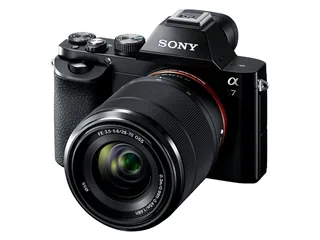
| Lens detail | Interchangeable E-mount; full-frame FE lenses use the whole sensor, while APS-C lenses use a crop. ILCE-7K includes FE 28–70mm F3.5–5.6 OSS; the photograph shows this kit. | – |
| Autofocus | Fast Hybrid AF; 117 phase-detection and 25 contrast-detection points in full-frame mode; single AF, continuous AF, direct manual focus and manual focus; Eye AF and Lock-on AF | Fast Hybrid AF with 693 phase-detection and 425 contrast-detection points; phase-detection covers approximately 93% of the image area. Eye AF supports continuous AF. |
| Shutter | Electronically controlled focal-plane shutter; 30 seconds to 1/8000 second plus Bulb; flash sync 1/250 second | Focal-plane shutter; 30 seconds to 1/8000 second plus Bulb; electronic first curtain and silent electronic shooting. |
| Burst detail | Approximately 5 fps Speed Priority Continuous or 2.5 fps normal continuous shooting. Sony's original ILCE-7/7R Help Guide states that speed-priority focus normally fixes at the first image, but specifically permits phase-detection AF with Continuous AF on the ILCE-7; exposure behaviour depends on AEL-with-shutter settings. Speed and tracking depend on shooting conditions and lens compatibility. Sony specifies a speed-priority buffer of 25 RAW or 23 RAW+JPEG photographs. | Up to approximately 10 fps in Hi+ with AF/AE tracking using mechanical or silent shooting; approximately 8 fps in Hi with live view. Maximum speed depends on settings and lens compatibility. Silent shooting can distort moving subjects. Sony gives buffers of approximately 177 standard JPEG, 89 compressed RAW or 40 uncompressed RAW images under its UHS-II SDXC test conditions. |
| Stabilisation detail | No sensor-shift stabilisation; optical correction requires a compatible OSS lens | Five-axis image-sensor shift; Sony claims 5 stops under CIPA conditions for pitch/yaw with Planar T* FE 50mm F1.4 ZA and long-exposure noise reduction off. Correction depends on the lens. |
| Flash | No built-in flash; external flash uses the Multi Interface Shoe | – |
| Exposure controls | Program, aperture priority, shutter priority and manual; Intelligent Auto, Superior Auto, scene modes, Sweep Panorama, DRO and Auto HDR | – |
| Video | ||
| Highest video resolution | 1920 × 1080 at 60 fps | 3840 × 2160 at 30 fps |
| Video detail | AVCHD Full HD 60p/24p on the Japanese model; PAL versions offer 50p/25p. Interlaced 60i/50i modes are separate from progressive frame rates. MP4 recording also available. HDMI 4K output is for still-image playback, not 4K movie recording. | Japanese/NTSC XAVC S 4K at 30p or 24p, approximately 100 or 60 Mbps; the UK PAL specification lists 25p. Full HD reaches 120p in NTSC modes. S-Log2, S-Log3 and HLG supported. Sony specifies different sensor readout at 24p and 30p; PhotographyBlog reports a 1.2× crop at 30p. Continuous recording is limited to approximately 29 minutes. |
| Audio | Built-in stereo microphone; 3.5 mm microphone and headphone sockets; recording-level adjustment and audio-level display | Built-in stereo microphone; 3.5 mm microphone and headphone sockets. |
| Screen and viewfinder | ||
| Viewfinder | Electronic | Electronic |
| Screen size | 3″ | 3″ |
| Screen dots | 921,600 | 921,600 |
| Touchscreen | No | Yes |
| Tilting screen | Yes | Yes |
| Display detail | TFT screen tilts approximately 90° up or 45° down; dots count colour subpixels | TFT screen tilts approximately 107° up and 41° down; touch focus is supported. Dots count colour subpixels. |
| Viewfinder detail | 0.5-inch XGA OLED Tru-Finder; 2,359,296 dots; 100% coverage; approximately 0.71× magnification with a 50 mm lens at infinity | 0.5-inch electronic viewfinder; 2,359,296 dots; 100% coverage and approximately 0.78× magnification with a 50 mm lens at infinity. |
| Connections and design | ||
| Wi-Fi | Yes | Yes |
| Bluetooth | – | Yes |
| Battery life (maker's claim) | 340 photographs | 710 photographs |
| Body weight | 416 g (better) | 565 g |
| Release detail | Sony Japan specifies 15 November 2013 for the original ILCE-7 body and ILCE-7K kit, following its 16 October announcement. This is not the higher-resolution Alpha 7R or a later Alpha 7 generation. | Sony Japan specifies 23 March 2018 for the ILCE-7M3 body and ILCE-7M3K kit, following its 27 February announcement; this is the Japanese sale date, not a UK release claim. |
| Recording media | SD, SDHC and SDXC including UHS-I; Memory Stick PRO Duo, PRO-HG Duo and XC-HG Duo | Two card slots; slot 1 supports UHS-I and UHS-II SD cards, while slot 2 supports UHS-I SD and compatible Memory Stick media. |
| Ports | Multi/Micro USB, Micro HDMI, microphone and headphone sockets, Multi Interface Shoe | USB-C with USB 3.1 Gen 1, Multi/Micro USB, Micro HDMI, microphone and headphone sockets and Multi Interface Shoe. |
| Wireless connections | Built-in Wi-Fi and NFC | Wi-Fi IEEE 802.11b/g/n at 2.4 GHz, Bluetooth 4.1 and NFC. |
| Battery life detail | NP-FW50; Sony Japan claims approximately 340 photographs using the monitor or 270 using the viewfinder under CIPA conditions | NP-FZ100; approximately 710 photographs with the monitor or 610 with the viewfinder under CIPA conditions. |
| Charging | USB charging in the camera | USB-C or Multi/Micro USB charging and power supply. |
| Dimensions | Approximately 126.9 × 94.4 × 48.2 mm (width × height × depth) in Sony's launch table; the Japanese specification also gives 54.8 mm from grip to viewfinder, versus 48.2 mm from grip to monitor | Approximately 126.9 × 95.6 × 73.7 mm maximum (width × height × depth); Sony also gives 62.7 mm from grip to monitor. |
| Weight detail | Approximately 416 g body only; 474 g including battery and Memory Stick PRO Duo; both exclude the lens | Approximately 565 g body only; 650 g including battery and memory card; lens excluded. |
| In the box | – | NP-FZ100 battery, AC adaptor AC-UUD12, shoulder strap, body cap, accessory shoe cap, eyepiece cup and Micro USB cable, according to Sony Japan. |
| Materials | Magnesium-alloy top cover and internal structure; dust- and moisture-resistant design, not a waterproof rating | – |

More comparisons
- Sony Alpha 7 III vs Sony Alpha 7R VI
- Sony Alpha 7 vs Sony Alpha 7R VI
- Sony Alpha 7 vs Sony Alpha 7 V
- Sony Alpha 7 III vs Sony Alpha 7 V
- Sony Alpha 1 II vs Sony Alpha 7 III
- Sony Alpha 1 II vs Sony Alpha 7
- Sony Alpha 7 III vs Sony Alpha 9 III
- Sony Alpha 7 vs Sony Alpha 9 III
- Sony Alpha 7 III vs Sony Alpha 7C II
- Sony Alpha 7 III vs Sony Alpha 7CR
- Sony Alpha 7 vs Sony Alpha 7C II
- Sony Alpha 7 vs Sony Alpha 7CR
- Sony Alpha 6700 vs Sony Alpha 7 III
- Sony Alpha 6700 vs Sony Alpha 7
- Sony Alpha 7 III vs Sony Alpha 7R V
- Sony Alpha 7 vs Sony Alpha 7R V