Sony Alpha 7 vs Sony Alpha 7 V
Better figure, where one is clearly better
| SonyAlpha 7 | SonyAlpha 7 V | |
|---|---|---|
| Overview | ||
| Released | November 2013 | December 2025 |
| Image and sensor | ||
| Camera type | Mirrorless | Mirrorless |
| Sensor format | Full frame | Full frame |
| Sensor type | Exmor CMOS | Partially stacked Exmor RS CMOS |
| Sensor dimensions | 35.8 × 23.9 mm | 35.9 × 23.9 mm |
| Effective resolution | 24.3 MP | 33 MP |
| Largest image | 6000 × 4000 | 7008 × 4672 |
| RAW recording | Yes | Yes |
| Standard ISO range | 100–25600 | 100–51200 |
| Sensor detail | Approximately 24.7 million total pixels; 3:2 sensor; anti-static coating and ultrasonic dust reduction | Approximately 35.7 million total pixels; partially stacked full-frame sensor with optical low-pass filter. Sony's up-to-16-stop dynamic-range claim applies to stills with the mechanical shutter, not a review measurement. |
| Image formats | JPEG, RAW and RAW+JPEG; Sony ARW 2.3; 14-bit RAW output | JPEG, HEIF and RAW in Sony ARW 6.0 format; single-image effective resolution is 33 MP, distinct from software composite or enlarged output |
| ISO detail | Standard still-image ISO 100–25600; expanded ISO 50. Multi Frame NR offers ISO 51200 by combining images, rather than extending the standard single-image range. | Standard still-image ISO 100–51200; expanded ISO 50–204800. Movie ISO 100–51200, expandable to 102400. |
| Image processor | BIONZ X | BIONZ XR2 with integrated AI processing functions |
| Lens and shooting | ||
| Lens mount | Sony E-mount | Sony E-mount |
| Stabilisation | Optical lens stabilisation | Sensor shift |
| Maximum continuous burst | 5 fps | 30 fps |
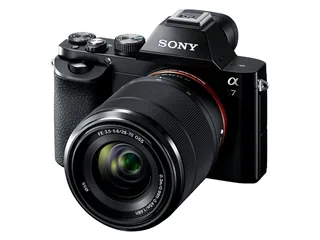
| Lens detail | Interchangeable E-mount; full-frame FE lenses use the whole sensor, while APS-C lenses use a crop. ILCE-7K includes FE 28–70mm F3.5–5.6 OSS; the photograph shows this kit. | – |
| Autofocus | Fast Hybrid AF; 117 phase-detection and 25 contrast-detection points in full-frame mode; single AF, continuous AF, direct manual focus and manual focus; Eye AF and Lock-on AF | Fast Hybrid AF with up to 759 phase-detection points; recognition for humans, animals, birds, insects, cars, trains and aeroplanes, plus automatic subject selection. Maker claims up to 94% frame coverage; AF-S detection down to EV −4 with an F2.0 lens at ISO 100. |
| Shutter | Electronically controlled focal-plane shutter; 30 seconds to 1/8000 second plus Bulb; flash sync 1/250 second | Electronic shutter 1/16000 second to 30 seconds; mechanical shutter 1/8000 second to 30 seconds plus Bulb; full-frame flash sync 1/250 second |
| Burst detail | Approximately 5 fps Speed Priority Continuous or 2.5 fps normal continuous shooting. Sony's original ILCE-7/7R Help Guide states that speed-priority focus normally fixes at the first image, but specifically permits phase-detection AF with Continuous AF on the ILCE-7; exposure behaviour depends on AEL-with-shutter settings. Speed and tracking depend on shooting conditions and lens compatibility. Sony specifies a speed-priority buffer of 25 RAW or 23 RAW+JPEG photographs. | Hi+ up to 30 fps electronically with AF/AE tracking and 14-bit RAW, or 10 fps mechanically. Electronic Hi+ is blackout-free; speed depends on lens, card, format and shooting conditions. Pre-capture can retain up to one second before full shutter press. Maker maximum-speed buffer figures include 185 Fine JPEG, 95 RAW or 35 lossless-compressed RAW photographs under its test conditions. |
| Stabilisation detail | No sensor-shift stabilisation; optical correction requires a compatible OSS lens | Five-axis sensor shift; maker claims 7.5 stops at the centre and 6.5 at the periphery under CIPA 2024 pitch/yaw/roll conditions with FE 50mm F1.2 GM and long-exposure noise reduction off. Dynamic Active movie mode adds more crop than Active mode. |
| Flash | No built-in flash; external flash uses the Multi Interface Shoe | – |
| Exposure controls | Program, aperture priority, shutter priority and manual; Intelligent Auto, Superior Auto, scene modes, Sweep Panorama, DRO and Auto HDR | – |
| Video | ||
| Highest video resolution | 1920 × 1080 at 60 fps | 3840 × 2160 at 120 fps |
| Video detail | AVCHD Full HD 60p/24p on the Japanese model; PAL versions offer 50p/25p. Interlaced 60i/50i modes are separate from progressive frame rates. MP4 recording also available. HDMI 4K output is for still-image playback, not 4K movie recording. | Internal 4K up to 120p NTSC or 100p PAL in APS-C/Super 35 mode; full-frame 4K 60p/50p uses 7K oversampling with 4K Angle of View Priority on. XAVC S and XAVC HS support 10-bit 4:2:2; XAVC S-I 4K reaches 60p/50p. No RAW movie output. USB streaming is separate, up to 4K 30p/25p or Full HD 60p/50p. |
| Audio | Built-in stereo microphone; 3.5 mm microphone and headphone sockets; recording-level adjustment and audio-level display | – |
| Screen and viewfinder | ||
| Viewfinder | Electronic | Electronic |
| Screen size | 3″ | 3.2″ |
| Screen dots | 921,600 | 2,095,104 |
| Touchscreen | No | Yes |
| Tilting screen | Yes | Yes |
| Display detail | TFT screen tilts approximately 90° up or 45° down; dots count colour subpixels | Four-axis multi-angle TFT; approximately 98° upwards, 40° downwards, 180° sideways and 270° rotation; dots count colour subpixels |
| Viewfinder detail | 0.5-inch XGA OLED Tru-Finder; 2,359,296 dots; 100% coverage; approximately 0.71× magnification with a 50 mm lens at infinity | 0.5-type OLED; 3,686,400 dots; approximately 0.78× magnification; 60 or 120 fps display |
| Connections and design | ||
| Wi-Fi | Yes | Yes |
| Bluetooth | – | Yes |
| Battery life (maker's claim) | 340 photographs | 750 photographs |
| Body weight | 416 g (better) | 610 g |
| Release detail | Sony Japan specifies 15 November 2013 for the original ILCE-7 body and ILCE-7K kit, following its 16 October announcement. This is not the higher-resolution Alpha 7R or a later Alpha 7 generation. | Sony Europe's announcement states body availability to purchase from 2 December 2025; Sony Japan specifies 19 December 2025. The Japanese ILCE-7M5M lens kit followed on 10 April 2026 rather than the body's date. |
| Recording media | SD, SDHC and SDXC including UHS-I; Memory Stick PRO Duo, PRO-HG Duo and XC-HG Duo | Slot 1 accepts CFexpress 2 Type A or UHS-I/II SD; slot 2 accepts UHS-I/II SD |
| Ports | Multi/Micro USB, Micro HDMI, microphone and headphone sockets, Multi Interface Shoe | Full-size HDMI Type A; two USB-C ports, port 1 at 10Gbps USB 3.2 and port 2 at 480Mbps USB 2.0; 3.5 mm microphone and headphone sockets; Multi Interface Shoe with digital audio |
| Wireless connections | Built-in Wi-Fi and NFC | Wi-Fi 802.11a/b/g/n/ac/ax, including Wi-Fi 6E at 2.4/5/6 GHz where regional rules permit; Bluetooth 5.3; no NFC |
| Battery life detail | NP-FW50; Sony Japan claims approximately 340 photographs using the monitor or 270 using the viewfinder under CIPA conditions | NP-FZ100; maker CIPA claim approximately 750 photographs using the monitor or 630 using the viewfinder |
| Charging | USB charging in the camera | In-camera USB-C charging and power supply; USB Power Delivery supported |
| Dimensions | Approximately 126.9 × 94.4 × 48.2 mm (width × height × depth) in Sony's launch table; the Japanese specification also gives 54.8 mm from grip to viewfinder, versus 48.2 mm from grip to monitor | Approximately 130.3 × 96.4 × 82.4 mm maximum; 72.3 mm depth from grip to monitor |
| Weight detail | Approximately 416 g body only; 474 g including battery and Memory Stick PRO Duo; both exclude the lens | Approximately 610 g body only or 695 g with battery and memory card. Photography Blog's narrative mislabels 695 g as excluding battery/card; TechRadar lists 659 g. Main weight follows Sony's exact body-only specification. |
| In the box | – | NP-FZ100 battery, shoulder strap, body cap, accessory shoe cap and eyepiece cup, according to Sony UK |
| Materials | Magnesium-alloy top cover and internal structure; dust- and moisture-resistant design, not a waterproof rating | – |

More comparisons
- Canon EOS R8 Mark II vs Sony Alpha 7 V
- Sony Alpha 7 V vs Sony Cyber-shot DSC-RX10 V
- Sony Alpha 7 V vs Sony Alpha 7R VI
- Sony Alpha 7 vs Sony Alpha 7R VI
- Panasonic LUMIX S1II vs Sony Alpha 7 V
- Canon EOS R6 Mark III vs Sony Alpha 7 V
- Nikon Z6III vs Sony Alpha 7 V
- Sony Alpha 7 V vs Sony Alpha DSLR-A290
- Sony Alpha 7 V vs Sony Alpha DSLR-A390
- Sony Alpha 7 V vs Sony Alpha DSLR-A450
- Sony Alpha 7 V vs Sony Alpha DSLR-A560
- Sony Alpha 7 V vs Sony Alpha DSLR-A230
- Sony Alpha 7 V vs Sony Alpha DSLR-A330
- Sony Alpha 7 V vs Sony Alpha DSLR-A380
- Sony Alpha 7 V vs Sony Alpha DSLR-A500
- Sony Alpha 7 V vs Sony Alpha DSLR-A550