Sony Cyber-shot DSC-H400 vs Sony Cyber-shot DSC-P92
Better figure, where one is clearly better
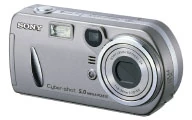
| SonyCyber-shot DSC-H400 | SonyCyber-shot DSC-P92 | |
|---|---|---|
| Overview | ||
| Released | 2014 | 2003 |
| Image and sensor | ||
| Camera type | Bridge | Compact |
| Sensor format | 1/2.3-type | 1/1.8-type |
| Sensor type | Super HAD CCD | Super HAD CCD |
| Effective resolution | 20.1 MP | 5.09 MP |
| Largest image | 5152 × 3864 | 2592 × 1944 |
| RAW recording | No | No |
| Standard ISO range | 80–3200 | 100–400 |
| Sensor detail | 1/2.3-type CCD with 20.4 million total photosites; optical format is not a physical dimension | 1/1.8-type primary-colour Super HAD CCD; exact operating instructions give approximately 5.255 million total and 5.09 million effective photosites. Sony launch rounds these to 5.3 and 5.1 MP |
| Image formats | JPEG (DCF, Exif and MPF Baseline); Sweep Panorama stitches multiple exposures separately from sensor resolution | JPEG Exif 2.2 stills with Fine/Standard compression; GIF Clip Motion and MPEG-1 movies or mono voice-with-still recording. No RAW recording |
| ISO detail | – | Auto or manually selected ISO 100, 200 or 400 |
| Image processor | – | 14-bit DXP A/D conversion; Clear Colour NR, Clear Luminance NR and NR Slow Shutter processing |
| Lens and shooting | ||
| Built-in lens | 24.5–1550 mm equivalent | 39–117 mm equivalent |
| Maximum aperture | f/3.4–6.5 | f/2.8–5.6 |
| Optical zoom | 63× | 3× |
| Stabilisation | Optical lens stabilisation | – |
| Maximum continuous burst | 0.71 fps | – |
| Lens detail | Sony lens, actual 4.4–277 mm; 24.5–1550 mm equivalent for stills. Movie equivalents 32.1–2029 mm at 16:9 or 29.2–1849 mm at 4:3. 55 mm filter diameter; not a ZEISS lens | Physical focal length 8–24 mm, equivalent to 39–117 mm, F2.8–5.6 in the exact Sony launch and manual. Normal autofocus from 50 cm wide or 60 cm tele; Macro from 10 cm wide or 60 cm tele. Lens retracts and its automatic cover closes when powered off. Smart Zoom crops at lower image sizes, up to 12× total at VGA; no Smart Zoom at maximum 5.0M or 4.5M (3:2) size |
| Autofocus | Multi-point, centre, spot, tracking and face-tracking autofocus; AF illuminator. Published minimum distance approximately 1 cm wide or 3.5 m telephoto | Multi AF or centre AF with AF-assist illuminator; preset distances 0.5, 1, 3, 7 m and infinity, not continuous manual focusing |
| Shutter | Intelligent Auto 2–1/2000 second, Program 1–1/2000, Manual 30–1/2000 | Automatic 2–1/2000 second in the exact Sony Japan P92 table; no manual shutter selection. Contemporary secondary tables state a 1/1000-second limit; maker table retained |
| Burst detail | Approximately 0.71 fps at maximum still resolution, up to 100 frames | Burst 3 captures three full-size images with an approximately 0.5-second interval in the exact manual; brief three-shot mode, not an unrestricted continuous rate. Multi Burst stores sixteen subframes in one 1.2M composite with 1/30, 1/15 or 1/7.5-second intervals. Maker lists 1.6 seconds between maximum-size single shots and 2.3-second startup, distinct from burst rate |
| Stabilisation detail | Optical SteadyShot; optical zoom available during movie recording | – |
| Flash | Built-in pop-up flash; ISO Auto range approximately 0.4–8.8 m wide or 3.5–4.6 m telephoto. Advanced Flash increases sensitivity; no external flash connection | Built-in Auto, forced, off and slow-sync flash with red-eye reduction and daylight fill. ISO Auto recommended distance 0.5–3.8 m wide or 0.6–2.5 m tele in the exact manual |
| Exposure controls | Intelligent Auto, Easy, Program, aperture priority, shutter priority, Manual, Sweep Panorama, scene selection and picture effects; ±2 EV in 1/3 EV steps; manual exposure offers F3.4 or F8.1 at maximum wide angle, F6.5 or F8.0 at maximum telephoto, rather than a continuous aperture range | Automatic and Program exposure with ±2 EV in 1/3 EV steps, multi-pattern/spot metering, Twilight, Twilight Portrait, Landscape, Snow and Beach scenes; no aperture/shutter priority or manual exposure |
| Video | ||
| Highest video resolution | 1280 × 720 at 30 fps | 640 × 480 at 16 fps |
| Video detail | MP4 MPEG-4 AVC/H.264, 1280×720 at 30 progressive fps in Fine or Standard quality; VGA at 30 fps. No 1080p recording; Fine approximately 9 Mbps, Standard 6 Mbps, VGA 3 Mbps. General continuous recording limit approximately 29 minutes; 720p Fine approximately 15 minutes due to 2 GB file limit. HD movies require a memory card | MPEG-1 VX 640×480 at 16 fps with mono sound in Sony US launch specifications reproduced by DPReview. Mail 160×112 mode is separate. Clip length limited by card capacity; zoom cannot change during recording |
| Audio | Built-in monaural microphone and speaker; exact Sony operating instructions distinguish these from incorrect stereo descriptions in some reviews | Built-in electret condenser microphone and dynamic speaker. Mono movie sound; still-image voice memo for five seconds after a tap or up to 40 seconds while holding the shutter |
| Screen and viewfinder | ||
| Viewfinder | Electronic | Optical |
| Screen size | 3″ | 1.5″ |
| Screen dots | 460,800 | 123,200 |
| Touchscreen | No | No |
| Tilting screen | No | No |
| Display detail | Fixed 3-inch TFT LCD with 460800 colour-subpixel dots and five brightness settings | Fixed 1.5-type TFT with 123,200 colour-subpixel dots (560×220); these are not image pixels |
| Viewfinder detail | 0.2-type electronic viewfinder with approximately 201600 equivalent dots, 100% coverage and dioptre adjustment; manual screen/viewfinder switching | Optical zoom finder; Smart Zoom cropping and Macro framing differ from finder image, so maker directs Macro use to LCD |
| Connections and design | ||
| Wi-Fi | No | – |
| Battery life (maker's claim) | 300 photographs | – |
| Body weight | 628 g | 198.5 g (better) |
| Release detail | Sony announced planned March 2014 US and April 2014 UK availability; April reviews describe the sold camera. Earliest worldwide actual first-sale month remains unresolved, so year precision retained | Sony Japan announced planned availability on 16 May 2003. Exact ePHOTOzine test on 11 August and Pixinfo test on 14 August describe the sold camera and contemporary prices, confirming actual sale in 2003; earliest actual retail month remains unresolved, so year precision retained. No explicit direct predecessor relationship established |
| Recording media | Approximately 55 MB internal memory; Memory Stick Duo/PRO Duo/PRO-HG Duo/XC-HG Duo, Memory Stick Micro, SD/SDHC/SDXC and microSD/microSDHC/microSDXC, using appropriate adapters | Memory Stick and Memory Stick PRO; 16 MB Memory Stick supplied. Sony launch and manual cover PRO through 1 GB, excluding high-speed PRO transfer. Duo requires its adaptor |
| Ports | USB / A/V OUT jack for USB 2.0 and standard-definition analogue video/audio output; no HDMI | USB mini-B with mass-storage or PTP connection, mono A/V OUT minijack with selectable NTSC/PAL, DC IN for optional AC-LS5. Sony US launch calls USB 2.0 compatibility; ePHOTOzine found no transfer-speed improvement using a USB 2.0 connection, so Hi-Speed performance is not established |
| Battery life detail | NP-BX1 lithium-ion battery, nominal 3.6 V, 1240 mAh / 4.5 Wh. CIPA approximately 300 stills/150 minutes using LCD or 320 stills/160 minutes using viewfinder. Typical movie shooting approximately 60/75 minutes LCD/viewfinder; continuous movies approximately 120/135 minutes | Two supplied NH-AA-DA Ni-MH AA cells; R6 alkaline AA also supported. Exact manual average-use test at 25°C and Fine compression: approximately 270 images/135 minutes with LCD on or 450 images/225 minutes off, one image every 30 seconds, alternating zoom ends, flash every second image and restart every ten; not labelled CIPA. Sony alkaline comparison: 50 images/25 minutes on or 110 images/55 minutes off. Continuous 160×112 movies approximately 160 minutes on or 210 off; manual 5,400 images/270 minutes is playback, not shooting |
| Charging | In-camera USB charging with supplied AC-UB10C adapter or a computer; camera switched off. Approximately 230 minutes for a full charge using supplied adapter; supplied adapter supports playback power but not shooting power. Shooting mains power requires separately sold AC-UD10 or region-dependent AC-UD11 | Supplied external BC-CS2A/CS2B charger: approximately six hours for depleted supplied Ni-MH cells at 25°C. Optional BC-CSQ2 quick charger approximately 2.5 hours for two cells or five hours for four; these are not standard charger times |
| Dimensions | 129.6×95.0×122.3 mm width×height×depth (CIPA) | 119.5×57.7×36.8 mm width×height×depth, excluding protruding portions in the exact manual |
| Weight detail | Approximately 628 g body only; approximately 655 g with NP-BX1 battery and Memory Stick PRO Duo under CIPA conditions | Approximately 198.5 g body only in the Sony Japan launch; approximately 260.5 g with two batteries, Memory Stick and wrist strap in the exact manual |
| Materials | Sony states the camera is not dust-proof, splash-proof or waterproof | – |
| Colours | Black | – |
| In the box | NP-BX1 battery, AC-UB10C adapter, dedicated USB cable, shoulder strap, lens cap and instructions; mains lead supplied outside USA, Canada and China | Two rechargeable AA Ni-MH cells, battery case, BC-CS2A/CS2B charger and mains lead, 16 MB Memory Stick, USB and mono A/V cables, wrist strap, software CD and operating instructions; AC-LS5 optional |

More comparisons
- Sony Cyber-shot DSC-H400 vs Sony Cyber-shot DSC-HX99
- Sony Cyber-shot DSC-HX99 vs Sony Cyber-shot DSC-P92
- Sony Cyber-shot DSC-H400 vs Sony Cyber-shot DSC-HX350
- Sony Cyber-shot DSC-HX350 vs Sony Cyber-shot DSC-P92
- Sony Cyber-shot DSC-H400 vs Sony Cyber-shot DSC-HX80
- Sony Cyber-shot DSC-HX80 vs Sony Cyber-shot DSC-P92
- Sony Cyber-shot DSC-H400 vs Sony Cyber-shot DSC-HX90V
- Sony Cyber-shot DSC-HX90V vs Sony Cyber-shot DSC-P92
- Sony Cyber-shot DSC-H400 vs Sony Cyber-shot DSC-WX500
- Sony Cyber-shot DSC-P92 vs Sony Cyber-shot DSC-WX500
- Sony Cyber-shot DSC-H400 vs Sony Cyber-shot DSC-HX400V
- Sony Cyber-shot DSC-H400 vs Sony Cyber-shot DSC-HX60V
- Sony Cyber-shot DSC-HX400V vs Sony Cyber-shot DSC-P92
- Sony Cyber-shot DSC-HX60V vs Sony Cyber-shot DSC-P92
- Sony Cyber-shot DSC-H200 vs Sony Cyber-shot DSC-H400
- Sony Cyber-shot DSC-H400 vs Sony Cyber-shot DSC-HX300