Sony Cyber-shot DSC-HX1 vs Sony Cyber-shot DSC-RX10 IV
Better figure, where one is clearly better
| SonyCyber-shot DSC-HX1 | SonyCyber-shot DSC-RX10 IV | |
|---|---|---|
| Overview | ||
| Released | April 2009 | October 2017 |
| Image and sensor | ||
| Camera type | Bridge | Bridge |
| Sensor format | Other | 1.0-type |
| Sensor type | Exmor CMOS | Exmor RS stacked CMOS with DRAM |
| Sensor dimensions | – | 13.2 × 8.8 mm |
| Effective resolution | 9.1 MP | 20.1 MP |
| Largest image | 3456 × 2592 | 5472 × 3648 |
| RAW recording | No | Yes |
| Standard ISO range | 125–3200 | 100–12800 |
| Sensor detail | 1/2.4-type progressive-scan Exmor CMOS; 10.3 million total and 9.1 million effective photosites. Optical format is not a physical sensor measurement | 1.0-type optical format; physical dimensions 13.2 × 8.8 mm; stacked processing circuitry and attached DRAM memory |
| Image formats | Fine or Standard JPEG still photographs; no RAW recording. Sweep Panorama produces stitched images up to 7152 × 1080 pixels horizontally | JPEG and RAW (Sony ARW 2.3); XAVC S and AVCHD 2.0 movies |
| ISO detail | Burst and bracket shooting, DRO Plus and Advanced Sports modes limit the selectable range to ISO 125–800; ordinary still shooting extends to ISO 3200 | Standard single-frame ISO 100–12800; extended ISO 64/80; multi-shot noise reduction reaches ISO 25600 |
| Image processor | BIONZ; 12-bit DXP processing | BIONZ X and front-end LSI |
| Lens and shooting | ||
| Built-in lens | 28–560 mm equivalent | 24–600 mm equivalent |
| Maximum aperture | f/2.8–5.2 | f/2.4–4 |
| Optical zoom | 20× | 25× |
| Stabilisation | Optical lens stabilisation | Optical lens stabilisation |
| Maximum continuous burst | 10 fps | 24 fps |
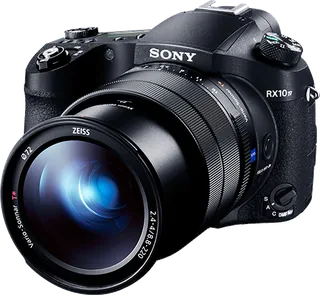
| Lens detail | Sony G lens with actual 5–100 mm focal range; 13 elements in 10 groups including one aspherical and one ED element; 57 mm filter diameter. Optional VCL-DH1757 1.7× teleconverter is separate from the built-in lens | ZEISS Vario-Sonnar T*; actual 8.8–220 mm; 18 elements in 13 groups, including six aspherical elements; nine-blade aperture; no built-in ND filter |
| Autofocus | Nine-point multi AF, centre AF, flexible spot, semi-manual and manual focus; AF illuminator. Focus distance from lens front is approximately 1 cm to infinity at wide angle and 150 cm to infinity at telephoto | Fast Hybrid AF with 315 phase-detection points covering approximately 65% of the frame and 25 contrast-detection areas; AF-S, AF-A, AF-C, direct manual focus and manual focus; Eye AF, Lock-on AF and focus range limiter at 150–600 mm equivalent |
| Shutter | Mechanical shutter; Sony specifies 2–1/4000 second in Auto, 1–1/4000 in Program, 30–1/4000 in shutter priority or Manual and 8–1/2000 in aperture priority | Mechanical manual mode permits Bulb and 30 seconds to 1/2000 second at f/8 or smaller; maximum speed wide open is 1/1000 second. Electronic shutter reaches 1/32000 second. |
| Burst detail | Up to 10 full-resolution frames at 10 fps; High, Mid and Low drive modes. Focus, exposure and white balance remain fixed from the first photograph; flash is disabled and slow shutters reduce speed. Internal-memory burst recording is limited to VGA; full-resolution bursts require a supported card | Up to 24 fps Hi with AF/AE tracking, 10 fps Mid or 3.5 fps Low; maker buffer claim up to 249 Fine JPEG images in Hi mode; rate slows after the buffer fills |
| Stabilisation detail | Optical SteadyShot with continuous or shooting-only operation | Optical still-image stabilisation; maker claim up to 4.5 stops at 600 mm equivalent under CIPA conditions. Intelligent Active movie mode adds electronic correction. |
| Flash | Automatic pop-up flash with forced, off and slow-sync modes; ISO Auto range approximately 0.3–9.2 m wide and 1.5–5.1 m telephoto; ±2 EV adjustment in 1/3 EV steps | Built-in flash and Multi Interface Shoe for compatible accessories |
| Exposure controls | Program, aperture priority, shutter priority and Manual; multi-pattern, centre-weighted and spot metering; ±2 EV in 1/3 EV steps. Hand-held Twilight and Anti Motion Blur combine six exposures into one image | – |
| Video | ||
| Highest video resolution | 1440 × 1080 at 30 fps | 3840 × 2160 at 30 fps |
| Video detail | MP4 MPEG-4 AVC/H.264; 1440 × 1080 at approximately 30 fps in Fine or Standard, 1280 × 720 at 30 fps and 640 × 480 at 30 fps. Optical zoom remains available while filming; maximum continuous clip approximately 29 minutes or 2 GB. Recorded width is 1440 pixels rather than 1920 | NTSC XAVC S 4K up to 3840 × 2160 at 30p or 24p, up to 100 Mbps, with full-pixel readout without binning; approximately 29-minute recording limit. Full HD up to 120p. Separate HFR captures 240/480/960 fps for approximately four seconds in quality mode or seven in duration mode, with reduced-resolution sensor readout encoded as Full HD; no audio. PAL is selectable; S-Log2, S-Log3 and proxy recording supported. |
| Audio | Built-in stereo microphone and playback speaker | Stereo recording; LPCM or Dolby Digital by recording format; microphone input and headphone monitoring |
| Screen and viewfinder | ||
| Viewfinder | Electronic | Electronic |
| Screen size | 3″ | 3″ |
| Screen dots | 230,400 | 1,440,000 |
| Touchscreen | – | Yes |
| Tilting screen | Yes | Yes |
| Display detail | Clear Photo LCD Plus TFT with adjustable angle and brightness | LCD tilts approximately 109° upwards and 41° downwards; Touch Focus and Touch Pad focus-point selection; backlit top settings display |
| Viewfinder detail | Electronic viewfinder with approximately 201,000 equivalent dots | 0.39-type OLED with 2,359,296 dots, 100% coverage and approximately 0.70× equivalent magnification |
| Connections and design | ||
| Wi-Fi | – | Yes |
| Bluetooth | – | Yes |
| Battery life (maker's claim) | 390 photographs | 400 photographs |
| Body weight | 453 g (better) | 1050 g |
| Release detail | Sony's US announcement, reproduced in full by DPReview, specifies April 2009 availability. Sony Japan gives 24 April 2009 for Japanese sale; the international first day is not established | Sony announced October 2017 shipments in North America, without a day; Japan went on sale on 6 October, after preorder opening on 20 September. Sony described RX10 III as an existing current model; no direct replacement inferred. |
| Recording media | Memory Stick Duo, PRO Duo and PRO-HG Duo; approximately 11 MB internal memory. Fine, Standard and 720 video modes require PRO Duo or PRO-HG Duo | SD, SDHC, SDXC and Memory Stick variants; XAVC S requires Class 10 or faster SDHC/SDXC, and 100 Mbps requires UHS-I U3 |
| Ports | Proprietary multi terminal for USB, AV output and HDMI through the supplied adapter; Hi-Speed USB 2.0 and DC input. HDMI cable is separate | Multi/Micro USB with USB 2.0, Micro HDMI, Multi Interface Shoe, 3.5 mm microphone input and headphone output |
| Wireless connections | – | Wi-Fi 802.11b/g/n at 2.4 GHz, NFC and Bluetooth connection for location information from a compatible phone |
| Battery life detail | NP-FH50 InfoLithium H battery; maker CIPA claim approximately 390 still photographs or 195 minutes, and approximately 150 minutes continuous movie recording | NP-FW50; CIPA maker claim approximately 400 photographs using LCD or 370 using viewfinder |
| Charging | Supplied BC-VH1-series battery charger | USB charging and power supply during shooting or playback |
| Dimensions | Approximately 114.5 × 82.8 × 91.8 mm (width × height × depth) | Approximately 132.5 × 94 × 145 mm from lens front to viewfinder; 127.4 mm depth from lens front to monitor |
| Weight detail | Approximately 453 g camera only; 504 g with NP-FH50 battery and Memory Stick Duo, according to Sony's original announcement and archived specifications | Approximately 1050 g body only or 1095 g with battery and media |
| Colours | – | Black |
| In the box | NP-FH50 battery, BC-VH1-series charger, dedicated USB/AV cable, HDMI adapter, shoulder strap, lens cap and cap strap, software CD and instructions; power cable varies by region | – |

More comparisons
- Sony Cyber-shot DSC-RX10 IV vs Sony Cyber-shot DSC-RX10 V
- Sony Cyber-shot DSC-HX1 vs Sony Cyber-shot DSC-HX99
- Sony Cyber-shot DSC-HX100V vs Sony Cyber-shot DSC-RX10 IV
- Sony Cyber-shot DSC-HX200V vs Sony Cyber-shot DSC-RX10 IV
- Sony Cyber-shot DSC-RX10 vs Sony Cyber-shot DSC-RX10 IV
- Sony Cyber-shot DSC-RX10 II vs Sony Cyber-shot DSC-RX10 IV
- Sony Cyber-shot DSC-RX10 III vs Sony Cyber-shot DSC-RX10 IV
- Sony Cyber-shot DSC-HX350 vs Sony Cyber-shot DSC-RX10 IV
- Sony Cyber-shot DSC-HX1 vs Sony Cyber-shot DSC-HX350
- Sony Cyber-shot DSC-HX1 vs Sony Cyber-shot DSC-HX80
- Sony Cyber-shot DSC-HX1 vs Sony Cyber-shot DSC-HX90V
- Sony Cyber-shot DSC-HX1 vs Sony Cyber-shot DSC-WX500
- Sony Cyber-shot DSC-HX1 vs Sony Cyber-shot DSC-HX400V
- Sony Cyber-shot DSC-HX1 vs Sony Cyber-shot DSC-HX60V
- Sony Cyber-shot DSC-H400 vs Sony Cyber-shot DSC-HX1
- Sony Cyber-shot DSC-HX1 vs Sony Cyber-shot DSC-HX100V