Sony Cyber-shot DSC-S600 vs Sony Cyber-shot DSC-T1
Better figure, where one is clearly better
| SonyCyber-shot DSC-S600 | SonyCyber-shot DSC-T1 | |
|---|---|---|
| Overview | ||
| Released | 2006 | November 2003 |
| Image and sensor | ||
| Camera type | Compact | Compact |
| Sensor format | Other | Other |
| Sensor type | Super HAD CCD | Super HAD CCD |
| Effective resolution | 6 MP | 5.1 MP |
| Largest image | 2816 × 2112 | 2592 × 1944 |
| RAW recording | No | No |
| Standard ISO range | 80–1000 | 100–400 |
| Sensor detail | 6.0 million effective pixels and 6.1 million gross pixels in exact Hong Kong maker release; optical 1/2.5-type is not a physical sensor measurement | 1/2.4-type interlaced Super HAD CCD; 5.3 million total and 5.1 million effective photosites; 14-bit analogue-to-digital conversion |
| Image formats | JPEG, maximum 2816×2112, 2816×1872 3:2 or 1920×1080 16:9. Clear RAW NR refers to internal noise processing, not RAW file recording | JPEG stills; 2592 × 1728 3:2 setting and smaller sizes; Fine or Standard compression |
| Image processor | Sony Real Imaging Processor | Real Imaging Processor |
| Lens and shooting | ||
| Built-in lens | 31–93 mm equivalent | 38–114 mm equivalent |
| Maximum aperture | f/2.8–5.1 | f/3.5–4.4 |
| Optical zoom | 3× | 3× |
| Lens detail | Carl Zeiss Vario-Tessar physical 5.1–15.3 mm F2.8–5.1, equivalent to 31–93 mm. Autofocus close limit 12 cm wide / 50 cm telephoto, automatic close focusing rather than a separate macro mode | Carl Zeiss Vario-Tessar, actual 6.7–20.1 mm; folded optics with eight groups and eleven elements, including three aspherical elements and a prism; lens moves inside the body rather than extending |
| Autofocus | Multi-area or centre autofocus, Single or Monitor AF and AF illuminator. No manual focus or focus-distance presets | Five-area multi-point AF; normal focus from 50 cm, macro from 8 cm wide or 25 cm telephoto; Magnifying Glass mode focuses from 1–20 cm at wide angle |
| Shutter | Exact UK archive gives Auto 1/8–1/2000 second; scene-dependent slower shutter and slow-shutter noise reduction | Maker table specifies 1/8–1/1000 second in Auto, 1–1/1000 second in Program and 1/250–1/1000 second in High-speed Shutter scene |
| Burst detail | Exact UK maker archive lists maximum seven frames and approximately 0.8-second interval, not sustained burst. Multi Burst stores 16 subframes together in one image | Brief burst of up to four full-resolution photographs with speed or framing priority; separate Multi Burst mode is not full-resolution continuous shooting |
| Flash | Auto ISO range approximately 0.2–7.0 m wide / 0.5–3.8 m telephoto. Exact Hong Kong release separately gives ISO1000 range 0.8–11.0 m wide / 0.5–6.4 m telephoto; 11 m is not the Auto ISO range | Built-in automatic, forced, off or slow-sync flash; no external flash connection |
| Exposure controls | Auto, Program auto and seven scenes including High Sensitivity; no manual exposure or aperture/shutter priority. ±2 EV compensation in 1/3 EV steps; multi-pattern or spot metering | Automatic and program exposure with ±2 EV compensation in 1/3 EV steps; eight scenes including fireworks and Magnifying Glass; Auto, Daylight, Cloudy, Fluorescent, Incandescent and Flash white balance |
| Video | ||
| Highest video resolution | 640 × 480 at 30 fps | 640 × 480 at 30 fps |
| Video detail | MPEG-1 mono audio; VGA Fine 640×480 at 30 fps requires Memory Stick PRO Duo. VGA Standard approximately 16.6 fps or 160×112 approximately 8.3 fps; optical zoom cannot change during movie recording | MPEG-1 with sound; 640 × 480 Fine at approximately 30 fps requires Memory Stick PRO Duo. Maker table gives approximately 17 fps Standard VGA and 8 fps 160 × 112 video-mail recording; duration limited by card capacity |
| Screen and viewfinder | ||
| Viewfinder | Optical | None |
| Screen size | 2″ | 2.5″ |
| Screen dots | 85,000 | 211,000 |
| Touchscreen | No | – |
| Tilting screen | No | – |
| Display detail | Fixed 2-inch TFT with approximately 85,000 dots; dots are not captured image pixels | Hybrid reflective/backlit TFT LCD with maker-stated 100% coverage; screen is the only viewfinder |
| Viewfinder detail | Separate optical finder | – |
| Connections and design | ||
| Battery life (maker's claim) | – | 170 photographs |
| Bluetooth | No | – |
| Body weight | 133 g (better) | 155 g |
| Release detail | Sony January 4 US announcement and January 10 Hong Kong announcement planned regional sale; Hong Kong stated early February. Exact March 2006 production-camera review establishes actual 2006 sale; earliest worldwide first-sale month remains unestablished, year precision retained. Sony Hong Kong expressly calls S40 the predecessor | Sony's original Japanese announcement specifies 21 November 2003 first sale; January in US launch coverage refers to later US availability |
| Recording media | 32 MB internal memory; optional Memory Stick Duo or Memory Stick PRO Duo. Full-size original Memory Stick cannot be inserted, and no card is supplied | Memory Stick Duo or PRO Duo; supplied 32 MB Duo card and adapter |
| Ports | Hi-Speed USB 2.0; no A/V output. Optional AC-LS5K power adaptor uses the battery-compartment connection | Camera multi-terminal mates with supplied cradle, which provides Hi-Speed USB 2.0, AV output and DC input |
| Battery life detail | Two supplied alkaline AA batteries. UK archive claims 130 shots/80 minutes CIPA, while exact Hong Kong maker table gives 160 shots/80 minutes. Optional 2500 mAh NiMH pair gives 460 shots; optional batteries and charger are not supplied. Unresolved supplied-cell conflict means headline shot count omitted | NP-FT1 InfoLithium; maker standard-use claim 170 photographs or 85 minutes with LCD on, flash for half of shots, power cycled every ten photographs and one photograph every 30 seconds. The original launch sheet does not call this CIPA testing |
| Charging | No charger supplied. Compatible optional rechargeable AA batteries require an external charger; supplied alkaline batteries must not be charged | Supplied USB cradle and AC power adapter; optional separate BC-TR1 charger |
| Dimensions | 99.9×52.0×36.8 mm width×height×depth in exact Hong Kong maker release; UK archive rounds width to99.0mm | 91 × 60 × 21 mm (width × height × depth); 17.3 mm at thinnest section |
| Weight detail | 133 g body; approximately181 g including batteries and wrist strap in exact maker release | Approximately 155 g camera only; 180 g including battery, Memory Stick Duo and hand strap |
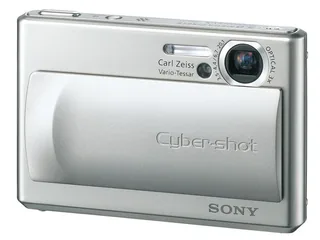
| Materials | – | Stainless steel body with sliding front lens cover |
| Colours | – | Silver or black in Sony's archived Japanese product listing |
| In the box | Two AA alkaline batteries, USB cable, wrist strap, software CD and guides. Optional rechargeable batteries, charger and AC-LS5K adaptor excluded | Japanese package includes NP-FT1, AC adapter, USB cradle, USB and AV cables, power cord, hand strap, software CD, 32 MB Memory Stick Duo and adapter |

More comparisons
- Sony Cyber-shot DSC-RX10 V vs Sony Cyber-shot DSC-T1
- Sony Alpha 6700 vs Sony Cyber-shot DSC-T1
- Sony Cyber-shot DSC-RX100 VII vs Sony Cyber-shot DSC-T1
- Sony Cyber-shot DSC-HX99 vs Sony Cyber-shot DSC-S600
- Sony Cyber-shot DSC-HX99 vs Sony Cyber-shot DSC-T1
- Sony Cyber-shot DSC-HX350 vs Sony Cyber-shot DSC-S600
- Sony Cyber-shot DSC-HX350 vs Sony Cyber-shot DSC-T1
- Sony Cyber-shot DSC-HX80 vs Sony Cyber-shot DSC-S600
- Sony Cyber-shot DSC-HX80 vs Sony Cyber-shot DSC-T1
- Sony Cyber-shot DSC-HX90V vs Sony Cyber-shot DSC-S600
- Sony Cyber-shot DSC-HX90V vs Sony Cyber-shot DSC-T1
- Sony Cyber-shot DSC-S600 vs Sony Cyber-shot DSC-WX500
- Sony Cyber-shot DSC-T1 vs Sony Cyber-shot DSC-WX500
- Sony Cyber-shot DSC-HX400V vs Sony Cyber-shot DSC-S600
- Sony Cyber-shot DSC-HX60V vs Sony Cyber-shot DSC-S600
- Sony Cyber-shot DSC-HX400V vs Sony Cyber-shot DSC-T1