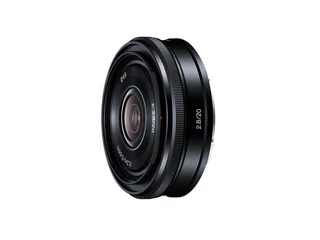
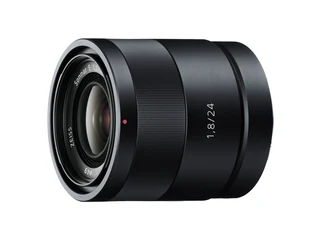
Sony E 20mm F2.8 vs Sony Sonnar T* E 24mm F1.8 ZA
Better figure, where one is clearly better
| SonyE 20mm F2.8 | SonySonnar T* E 24mm F1.8 ZA | |
|---|---|---|
| Overview | ||
| Released | March 2013 | December 2011 |
| Optics | ||
| Lens type | Prime | Prime |
| Focal length | 20 mm | 24 mm |
| Maximum aperture | f/2.8 | f/1.8 |
| Minimum aperture | f/16 | f/22 |
| Optical construction | Six elements in six groups | Eight elements in seven groups |
| Special elements | Three aspherical elements | Two aspherical elements and one ED glass element |
| Coatings | – | ZEISS T* coating |
| Diaphragm | Seven rounded blades | Seven rounded blades |
| Angle of view | 70° APS-C | 61° APS-C |
| Mount and compatibility | ||
| Mounts | Sony E | Sony E |
| Image circle | APS-C | APS-C |
| Image circle detail | APS-C coverage; 30 mm equivalent field of view | APS-C coverage; 36 mm equivalent field of view |
| Teleconverter support | Not compatible with Sony E-mount teleconverters | Not compatible with Sony E-mount teleconverters |
| Focus and stabilisation | ||
| Autofocus | Yes | Yes |
| Minimum focus distance | 0.2 m | 0.16 m |
| Maximum magnification | 0.12× | 0.25× |
| Optical stabilisation | No | No |
| Autofocus detail | – | Internal motor; maker does not identify a specific motor technology |
| Focus distance detail | 0.20 m minimum focus; manual-focus ring | 0.16 m minimum focus; internal focusing and electronically coupled manual-focus ring |
| Magnification detail | 0.12× maximum magnification | 0.25× maximum magnification; not classified as a dedicated macro lens |
| Stabilisation detail | No optical stabilisation | No optical stabilisation |
| Design | ||
| Filter diameter | 49 mm | 49 mm |
| Maximum diameter | 62.6 mm | 63 mm |
| Length | 20.4 mm | 65.5 mm |
| Weight | 69 g (better) | 225 g |
| Controls | Manual-focus ring; focus mode selected on the camera | Manual-focus ring; focus mode selected on camera; aluminium-alloy exterior |
| Dimensions detail | 62.6 mm maximum diameter × 20.4 mm length | 63 mm maximum diameter × 65.5 mm length |
| Weight detail | Approximately 69 g lens; separate hood and caps excluded | Approximately 225 g lens; separate hood and caps excluded |
| Lens hood | ALC-SH113 cap-type hood, supplied | ALC-SH114 petal bayonet hood, supplied |
| In the box | ALC-SH113 hood, front cap and rear cap; no case listed | ALC-SH114 hood, front cap, rear cap and soft case |
| Release detail | Sony Japan specifies 8 March 2013; the main date retains March month precision because exact global first day is not established. Sony’s US announcement dated 22 January 2013, reproduced by DPReview, and Sony Canada’s 29 January announcement specify later April availability in those markets. Full independently authored reviews read: Sony Alpha Lab Jay, predominantly NEX-6 with some NEX-3N samples (2013), and Sony Alpha Blog Marc Alhadeff, Alpha 6000 (2018). Lab’s raw comparison applies a lens profile and tone curve, whereas Blog’s sharpness verdict is more critical. Maker F16 minimum aperture supersedes Lab’s F22 table. Unpublished weather resistance/coatings omitted; no inferred direct replacement | Sony Japan’s 24 August2011 announcement specifies December2011 for this exact lens. Main date retains maker month precision; exact global first day is not established. Full independently authored reviews: Photography Blog MarkGoldstein May2012 on NEX-5N, including sharpness and conclusion pages, and OpticalLimits KlausSchroiff November2019. OpticalLimits discloses sample decentring and reports the best corner; its raw vignetting/bokeh/value criticisms differ from Blog’s practical verdict. Sony Hong Kong’s NEX-5N press release contains erroneous blanket OSS/twoED claims for all three different lenses and a camera/accessory availability table that omits this lens; these are not used for this model. Maker exact numeric specifications and Japan exact-model optical design take precedence. No unpublished weather-resistance claim |