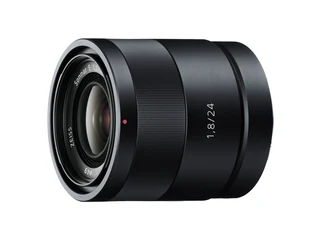
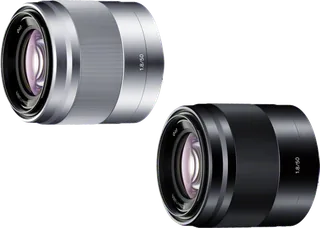
Sony Sonnar T* E 24mm F1.8 ZA vs Sony E 50mm F1.8 OSS
Better figure, where one is clearly better
| SonySonnar T* E 24mm F1.8 ZA | SonyE 50mm F1.8 OSS | |
|---|---|---|
| Overview | ||
| Released | December 2011 | December 2011 |
| Optics | ||
| Lens type | Prime | Prime |
| Focal length | 24 mm | 50 mm |
| Maximum aperture | f/1.8 | f/1.8 |
| Minimum aperture | f/22 | f/22 |
| Optical construction | Eight elements in seven groups | Nine elements in eight groups |
| Special elements | Two aspherical elements and one ED glass element | – |
| Coatings | ZEISS T* coating | – |
| Diaphragm | Seven rounded blades | Seven rounded blades |
| Angle of view | 61° APS-C | 32° APS-C |
| Mount and compatibility | ||
| Mounts | Sony E | Sony E |
| Image circle | APS-C | APS-C |
| Image circle detail | APS-C coverage; 36 mm equivalent field of view | APS-C coverage; 75 mm equivalent field of view |
| Teleconverter support | Not compatible with Sony E-mount teleconverters | Not compatible with Sony E-mount teleconverters |
| Focus and stabilisation | ||
| Autofocus | Yes | Yes |
| Minimum focus distance | 0.16 m | 0.39 m |
| Maximum magnification | 0.25× | 0.16× |
| Optical stabilisation | No | Yes |
| Autofocus detail | Internal motor; maker does not identify a specific motor technology | Internal motor and internal focusing; no specific drive designation published in read maker feature page |
| Focus distance detail | 0.16 m minimum focus; internal focusing and electronically coupled manual-focus ring | 0.39 m minimum focus; electronically coupled manual-focus ring |
| Magnification detail | 0.25× maximum magnification; not classified as a dedicated macro lens | 0.16× maximum magnification |
| Stabilisation detail | No optical stabilisation | Optical SteadyShot; Sony specifies approximately four stops, not guaranteed under every shooting condition |
| Design | ||
| Filter diameter | 49 mm | 49 mm |
| Maximum diameter | 63 mm | 62 mm |
| Length | 65.5 mm | 62 mm |
| Weight | 225 g | 202 g (better) |
| Controls | Manual-focus ring; focus mode selected on camera; aluminium-alloy exterior | Manual-focus ring; focus mode and optical stabilisation selected on the camera |
| Dimensions detail | 63 mm maximum diameter × 65.5 mm length | 62 mm maximum diameter × 62 mm length; aluminium-alloy exterior and internal focusing |
| Weight detail | Approximately 225 g lens; separate hood and caps excluded | Approximately 202 g lens; separate hood and caps excluded |
| Lens hood | ALC-SH114 petal bayonet hood, supplied | ALC-SH116 round bayonet hood |
| In the box | ALC-SH114 hood, front cap, rear cap and soft case | ALC-SH116 hood, front cap and rear cap; no case listed |
| Release detail | Sony Japan’s 24 August2011 announcement specifies December2011 for this exact lens. Main date retains maker month precision; exact global first day is not established. Full independently authored reviews: Photography Blog MarkGoldstein May2012 on NEX-5N, including sharpness and conclusion pages, and OpticalLimits KlausSchroiff November2019. OpticalLimits discloses sample decentring and reports the best corner; its raw vignetting/bokeh/value criticisms differ from Blog’s practical verdict. Sony Hong Kong’s NEX-5N press release contains erroneous blanket OSS/twoED claims for all three different lenses and a camera/accessory availability table that omits this lens; these are not used for this model. Maker exact numeric specifications and Japan exact-model optical design take precedence. No unpublished weather-resistance claim | Photography Blog’s contemporaneous 24 August 2011 US-price launch report specifies December availability; Imaging Resource’s later exact review corroborates end of 2011 release. Sony Japan delayed its local launch after Thai floods and finally specified 9 March 2012. Exact global first day unconfirmed. Sony Hong Kong added the black finish from September 2013; it is a colour configuration, not another generation. Two full independent reviews: Sony Alpha Lab Jay on NEX-5N, mostly corrected JPEG samples, and Sony Alpha Blog Marc Alhadeff on Alpha 6000. Their corner-sharpness judgments differ across bodies/tests. Unconfirmed ED glass/motor subtype in third-party descriptions omitted |
More comparisons
- Sony E 50mm F1.8 OSS vs Sony Sonnar T* FE 55mm F1.8 ZA
- Sony E 20mm F2.8 vs Sony Sonnar T* E 24mm F1.8 ZA
- Sony Sonnar T* E 24mm F1.8 ZA vs Sony E 35mm F1.8 OSS
- Sony E 35mm F1.8 OSS vs Sony E 50mm F1.8 OSS
- Sony DT 50mm F1.8 SAM vs Sony E 50mm F1.8 OSS
- Sony E 30mm F3.5 Macro vs Sony E 50mm F1.8 OSS
- Sony Sonnar T* E 24mm F1.8 ZA vs Sony E 30mm F3.5 Macro
- Sony E 16mm F2.8 vs Sony Sonnar T* E 24mm F1.8 ZA