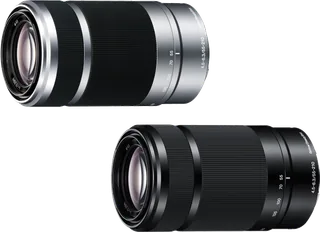
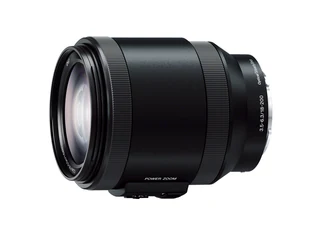
Sony E 55-210mm F4.5-6.3 OSS vs Sony E PZ 18-200mm F3.5-6.3 OSS
Better figure, where one is clearly better
| SonyE 55-210mm F4.5-6.3 OSS | SonyE PZ 18-200mm F3.5-6.3 OSS | |
|---|---|---|
| Overview | ||
| Released | October 2011 | November 2012 |
| Optics | ||
| Lens type | Zoom | Zoom |
| Focal length | 55–210 mm | 18–200 mm |
| Maximum aperture | f/4.5–6.3 | f/3.5–6.3 |
| Minimum aperture | f/22–32 | f/22–40 |
| Optical construction | Thirteen elements in nine groups | Seventeen elements in twelve groups |
| Special elements | Two ED glass elements and two aspherical elements | Four aspherical elements and one ED element (exact SELP18200 specification in Sony NEX-VG30H kit page) |
| Diaphragm | Seven rounded blades | Seven rounded blades |
| Angle of view | 28.2°–7.8° APS-C | 76°–8° APS-C |
| Mount and compatibility | ||
| Mounts | Sony E | Sony E |
| Image circle | APS-C | APS-C |
| Image circle detail | APS-C coverage; 82.5–315 mm equivalent field of view | APS-C coverage; 27–300 mm equivalent field of view |
| Teleconverter support | Not compatible with Sony E-mount teleconverters | Not compatible with Sony E-mount teleconverters |
| Focus and stabilisation | ||
| Autofocus | Yes | Yes |
| Minimum focus distance | 1 m | 0.3 m |
| Maximum magnification | 0.225× | 0.35× |
| Optical stabilisation | Yes | Yes |
| Autofocus detail | Internal motor and internal focusing; no specific motor designation published in read maker page | Linear motor; smooth quiet focusing and aperture operation |
| Focus distance detail | 1.0 m minimum focus; electronically coupled manual-focus ring | Minimum focus distance 0.3 m at 18 mm and 0.5 m at 200 mm |
| Magnification detail | 0.225× maximum magnification | 0.35× maximum magnification |
| Stabilisation detail | Optical SteadyShot; Sony’s original announcement claims up to approximately four stops, not guaranteed under every condition. Current spec page leaves stop rating blank | Built-in Optical SteadyShot with Active mode for enhanced wide-end movie stabilisation; no numeric stop rating in read exact maker lens page |
| Video features | – | Six-step zoom speed control with variable-speed and constant-speed operation; Active stabilisation mode |
| Design | ||
| Filter diameter | 49 mm | 67 mm |
| Maximum diameter | 63.8 mm | 93.2 mm |
| Length | 108 mm | 99 mm |
| Weight | 345 g (better) | 649 g |
| Controls | Separate zoom and manual-focus rings; focus mode and optical stabilisation selected on the camera | Focus and zoom rings, power zoom lever and zoom speed controls |
| Zoom design | Extending zoom barrel; internal focusing | Power zoom; aluminium-alloy exterior |
| Filter detail | – | 67 mm front filter thread |
| Weather resistance | – | No maker dust or moisture resistance claim in read exact pages |
| Dimensions detail | 63.8 mm maximum diameter × 108 mm length; aluminium-alloy exterior | 93.2 mm maximum diameter × 99 mm maker length |
| Weight detail | Approximately 345 g lens; separate hood and caps excluded | Approximately 649 g lens; separate hood and caps excluded |
| Lens hood | ALC-SH115 round bayonet hood | ALC-SH125 rectangular bayonet hood, supplied |
| In the box | ALC-SH115 hood, front cap and rear cap; no case listed | ALC-SH125 hood and front and rear caps; no case listed |
| Release detail | Sony Japan’s original announcement specifies October 2011, matching contemporaneous Photography Blog US launch coverage. Exact global first day unconfirmed. Full independent tests: Optical Limits/Photozone Klaus Schroiff, NEX-7, March 2012, and Sony Alpha Blog Marc Alhadeff, Alpha 6000, December 2018. Their long-end usability and autofocus impressions differ. Sony’s aluminium alloy and two aspherical plus two ED elements supersede Optical Limits magnesium-alloy/four-aspherical descriptions. No unconfirmed coatings or weather sealing adopted | Sony US camcorder announcement dated 11 September 2012 specifies November NEX-VG30H kit availability including exact SELP18200. Sony Japan announces kit 12 September with 14 December local sale; standalone lens later on 8 March 2013. Main release keeps earliest maker kit month, exact first global sale day unconfirmed. One accessible full exact review read: SonyAlphaLab Jason Hermann, principally NEX-6 with NEX-3N. ePHOTOzine exact review returns 403; no accessible eligible pair, so summary omitted. SonyAlphaLab unsupported four-stop claim and fixed-length statement not used. Maker six speed settings retained rather than review three-speed shorthand. No inferred predecessor link |
More comparisons
- Sony E 55-210mm F4.5-6.3 OSS vs Sony E 70-350mm F4.5-6.3 G OSS
- Sony E 18-135mm F3.5-5.6 OSS vs Sony E PZ 18-200mm F3.5-6.3 OSS
- Sony E PZ 18-105mm F4 G OSS vs Sony E PZ 18-200mm F3.5-6.3 OSS
- Sony E 18-200mm F3.5-6.3 OSS LE vs Sony E PZ 18-200mm F3.5-6.3 OSS
- Sony E 18-200mm F3.5-6.3 OSS LE vs Sony E 55-210mm F4.5-6.3 OSS