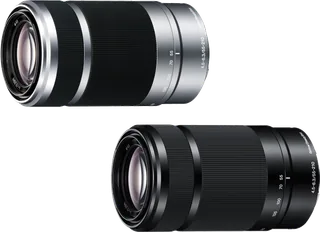
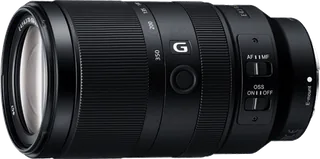
Sony E 55-210mm F4.5-6.3 OSS vs Sony E 70-350mm F4.5-6.3 G OSS
Better figure, where one is clearly better
| SonyE 55-210mm F4.5-6.3 OSS | SonyE 70-350mm F4.5-6.3 G OSS | |
|---|---|---|
| Overview | ||
| Released | October 2011 | October 2019 |
| Optics | ||
| Lens type | Zoom | Zoom |
| Focal length | 55–210 mm | 70–350 mm |
| Maximum aperture | f/4.5–6.3 | f/4.5–6.3 |
| Minimum aperture | f/22–32 | f/22–32 |
| Optical construction | Thirteen elements in nine groups | Nineteen elements in thirteen groups |
| Special elements | Two ED glass elements and two aspherical elements | One aspherical element and three ED glass elements |
| Diaphragm | Seven rounded blades | Seven rounded blades |
| Angle of view | 28.2°–7.8° APS-C | 22°–4°40′ APS-C |
| Mount and compatibility | ||
| Mounts | Sony E | Sony E |
| Image circle | APS-C | APS-C |
| Image circle detail | APS-C coverage; 82.5–315 mm equivalent field of view | APS-C coverage; 105–525 mm equivalent field of view |
| Teleconverter support | Not compatible with Sony E-mount teleconverters | Not compatible with SEL14TC or SEL20TC |
| Focus and stabilisation | ||
| Autofocus | Yes | Yes |
| Minimum focus distance | 1 m | 1.1 m |
| Maximum magnification | 0.225× | 0.23× |
| Optical stabilisation | Yes | Yes |
| Autofocus detail | Internal motor and internal focusing; no specific motor designation published in read maker page | XD linear motor for autofocus |
| Focus distance detail | 1.0 m minimum focus; electronically coupled manual-focus ring | Minimum focus 1.1 m at wide angle or 1.5 m at telephoto |
| Magnification detail | 0.225× maximum magnification | 0.23× maximum magnification at 350 mm |
| Stabilisation detail | Optical SteadyShot; Sony’s original announcement claims up to approximately four stops, not guaranteed under every condition. Current spec page leaves stop rating blank | Optical SteadyShot; no maker lens-only stop rating published. Digital Camera World measured approximately three stops in its test, not a maker guarantee |
| Design | ||
| Dust and moisture resistant | – | Yes |
| Filter diameter | 49 mm | 67 mm |
| Maximum diameter | 63.8 mm | 77 mm |
| Length | 108 mm | 142 mm |
| Weight | 345 g (better) | 625 g |
| Controls | Separate zoom and manual-focus rings; focus mode and optical stabilisation selected on the camera | Separate zoom and manual-focus rings, AF/MF switch, OSS on/off switch, zoom lock and one customisable focus-hold button |
| Zoom design | Extending zoom barrel; internal focusing | Extending zoom barrel with lock; Photography Blog measured approximately 48 mm additional extension at 350 mm |
| Filter detail | – | 67 mm front filter thread; filter does not rotate during focusing (Photography Blog) |
| Weather resistance | – | Dust- and moisture-resistant design; not guaranteed completely dust- or moisture-proof |
| Dimensions detail | 63.8 mm maximum diameter × 108 mm length; aluminium-alloy exterior | 77 mm maximum diameter × 142 mm length |
| Weight detail | Approximately 345 g lens; separate hood and caps excluded | Approximately 625 g lens; separate hood and caps excluded |
| Lens hood | ALC-SH115 round bayonet hood | ALC-SH160 round bayonet hood |
| In the box | ALC-SH115 hood, front cap and rear cap; no case listed | ALC-SH160 hood, ALC-F67S front cap and ALC-R1EM rear cap; no case listed |
| Release detail | Sony Japan’s original announcement specifies October 2011, matching contemporaneous Photography Blog US launch coverage. Exact global first day unconfirmed. Full independent tests: Optical Limits/Photozone Klaus Schroiff, NEX-7, March 2012, and Sony Alpha Blog Marc Alhadeff, Alpha 6000, December 2018. Their long-end usability and autofocus impressions differ. Sony’s aluminium alloy and two aspherical plus two ED elements supersede Optical Limits magnesium-alloy/four-aspherical descriptions. No unconfirmed coatings or weather sealing adopted | Sony Hong Kong specified mid-October 2019 availability. Photography Blog Mark Goldstein tested Alpha 6600; Digital Camera World Chris George and Matthew Richards identify Alpha 6600 sample images and Alpha 6400 raw lab testing. Stabilisation, long-end sharpness and flare judgments differ. Sony’s 1.1 m wide-angle focus supersedes Photography Blog’s repeated 1.5 m. Its 350 mm sharpness prose incorrectly says F5.6 despite F6.3 test crops. Digital Camera World raw lab distortion results supersede its conflicting all-focal-length pincushion prose. Unpublished fluorine/Nano AR/Linear Response MF claims are not borrowed from the 16–55 sibling |
More comparisons
- Nikon NIKKOR Z DX 50-250mm f/4.5-6.3 VR vs Sony E 70-350mm F4.5-6.3 G OSS
- Sony E 18-135mm F3.5-5.6 OSS vs Sony E 70-350mm F4.5-6.3 G OSS
- Sony E 70-350mm F4.5-6.3 G OSS vs Sony FE 70-300mm F4.5-5.6 G OSS
- Sony E 70-350mm F4.5-6.3 G OSS vs Sony FE 100-400mm F4.5-5.6 GM OSS
- Sony E 55-210mm F4.5-6.3 OSS vs Sony E PZ 18-200mm F3.5-6.3 OSS
- Sony E 18-200mm F3.5-6.3 OSS LE vs Sony E 55-210mm F4.5-6.3 OSS