Sony FE 12-24mm F2.8 GM vs Sony FE 8–14mm F3.5 Fisheye G
Better figure, where one is clearly better
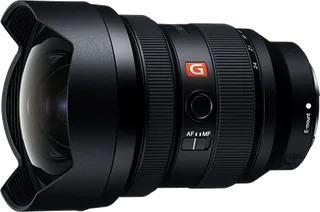
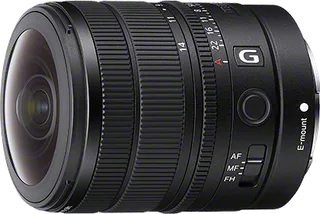
| SonyFE 12-24mm F2.8 GM | SonyFE 8–14mm F3.5 Fisheye G | |
|---|---|---|
| Overview | ||
| Released | July 2020 | September 2026 |
| Optics | ||
| Lens type | Zoom | Zoom |
| Focal length | 12–24 mm | 8–14 mm |
| Maximum aperture | f/2.8 | f/3.5 |
| Minimum aperture | f/22 | f/22 |
| Optical construction | 17 elements in 14 groups | 16 elements in 13 groups |
| Special elements | Three XA extreme-aspherical elements, one aspherical element, three ED and two Super ED glass elements | ED glass and aspherical elements |
| Coatings | Nano AR Coating II; fluorine coating on front element | Fluorine front-element coating |
| Diaphragm | Nine rounded blades | Seven rounded blades |
| Angle of view | 122°–84° full frame; 99°–61° APS-C | 180° full frame; 180°–116° APS-C |
| Projection | – | Circular fisheye at 8 mm; frame-filling diagonal fisheye at 14 mm. Neither is rectilinear. |
| Mount and compatibility | ||
| Mounts | Sony E | Sony E |
| Image circle | Full frame | Full frame |
| Image circle detail | Full-frame coverage; 18–36 mm equivalent field of view on APS-C | Full-frame coverage; Sony lists 12–21 mm APS-C focal-length equivalents, which do not describe rectilinear fields of view |
| Teleconverter support | Not compatible with SEL14TC or SEL20TC | Not compatible with SEL14TC or SEL20TC |
| Focus and stabilisation | ||
| Autofocus | Yes | Yes |
| Minimum focus distance | 0.28 m | 0.15 m |
| Maximum magnification | 0.14× | 0.22× |
| Optical stabilisation | No | No |
| Autofocus detail | Four XD linear motors, two per floating focus group; internal focusing | Two linear motors; Linear Response MF; up to120fps AF/AE tracking with Alpha9III under Sony test conditions, not a universal camera limit |
| Focus distance detail | Minimum focus 0.28 m throughout the zoom range; Linear Response MF | – |
| Magnification detail | Maximum magnification 0.14× | Maximum 0.22× magnification at the telephoto end |
| Stabilisation detail | No lens stabilisation; compatible bodies provide stabilisation | No lens stabilisation; compatible bodies provide stabilisation |
| Video features | – | Maker specifies suppressed breathing and quiet operation; spatial content can use two lenses with separate VENICE Extension System Mini units |
| Design | ||
| Dust and moisture resistant | Yes | Yes |
| Maximum diameter | 97.6 mm | 63.1 mm |
| Length | 137 mm | 82.8 mm |
| Weight | 847 g | 314 g (better) |
| Controls | AF/MF switch, one customisable focus-hold button, zoom and focus rings; no aperture ring | AF/MF/focus-hold mode switch, zoom lock and aperture ring with switchable click stops |
| Zoom design | – | Internal zoom minimises shifts in centre of gravity |
| Filter detail | No front filter thread; rear holder accepts cut sheet filters, with cutting template supplied | No threaded front filter attachment; supplied filter template |
| Weather resistance | Dust- and moisture-resistant design; not guaranteed completely dust- or moisture-proof | Dust- and moisture-resistant design; not guaranteed completely dust- or moisture-proof |
| Weight detail | Approximately 847 g lens with integral hood; separate caps excluded | Approximately 314 g lens; separately supplied hood and caps excluded |
| Lens hood | Fixed petal hood integrated into the lens | ALC-SH186 petal-shaped bayonet hood; remove for circular fisheye shooting |
| In the box | Locking front cap, ALC-R1EM rear cap, soft carrying case and filter template | ALC-SH186 hood, front cap, ALC-R1EM rear cap and filter template |
| Release detail | Sony Australia specified late July 2020 availability; Sony UK specified August for Europe and Japan specified 7 August, separate from 14 July pre-orders. Main date uses the earliest maker-confirmed July precision. TechRadar’s 24–48 mm APS-C equivalent is inconsistent with maker18–36 mm; Photography Blog’s focal-range section uses the APS-C angles, with maker full-frame angles retained here. Review distortion and corner-darkening differences are preserved | Sony UK announced on 8 September 2026 with availability from the end of September 2026; exact first-sale day is not published. Sony Japan gives 9 October 2026 for that market. Amateur Photographer’s at-a-glance text says 8–16 mm; Sony’s 8–14 mm range is used. |
More comparisons
- Sony FE 16–35mm F2.8 GM II vs Sony FE 8–14mm F3.5 Fisheye G
- Sony FE 16-25mm F2.8 G vs Sony FE 8–14mm F3.5 Fisheye G
- Sony FE 12-24mm F4 G vs Sony FE 8–14mm F3.5 Fisheye G
- Sony FE 12-24mm F2.8 GM vs Sony FE 16-25mm F2.8 G
- Sony FE 12-24mm F2.8 GM vs Sony FE 16–35mm F2.8 GM II
- Sony FE 12-24mm F2.8 GM vs Sony FE 14mm F1.8 GM
- Sony FE 12-24mm F2.8 GM vs Sony FE 12-24mm F4 G
- Sony FE 12-24mm F2.8 GM vs Sony FE 16-35mm F2.8 GM