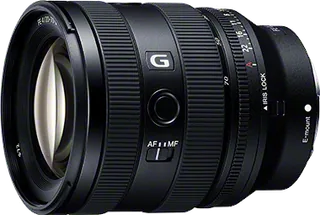
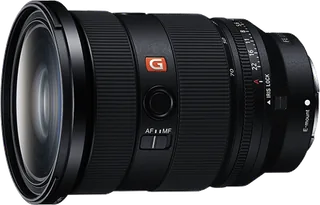
Sony FE 20-70mm F4 G vs Sony FE 24–70mm F2.8 GM II
Better figure, where one is clearly better
| SonyFE 20-70mm F4 G | SonyFE 24–70mm F2.8 GM II | |
|---|---|---|
| Overview | ||
| Released | February 2023 | May 2022 |
| Optics | ||
| Lens type | Zoom | Zoom |
| Focal length | 20–70 mm | 24–70 mm |
| Maximum aperture | f/4 | f/2.8 |
| Minimum aperture | f/22 | f/22 |
| Optical construction | 16 elements in 13 groups | 20 elements in 15 groups; OpticalLimits gives 22/16 in its table but 20/15 in the text, so maker figures are used |
| Special elements | Two AA advanced-aspherical elements, one aspherical element, three ED glass elements and one ED aspherical element | Five aspherical elements including two XA; two ED and two Super ED elements |
| Coatings | Fluorine coating on the front element; optimised antireflection coatings without a maker Nano AR designation | Nano AR Coating II; fluorine front-element coating |
| Diaphragm | Nine rounded blades | 11 rounded blades |
| Angle of view | 94°–34° full frame; 70°–23° APS-C | 84°–34° full frame; 61°–23° APS-C |
| Mount and compatibility | ||
| Mounts | Sony E | Sony E |
| Image circle | Full frame | Full frame |
| Image circle detail | Full-frame coverage; 30–105 mm equivalent field of view on APS-C | Full-frame coverage; 36–105 mm equivalent field of view on APS-C |
| Teleconverter support | Not compatible with SEL14TC or SEL20TC | Not compatible with SEL14TC or SEL20TC |
| Focus and stabilisation | ||
| Autofocus | Yes | Yes |
| Minimum focus distance | 0.25 m | 0.21 m |
| Maximum magnification | 0.39× | 0.32× |
| Optical stabilisation | No | No |
| Autofocus detail | Two XD linear motors; internal focusing; compatible Alpha 1 30 fps bursts require maker-specified shutter-speed and AF conditions | Four XD linear motors; floating focus; Linear Response MF |
| Focus distance detail | Autofocus minimum 0.30 m at 20 mm or0.25 m at 70 mm; manual focus minimum 0.25 m throughout the zoom range; Linear Response MF | Minimum focus 0.21 m at 24 mm or 0.30 m at 70 mm |
| Magnification detail | Maximum magnification 0.39× | – |
| Stabilisation detail | No lens stabilisation; compatible bodies provide stabilisation | No lens stabilisation; compatible bodies provide stabilisation |
| Video features | Reduced focus breathing and focus/axis shifts during zooming; compatible-body breathing compensation may alter field of view and quality. Body Active Mode requires compatibility and slightly narrows the field of view | Breathing compensation with compatible cameras; compensation crops the image |
| Design | ||
| Dust and moisture resistant | Yes | Yes |
| Filter diameter | 72 mm | 82 mm |
| Maximum diameter | 78.7 mm | 87.8 mm |
| Length | 99 mm | 119.9 mm |
| Weight | 488 g (better) | 695 g |
| Controls | Aperture ring with click on/off and Iris Lock switch, AF/MF switch and two customisable focus-hold buttons | Aperture ring, click on/off and iris-lock switches, two focus-hold buttons, AF/MF switch and Tight/Smooth zoom-resistance selector |
| Zoom design | Extending zoom barrel; 99 mm main length at the wide-angle setting | – |
| Filter detail | 72 mm front filter thread does not rotate during focusing | – |
| Weather resistance | Dust- and moisture-resistant design; not guaranteed completely dust- or moisture-proof | Dust- and moisture-resistant design; not guaranteed completely dust- or moisture-proof |
| Weight detail | Approximately 488 g lens; separate hood and caps excluded | Approximately 695 g lens; separately supplied hood, caps and case excluded |
| Lens hood | ALC-SH174 petal bayonet hood | ALC-SH168 petal-shaped bayonet hood |
| In the box | ALC-SH174 hood, ALC-F72S front cap, ALC-R1EM rear cap and soft case | ALC-SH168 hood, ALC-F82S front cap, ALC-R1EM rear cap, soft case and case strap |
| Release detail | Sony Europe specified February 2023 availability; Sony North America specified March, as did Photography Blog. Main date retains earliest maker regional month. Sony confirms F4 maximum aperture and two focus-hold buttons; Photography Blog’s F2.8 aperture-ring line and sibling 24–70 model reference are not imported | Sony Europe announced on 27 April 2022 with May 2022 availability. Photography Blog reports June for UK/US availability; the earlier maker European month is used. Sony identifies this as the second generation of the original GM lens; overlapping availability does not change that generation relationship. |
More comparisons
- Sony FE 24–70mm F2.8 GM II vs Sony FE 28-70mm F3.5-5.6 OSS II
- Sony FE 20-70mm F4 G vs Sony FE 28-70mm F3.5-5.6 OSS II
- Nikon NIKKOR Z 24-70mm f/2.8 S II vs Sony FE 24–70mm F2.8 GM II
- Sony FE 24–70mm F2.8 GM II vs Sony FE 28–70mm F2 GM
- Sony FE 24–70mm F2.8 GM II vs Sony FE 85mm F1.4 GM II
- Sony FE 20-70mm F4 G vs Sony FE 24-50mm F2.8 G
- Sony FE 24-50mm F2.8 G vs Sony FE 24–70mm F2.8 GM II
- Sony FE 16–35mm F2.8 GM II vs Sony FE 24–70mm F2.8 GM II
- Sony FE 20-70mm F4 G vs Sony Vario-Tessar T* FE 24-70mm F4 ZA OSS
- Sony FE 20-70mm F4 G vs Sony FE 24-105mm F4 G OSS
- Sony FE 20-70mm F4 G vs Sony FE 28-60mm F4-5.6
- Sony Vario-Sonnar T* 24–70mm F2.8 ZA SSM vs Sony FE 24–70mm F2.8 GM II
- Sony FE 24-70mm F2.8 GM vs Sony FE 24–70mm F2.8 GM II
- Sony FE 24–70mm F2.8 GM II vs Sony FE 35mm F1.4 GM
- Sony FE 24–70mm F2.8 GM II vs Sony FE 70–200mm F2.8 GM OSS II