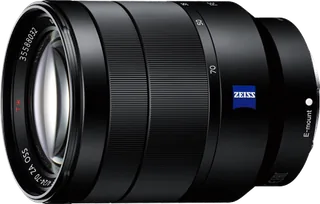
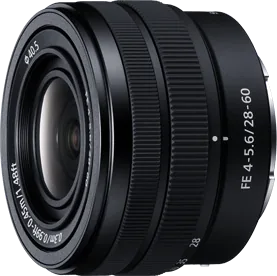
Sony Vario-Tessar T* FE 24-70mm F4 ZA OSS vs Sony FE 28-60mm F4-5.6
Better figure, where one is clearly better
| SonyVario-Tessar T* FE 24-70mm F4 ZA OSS | SonyFE 28-60mm F4-5.6 | |
|---|---|---|
| Overview | ||
| Released | January 2014 | October 2020 |
| Optics | ||
| Lens type | Zoom | Zoom |
| Focal length | 24–70 mm | 28–60 mm |
| Maximum aperture | f/4 | f/4–5.6 |
| Minimum aperture | f/22 | f/22–32 |
| Optical construction | Twelve elements in ten groups | Eight elements in seven groups |
| Special elements | Five aspherical elements and one ED element | Three aspherical elements |
| Coatings | Zeiss T* coating | – |
| Diaphragm | Seven rounded blades | Seven rounded blades |
| Angle of view | 84°–34° full frame; 61°–23° APS-C | 75°–40° full frame; 54°–27° APS-C |
| Mount and compatibility | ||
| Mounts | Sony E | Sony E |
| Image circle | Full frame | Full frame |
| Image circle detail | Full-frame coverage; 36–105 mm equivalent field of view on APS-C | Full-frame coverage; 42–90 mm equivalent field of view on APS-C |
| Teleconverter support | – | Not compatible with Sony E-mount teleconverters |
| Focus and stabilisation | ||
| Autofocus | Yes | Yes |
| Minimum focus distance | 0.4 m | 0.3 m |
| Maximum magnification | 0.2× | 0.16× |
| Optical stabilisation | Yes | No |
| Autofocus detail | – | Linear motor with internal focusing |
| Focus distance detail | 0.4 m maker minimum focus distance | 0.3 m minimum at 28 mm; 0.45 m at 60 mm |
| Magnification detail | 0.20× maximum magnification | 0.16× maximum magnification |
| Stabilisation detail | Built-in Optical SteadyShot; maker does not publish a stop rating | No optical stabilisation; compatible camera body stabilisation can be used |
| Video features | Constant F4 maximum aperture | Internal focusing keeps lens length unchanged during focus adjustment |
| Design | ||
| Dust and moisture resistant | Yes | Yes |
| Filter diameter | 67 mm | 40.5 mm |
| Maximum diameter | 73 mm | 66.6 mm |
| Length | 94.5 mm | 45 mm |
| Weight | 426 g | 167 g (better) |
| Controls | Manual-focus and zoom rings; stabilisation and focus mode controlled through camera | Manual-focus ring and mechanical zoom ring |
| Zoom design | – | Manual retractable zoom; rotate zoom ring to extend lens before shooting |
| Filter detail | 67 mm front filter thread | – |
| Weather resistance | Dust and moisture resistant design; not guaranteed to prevent all ingress | Dust and moisture resistant design; not guaranteed to prevent all ingress |
| Dimensions detail | 73 mm maximum diameter × 94.5 mm maker length | 66.6 mm maximum diameter × 45 mm retracted length; lens extends for shooting |
| Weight detail | Approximately 426 g lens; separate hood and caps excluded | Approximately 167 g lens; separate caps excluded |
| Lens hood | ALC-SH130 petal bayonet hood, supplied | No hood supplied |
| In the box | ALC-SH130 hood, front and rear caps and soft case | ALC-F405S front cap and ALC-R1EM rear cap; no case supplied |
| Release detail | Sony UK original maker press specifies January 2014 availability; Sony Japan original announcement also gives January. Exact first global sale day unconfirmed. Two independent full reviews read: Photography Blog Mark Goldstein using Alpha 7 and Amateur Photographer Richard Sibley, whose original charts use Alpha 7R and refreshed page adds Alpha 7 III samples. Different focal-length preference, overall quality and blur assessments qualified by body/processing. Blog reverses wide/tele angles, corrected to maker84–34degrees. AP observed approx0.5m telephoto focus is not substituted for maker0.4m main minimum. No maker motor type in read exact pages, so unpublished optional motor details omitted; no inferred predecessor link | Sony Hong Kong specifies Alpha 7C retail availability from the beginning of October 2020, including its FE 28–60 mm kit. Sony Japan specifies kit sale on 23 October 2020 and later separate lens sale on 29 January 2021; main release records first kit availability, not standalone sale. Announcement 14 September from Sony Alpha Universe US. Two independent full reviews read: Photography Blog Mark Goldstein on Alpha 7C and Digital Camera World Rod Lawton. Preserve real-world versus lab corner qualifications and distortion-correction dependence. No inferred predecessor link |
More comparisons
- Sony FE 28-60mm F4-5.6 vs Sony FE 28-70mm F3.5-5.6 OSS II
- Sony FE 24-50mm F2.8 G vs Sony FE 28-60mm F4-5.6
- Sony FE 20-70mm F4 G vs Sony Vario-Tessar T* FE 24-70mm F4 ZA OSS
- Sony FE 20-70mm F4 G vs Sony FE 28-60mm F4-5.6
- Sony FE 24-105mm F4 G OSS vs Sony Vario-Tessar T* FE 24-70mm F4 ZA OSS
- Sony FE 24-70mm F2.8 GM vs Sony Vario-Tessar T* FE 24-70mm F4 ZA OSS
- Sony Vario-Tessar T* FE 24-70mm F4 ZA OSS vs Sony FE PZ 28-135mm F4 G OSS