Sony FE 24-50mm F2.8 G vs Sony FE 28-60mm F4-5.6
Better figure, where one is clearly better
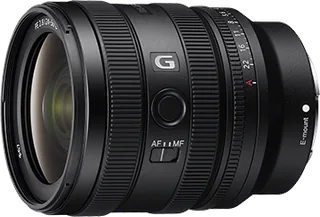
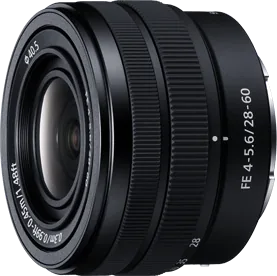
| SonyFE 24-50mm F2.8 G | SonyFE 28-60mm F4-5.6 | |
|---|---|---|
| Overview | ||
| Released | May 2024 | October 2020 |
| Optics | ||
| Lens type | Zoom | Zoom |
| Focal length | 24–50 mm | 28–60 mm |
| Maximum aperture | f/2.8 | f/4–5.6 |
| Minimum aperture | f/22 | f/22–32 |
| Optical construction | 16 elements in 13 groups | Eight elements in seven groups |
| Special elements | Four aspherical elements and two ED glass elements | Three aspherical elements |
| Coatings | Fluorine coating on the front element | – |
| Diaphragm | 11 rounded blades | Seven rounded blades |
| Angle of view | 84–47° full frame; 61–32° APS-C | 75°–40° full frame; 54°–27° APS-C |
| Mount and compatibility | ||
| Mounts | Sony E | Sony E |
| Image circle | Full frame | Full frame |
| Image circle detail | Full-frame coverage; 36–75 mm equivalent field of view on APS-C | Full-frame coverage; 42–90 mm equivalent field of view on APS-C |
| Teleconverter support | Not compatible with SEL14TC or SEL20TC | Not compatible with Sony E-mount teleconverters |
| Focus and stabilisation | ||
| Autofocus | Yes | Yes |
| Minimum focus distance | 0.18 m (manual focus) | 0.3 m |
| Maximum magnification | 0.33× (manual focus) | 0.16× |
| Optical stabilisation | No | No |
| Autofocus detail | Two linear motors; supports Alpha 9 III AF/AE tracking up to 120 fps under Sony test conditions; actual speed depends on shooting conditions and focus mode | Linear motor with internal focusing |
| Focus distance detail | Autofocus minimum 0.19 m at 24 mm and 0.30 m at 50 mm; manual focus minimum 0.18 m at 24 mm and 0.29 m at 50 mm; Linear Response MF | 0.3 m minimum at 28 mm; 0.45 m at 60 mm |
| Magnification detail | Maximum magnification 0.30× with autofocus or 0.33× with manual focus | 0.16× maximum magnification |
| Stabilisation detail | No lens stabilisation; compatible bodies provide stabilisation | No optical stabilisation; compatible camera body stabilisation can be used |
| Video features | Breathing compensation on compatible bodies may alter angle of view and image quality, with compensation not guaranteed in every situation. Supports compatible-body Active Mode stabilisation with a narrower angle of view; 4K120p/FHD240p tracking depends on the camera | Internal focusing keeps lens length unchanged during focus adjustment |
| Design | ||
| Dust and moisture resistant | Yes | Yes |
| Filter diameter | 67 mm | 40.5 mm |
| Maximum diameter | 74.8 mm | 66.6 mm |
| Length | 92.3 mm | 45 mm |
| Weight | 440 g | 167 g (better) |
| Controls | Aperture ring with click on/off, AF/MF switch and one customisable focus-hold button | Manual-focus ring and mechanical zoom ring |
| Zoom design | Short extending zoom barrel; Sony qualifies its small centre-of-gravity shift for gimbal use | Manual retractable zoom; rotate zoom ring to extend lens before shooting |
| Weather resistance | Dust- and moisture-resistant design; not guaranteed completely dust- or moisture-proof | Dust and moisture resistant design; not guaranteed to prevent all ingress |
| Dimensions detail | – | 66.6 mm maximum diameter × 45 mm retracted length; lens extends for shooting |
| Weight detail | Approximately 440 g lens; separate hood and caps excluded | Approximately 167 g lens; separate caps excluded |
| Lens hood | ALC-SH178 petal bayonet hood | No hood supplied |
| In the box | ALC-SH178 hood, ALC-F67S front cap and ALC-R1EM rear cap; no case | ALC-F405S front cap and ALC-R1EM rear cap; no case supplied |
| Release detail | Sony UK and North America specify May 2024 availability. Sony Japan revised its original 19 April date to 17 May in an update dated 5 April. Photography Blog gives April; the revised maker sale evidence takes priority. Maker dimensions, 67 mm filter and 36–75 mm APS-C equivalent take priority over typographic mistakes in review text | Sony Hong Kong specifies Alpha 7C retail availability from the beginning of October 2020, including its FE 28–60 mm kit. Sony Japan specifies kit sale on 23 October 2020 and later separate lens sale on 29 January 2021; main release records first kit availability, not standalone sale. Announcement 14 September from Sony Alpha Universe US. Two independent full reviews read: Photography Blog Mark Goldstein on Alpha 7C and Digital Camera World Rod Lawton. Preserve real-world versus lab corner qualifications and distortion-correction dependence. No inferred predecessor link |
More comparisons
- Sony FE 28-60mm F4-5.6 vs Sony FE 28-70mm F3.5-5.6 OSS II
- Sony FE 24-50mm F2.8 G vs Sony FE 28-70mm F3.5-5.6 OSS II
- Nikon NIKKOR Z 24-70mm f/2.8 S II vs Sony FE 24-50mm F2.8 G
- Sony FE 24-50mm F2.8 G vs Sony FE 28–70mm F2 GM
- Sony FE 20-70mm F4 G vs Sony FE 24-50mm F2.8 G
- Sony FE 24-50mm F2.8 G vs Sony FE 24–70mm F2.8 GM II
- Sony FE 16–35mm F2.8 GM II vs Sony FE 24-50mm F2.8 G
- Sony FE 20-70mm F4 G vs Sony FE 28-60mm F4-5.6
- Sony Vario-Tessar T* FE 24-70mm F4 ZA OSS vs Sony FE 28-60mm F4-5.6