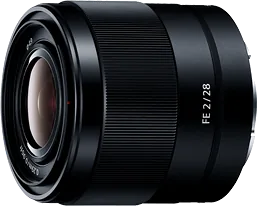
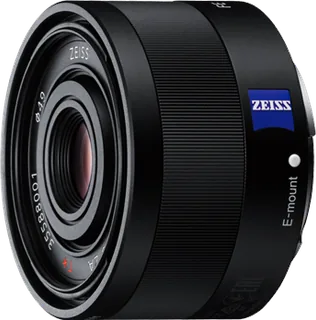
Sony FE 28mm F2 vs Sony Sonnar T* FE 35mm F2.8 ZA
Better figure, where one is clearly better
| SonyFE 28mm F2 | SonySonnar T* FE 35mm F2.8 ZA | |
|---|---|---|
| Overview | ||
| Released | March 2015 | November 2013 |
| Optics | ||
| Lens type | Prime | Prime |
| Focal length | 28 mm | 35 mm |
| Maximum aperture | f/2 | f/2.8 |
| Minimum aperture | f/22 | f/22 |
| Optical construction | Nine elements in eight groups | Seven elements in five groups |
| Special elements | Three aspherical elements including one AA (advanced aspherical), and two ED glass elements | Three double-sided aspherical elements, six aspherical surfaces |
| Coatings | All lens surfaces multi-coated to suppress flare and ghosting | Zeiss T* coating |
| Diaphragm | Nine rounded blades | Seven rounded blades |
| Angle of view | 75° full frame; 54° APS-C | 63° full frame; 44° APS-C |
| Mount and compatibility | ||
| Mounts | Sony E | Sony E |
| Image circle | Full frame | Full frame |
| Image circle detail | Full-frame coverage; 42 mm equivalent field of view on APS-C | Full-frame coverage; 52.5 mm equivalent field of view on APS-C |
| Teleconverter support | Not compatible with Sony E-mount teleconverters; SEL075UWC ultra-wide converter gives 21 mm F2.8, SEL057FEC fisheye converter gives 16 mm F3.5 | – |
| Focus and stabilisation | ||
| Autofocus | Yes | Yes |
| Minimum focus distance | 0.25 m (manual focus) | 0.35 m |
| Maximum magnification | 0.16× (manual focus) | 0.12× |
| Optical stabilisation | No | No |
| Autofocus detail | Linear motor; internal focusing without changing overall lens length | Linear motor and internal focusing; overall length remains unchanged during focusing |
| Focus distance detail | 0.29 m minimum in autofocus; 0.25 m in manual focus | 0.35 m minimum focus distance |
| Magnification detail | 0.13× in autofocus; 0.16× in manual focus | 0.12× maximum magnification |
| Stabilisation detail | No optical stabilisation | No optical stabilisation |
| Design | ||
| Dust and moisture resistant | Yes | Yes |
| Filter diameter | 49 mm | 49 mm |
| Maximum diameter | 64 mm | 61.5 mm |
| Length | 60 mm | 36.5 mm |
| Weight | 200 g | 120 g (better) |
| Controls | Manual-focus ring; focus mode selected on camera; aluminium-alloy exterior | Manual-focus ring; focus mode selected on camera; aluminium exterior |
| Filter detail | – | 49 mm thread on lens; supplied cap-type hood also accepts 40.5 mm filters |
| Weather resistance | Dust and moisture resistant design; not guaranteed to prevent all ingress | Dust and moisture resistant design; not guaranteed to prevent all ingress |
| Dimensions detail | 64 mm maximum diameter × 60 mm length | 61.5 mm maximum diameter × 36.5 mm length |
| Weight detail | Approximately 200 g lens; separate hood and caps excluded | Approximately 120 g lens; separate hood and caps excluded |
| Lens hood | ALC-SH112 petal bayonet hood, supplied | ALC-SH129 cap-type hood, supplied |
| In the box | ALC-SH112 hood, front cap and rear cap; no case listed | ALC-SH129 hood, 40.5 mm front cap and rear cap; no case listed |
| Release detail | Sony Singapore’s5 March2015 press release reproduced in full by Shutter Journey states this exact lens available from March2015 onwards; exact first day unconfirmed. SonyJapan gives17 April2015 and SonyUS May2015, so main release retains earlier Singapore month. Announcement3March2015 is the dated SonyUS release reproduced by DPReview. SonyHK launch PDF availability table could not be retrieved through proxy, so no date borrowed from it. Full exact independent reviews read: Photography Blog MarkGoldstein Alpha7S and Amateur Photographer AndyWestlake predominantlyAlpha7 withAlpha7R AF experience. Blog copied28–70 lens name in sharpness intro and incorrect55mm thread/54° full-frame angle/no-case contradiction; exact maker49mm/75°/no-case fields supersede these. Reviews retained with body and raw-correction qualifications | Sony Japan announcement dated 16 October 2013 gives 15 November 2013 availability; main month precision because exact global first day is not established. Full exact independent reviews read: Photography Blog Mark Goldstein on Alpha 7 and OpticalLimits Klaus Schroiff on Alpha 7R. Their value, colour-fringing and highlight-rendering disagreement is preserved. Blog angle-of-view prose incorrectly gives 52.5 degrees: maker 63 degrees is used, with 52.5 mm instead the APS-C equivalent focal length. No inferred predecessor link |