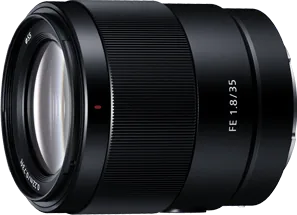
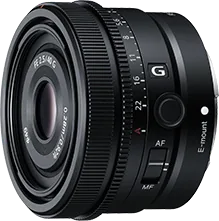
Sony FE 35mm F1.8 vs Sony FE 40mm F2.5 G
Better figure, where one is clearly better
| SonyFE 35mm F1.8 | SonyFE 40mm F2.5 G | |
|---|---|---|
| Overview | ||
| Released | August 2019 | April 2021 |
| Optics | ||
| Lens type | Prime | Prime |
| Focal length | 35 mm | 40 mm |
| Maximum aperture | f/1.8 | f/2.5 |
| Minimum aperture | f/22 | f/22 |
| Optical construction | 11 elements in nine groups | Nine elements in nine groups |
| Special elements | One aspherical element | Three aspherical elements |
| Diaphragm | Nine rounded blades | Seven rounded blades |
| Angle of view | 63° full frame; 44° APS-C | 57° full frame; 39° APS-C |
| Mount and compatibility | ||
| Mounts | Sony E | Sony E |
| Image circle | Full frame | Full frame |
| Image circle detail | Full-frame coverage; 52.5 mm equivalent field of view on APS-C | Full-frame coverage; 60 mm equivalent field of view on APS-C |
| Teleconverter support | Not compatible with SEL14TC or SEL20TC | Not compatible with SEL14TC or SEL20TC |
| Focus and stabilisation | ||
| Autofocus | Yes | Yes |
| Minimum focus distance | 0.22 m | 0.25 m (manual focus) |
| Maximum magnification | 0.24× | 0.23× (manual focus) |
| Optical stabilisation | No | No |
| Autofocus detail | Linear motor; internal focusing | Two linear motors; internal focusing. Maker does not designate these motors XD |
| Focus distance detail | Minimum focus 0.22 m; Linear Response MF | Minimum focus 0.28 m in AF or 0.25 m in MF; Linear Response MF |
| Magnification detail | – | Maximum magnification 0.20× in AF or 0.23× in MF |
| Stabilisation detail | No lens stabilisation; compatible bodies provide stabilisation | No lens stabilisation; compatible bodies provide stabilisation |
| Video features | Internal focusing reduces changes in angle of view during focusing; quiet focus drive supports fine continuous focus movements | – |
| Design | ||
| Dust and moisture resistant | Yes | Yes |
| Filter diameter | 55 mm | 49 mm |
| Maximum diameter | 65.6 mm | 68 mm |
| Length | 73 mm | 45 mm |
| Weight | 280 g | 173 g (better) |
| Controls | AF/MF switch and one customisable focus-hold button | Aperture ring with click on/off switch, AF/MF switch and one customisable focus-hold button |
| Filter detail | 55 mm front filter thread; front element does not rotate during focusing | – |
| Weather resistance | Dust- and moisture-resistant design; not guaranteed completely dust- or moisture-proof | Dust- and moisture-resistant design; not guaranteed completely dust- or moisture-proof |
| Dimensions detail | Aluminium-alloy exterior; internal focusing preserves overall length | Aluminium exterior and hood; internal focusing preserves lens length |
| Weight detail | Approximately 280 g lens; separate hood and caps excluded | Approximately 173 g lens; separate hood and caps excluded |
| Lens hood | ALC-SH159 petal bayonet hood | ALC-SH166 cap-type hood |
| In the box | ALC-SH159 hood, ALC-F55S front cap and ALC-R1EM rear cap; no case listed | ALC-SH166 hood, ALC-F49S front cap and ALC-R1EM rear cap; no case listed |
| Release detail | Sony Japan specified 30 August 2019; main date retains month precision for regional release. Amateur Photographer Andy Westlake tested an Alpha 7R III; Photography Blog Mark Goldstein used an Alpha 7 III. Their distortion type/severity, wide-open sharpness and close-up blur judgments differ and are retained. Maker weight 280 g supersedes Blog 281 g; no case is listed in the maker specifications despite Blog mentioning one | Sony Europe specified April 2021 availability, separately from the 23 March announcement. Photography Blog Mark Goldstein and Digital Camera World Rod Lawton independently reviewed this exact model; shading judgments differ. Sony specifies two linear motors and three aspherical elements; no XD, ED or fluorine designation is borrowed from Photography Blog’s conflicting description |
More comparisons
- Sony FE 24mm F2.8 G vs Sony FE 40mm F2.5 G
- Sony FE 40mm F2.5 G vs Sony FE 50mm F2.5 G
- Sony FE 35mm F1.4 GM vs Sony FE 40mm F2.5 G
- Sony FE 35mm F1.4 GM vs Sony FE 35mm F1.8
- Sony FE 28mm F2 vs Sony FE 35mm F1.8
- Sony FE 35mm F1.8 vs Sony Sonnar T* FE 35mm F2.8 ZA
- Sony FE 35mm F1.8 vs Sony Sonnar T* FE 55mm F1.8 ZA
- Sony Distagon T* FE 35mm F1.4 ZA vs Sony FE 35mm F1.8