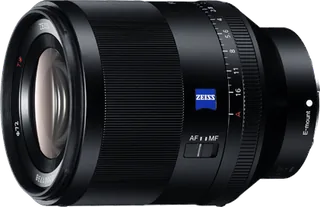
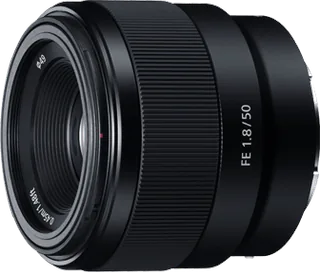
Sony Planar T* FE 50mm F1.4 ZA vs Sony FE 50mm F1.8
Better figure, where one is clearly better
| SonyPlanar T* FE 50mm F1.4 ZA | SonyFE 50mm F1.8 | |
|---|---|---|
| Overview | ||
| Released | July 2016 | April 2016 |
| Optics | ||
| Lens type | Prime | Prime |
| Focal length | 50 mm | 50 mm |
| Maximum aperture | f/1.4 | f/1.8 |
| Minimum aperture | f/16 | f/22 |
| Optical construction | Twelve elements in nine groups; double-Gauss design combined with a rear internal-focusing group | Six elements in five groups; double-Gauss design |
| Special elements | Two aspherical elements in total including one AA advanced aspherical element; one ED glass element | One aspherical element |
| Coatings | Zeiss T* coating | – |
| Diaphragm | Eleven rounded blades | Seven rounded blades |
| Angle of view | 47° full frame; 32° APS-C | 47° full frame; 32° APS-C |
| Mount and compatibility | ||
| Mounts | Sony E | Sony E |
| Image circle | Full frame | Full frame |
| Image circle detail | Full-frame coverage; 75 mm equivalent field of view on APS-C | Full-frame coverage; 75 mm equivalent field of view on APS-C |
| Teleconverter support | Not compatible with Sony E-mount teleconverters | – |
| Focus and stabilisation | ||
| Autofocus | Yes | Yes |
| Minimum focus distance | 0.45 m | 0.45 m |
| Maximum magnification | 0.15× | 0.14× |
| Optical stabilisation | No | No |
| Autofocus detail | Ring-drive SSM (Super Sonic wave Motor) | – |
| Focus distance detail | 0.45 m minimum focus distance | 0.45 m minimum focus distance |
| Magnification detail | 0.15× maximum magnification | 0.14× maximum magnification |
| Stabilisation detail | No optical stabilisation; compatible camera body stabilisation can be used | No optical stabilisation; compatible camera body stabilisation can be used |
| Video features | Aperture click switch permits continuous adjustment without click sound | – |
| Design | ||
| Dust and moisture resistant | Yes | – |
| Filter diameter | 72 mm | 49 mm |
| Maximum diameter | 83.5 mm | 68.6 mm |
| Length | 108 mm | 59.5 mm |
| Weight | 778 g | 186 g (better) |
| Controls | Manual-focus ring, AF/MF switch and aperture ring with click on/off switch | Manual-focus ring; focus mode selected on camera; metal lens mount |
| Weather resistance | Dust and moisture resistant design; not guaranteed to prevent all ingress | – |
| Dimensions detail | 83.5 mm maximum diameter × 108 mm length | 68.6 mm maximum diameter × 59.5 mm length |
| Weight detail | Approximately 778 g lens; separate hood and caps excluded | Approximately 186 g lens; separate hood and caps excluded. Sony Netherlands launch release states 192 g, superseded here by exact-model Sony Japan technical specifications |
| Lens hood | ALC-SH143 petal bayonet hood, supplied | ALC-SH146 round bayonet hood, supplied |
| In the box | ALC-SH143 hood, ALC-F72S front cap, ALC-R1EM rear cap and soft case | ALC-SH146 hood, ALC-F49S front cap and ALC-R1EM rear cap; no case listed |
| Release detail | Sony US announcement dated 11 July 2016 on PRNewswire gives shipping in July; Sony Japan specifies 29 July. Main release retains month precision because exact global first day is not established. Two independent full reviews read: Photography Blog Mark Goldstein and Amateur Photographer Andy Westlake, both using Alpha 7R II. Their wide-open sharpness and focus-speed disagreement retained; AP page refreshed in 2023 includes later GM context. Blog focus paragraph incorrectly says 71 mm filter; maker 72 mm used. No inferred predecessor link | Sony Netherlands announcement dated 29 March 2016 states availability from April 2016; exact first on-sale day not established. Main release retains month precision. Full independent exact-model reviews read: Photography Blog on Alpha 7S and Amateur Photographer Andy Westlake with Alpha 7R II autofocus experience. Review differences in corner sharpness and longitudinal fringing are preserved; the Blog explicitly qualifies its 12-megapixel test body. Reviews assess original launch-era focus behaviour, not subsequent firmware |
More comparisons
- Sony FE 50mm F1.4 GM vs Sony Planar T* FE 50mm F1.4 ZA
- Sony FE 50mm F1.8 vs Sony FE 50mm F2.5 G
- Sony FE 50mm F1.2 GM vs Sony Planar T* FE 50mm F1.4 ZA
- Canon RF 50mm F1.8 STM vs Sony FE 50mm F1.8
- Sony FE 50mm F1.8 vs Sony FE 50mm F2.8 Macro
- Sony Planar T* FE 50mm F1.4 ZA vs Sony FE 50mm F2.8 Macro
- Sony 50mm F1.4 vs Sony Planar T* FE 50mm F1.4 ZA
- Sony Distagon T* FE 35mm F1.4 ZA vs Sony Planar T* FE 50mm F1.4 ZA
- Sony Planar T* FE 50mm F1.4 ZA vs Sony Sonnar T* FE 55mm F1.8 ZA
- Sony FE 50mm F1.8 vs Sony Sonnar T* FE 55mm F1.8 ZA