Sony PlayStation Portal vs Sony PSP-2000
Better figure, where one is clearly better
| SonyPlayStation Portal | SonyPSP-2000 | |
|---|---|---|
| Overview | ||
| Released | November 2023 | September 2007 |
| Performance | ||
| Type | Handheld | Handheld |
| CPU | – | Sony PSP CPU, up to 333 MHz |
| Memory | – | 64 MB |
| Disc drive | No | Yes |
| CPU | – | PSP CPU with system clock frequency from 1 to 333 MHz |
| Memory detail | – | 64 MB main memory |
| Storage detail | Streams games rather than downloading and running them locally; Sony does not publish internal storage capacity | Read-only UMD drive for PSP games and UMD Video; no built-in storage for game saves |
| Storage expansion | – | Memory Stick PRO Duo slot |
| Display and video | ||
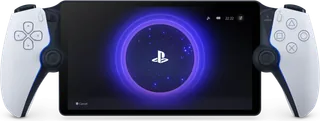
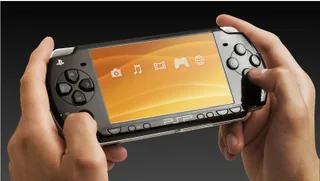
| Built-in screen | 8″ LCD, 1920 × 1080 | 4.3″ LCD, 480 × 272 |
| Built-in screen | Full HD LCD touchscreen; streams supported games at up to 1080p and 60 fps, depending on the game and network | 4.3-inch 16:9 TFT LCD, 480 × 272 pixels, approximately 16.77 million colours |
| Video output | Built-in screen; no external video output listed by Sony | Analogue TV output through the video-out/headset connector; game output needs a progressive TV and a separately sold component or D-terminal cable |
| Audio | Built-in stereo speakers; 3.5 mm headset jack; PlayStation Link wireless audio; Tempest 3D AudioTech in supported games with compatible wired or PlayStation Link headphones | Built-in stereo speakers and headset connector |
| Design and power | ||
| Weight | 529 g | 189 g (better) |
| Battery life detail | Built-in lithium-ion battery, 4370 mAh at 3.87 V (Sony CFI-Y1016 manual); approximately 2 hours 30 minutes to charge through a PS5 USB Type-C port. TechRadar measured just over 6 hours with haptics enabled and adjusted brightness; GamesRadar measured about 5 hours at full brightness, while Tom's Guide usually obtained about 3 hours with brightness and volume above average | 1200 mAh removable lithium-ion battery pack; can also draw power by USB while in USB Connection mode |
| Size | – | 169.4 × 18.6 × 71.4 mm (width × height × depth, excluding the largest projection) |
| Power use | Rated charging input 5 V, 3 A; Sony specifies a USB Type-C power adapter supporting USB Power Delivery and at least 5 V, 3 A | – |
| Colours | White and Midnight Black in Sony's current UK range; a grey PlayStation 30th Anniversary limited edition was also released (GamesRadar) | Piano Black, Ceramic White and Ice Silver at announcement; regional availability varies |
| In the box | Remote player and USB cable; Tom's Guide identifies the cable as USB-C to USB-C | – |
| Connections | ||
| Ports | USB Type-C charging port and 3.5 mm headset jack | Mini-B USB 2.0, DC IN 5 V, DC OUT, video-out/headset connector and Memory Stick Duo slot |
| Wi-Fi and Bluetooth | Wi-Fi IEEE 802.11a/b/g/n/ac and PlayStation Link (2.4 GHz); ordinary Bluetooth headphones are not supported. Sony specifies at least 5 Mbps for Remote Play and recommends at least 15 Mbps; public Wi-Fi requiring additional validation needs system software 3.0.1 or later and a smartphone or tablet, following initial setup on home Wi-Fi | Wi-Fi IEEE 802.11b, including infrastructure and ad hoc modes |
| Controller | Built-in D-pad, two analogue sticks, face and shoulder buttons; haptic feedback and adaptive triggers in supported games; touchscreen areas reproduce the DualSense touchpad | Built-in D-pad, analogue stick, four face buttons and two shoulder buttons |
| Backward compatibility | Remote Play of compatible PS5 and PS4 games installed on a PS5; cannot connect directly to a PS4; games requiring a VR headset or other additional peripherals are excluded. Cloud streaming supports selected PS5 titles from the Game and Classics Catalogues and selected owned digital PS5 games with PlayStation Plus Premium; eligible titles vary by region and time, and a PS5 is not required for this mode | – |
More comparisons
- ASUS ROG Xbox Ally vs Sony PlayStation Portal
- Nintendo Switch 2 vs Sony PlayStation Portal
- Sony PlayStation 5 Pro vs Sony PlayStation Portal
- Sony PlayStation 5 Pro vs Sony PSP-2000
- ASUS ROG Ally X (2024) vs Sony PlayStation Portal
- Sony PlayStation Portal vs Valve Steam Deck OLED
- Sony PlayStation Portal vs Valve Steam Deck LCD
- Nintendo Switch – OLED Model vs Sony PlayStation Portal
- ASUS ROG Ally (2023) vs Sony PlayStation Portal
- Sony PlayStation Portal vs Sony PlayStation Vita
- Lenovo Legion Go (2023) vs Sony PlayStation Portal
- Sony PlayStation 5 Slim vs Sony PlayStation Portal
- Sony PlayStation 5 vs Sony PlayStation Portal
- Sony PlayStation 4 Pro vs Sony PlayStation Portal
- Sony PlayStation 4 Slim vs Sony PlayStation Portal
- Sony PlayStation 4 (CUH-1200) vs Sony PlayStation Portal